.avif)

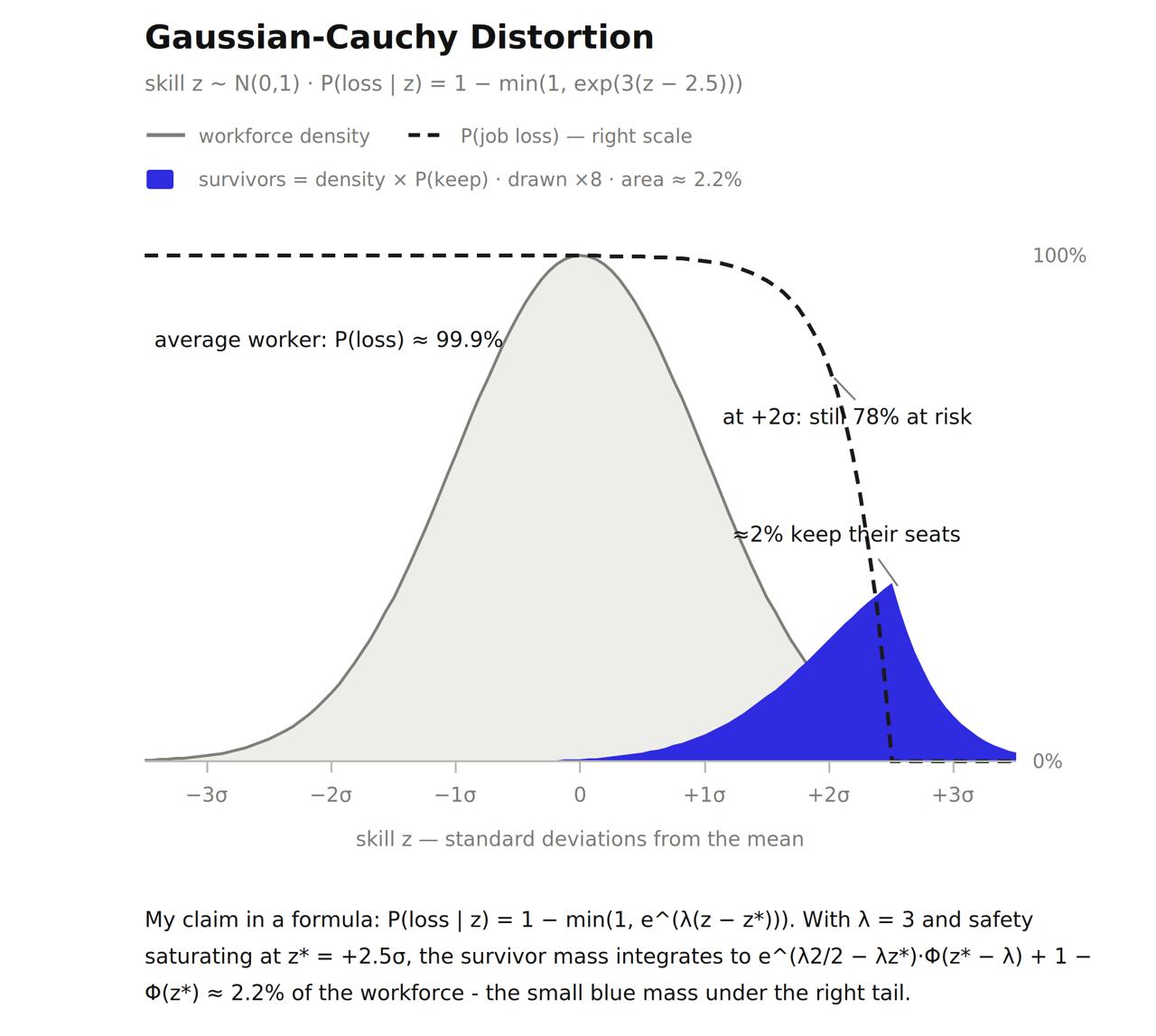
With AI being the primary driver of automation at this point, I ask myself which work will be automated the most. This is a difficult question with many facets and I certainly do not want to provide an exhaustive answer in this piece. I aim to identify one dimension of knowledge work whose automation is most readily predictable. I believe the likelihood of anyone losing their job decreases exponentially along the Gaussian curve's x-axis. If you are incredibly bad at your job, you will almost definitely lose it, because AI will do it not only better, but also with fewer mistakes. If you are average, AI will likely be better and even more likely be cheaper than you, so you will also lose your job. Only those who are truly gifted will keep it, while all others will have to retrain.
This seems to occur in two ways: first, as with the industrial and digital revolutions, extraordinarily gifted individuals will retain their jobs because the technology driving the automation cannot replicate their level of skill or creativity. I call this Gaussian automation. Everyone left of their position in the Gauss curve will eventually be rationalised. Second, there is a type of automation that is unique to the AI revolution: in some professions, extraordinarily talented people will be the ones replacing others. I call this Cauchy automation, or Power-Law automation. In this scenario, the Gaussian curve is reorganising itself, with individuals suddenly doing exponentially more than others, thereby mapping to a power-law distribution of productivity rather than a Gaussian distribution. Funnily, I believe this will be especially the case for professions in which the distribution of output is already more akin to a powerlaw. This is a new form of automation with vast implications.
To address Gaussian automation, which happened both in the industrial revolution and the digital revolution, I can think of many examples. In textiles, for example, the spinning jenny and the power loom annihilated the worst hand-spinners and handloom weavers first: if your output was slow and inconsistent, the spinning jenny got you hard. If your output was merely decent, the machine eventually beat you on price and reliability. The people who remained weren’t “median”; they were the right tail: master craft experts serving luxury niches. Those were more akin to artists than those “just doing their jobs”. The same occurred in agriculture, where only specialist plant breeders retained their jobs and other farmers were replaced by tractors and threshers.
The digital revolution did the same thing to office work. Online booking systems first eliminated those who added little value beyond what customers could find elsewhere. Then, Expedia and Kayak came for the average agents who simply matched flights to destinations. The only ones who remained were those with exceptional expertise, again specialists who could orchestrate complex multi-destination itineraries, had incredible taste, or could leverage insider relationships for impossible-to-get reservations.
On the other hand, the big foundation models work a little differently. They partly automate what the neocortex does in the human brain and thus extend into any domain of knowledge work. Contemporary AI is a Swiss Army knife, a pass-partout, the ultimate all-rounder. The best lawyers can do 10 times as much work as they could before, thereby reducing the immediate need for lawyers by 10x.
The thing I expect to happen is simple: In industries in which demand is confined, e.g. the amount of legal support needed is not going to 10x tomorrow, we will see the best decile of lawyers perform the tasks of the other 90%. In industries that have a fungible nature, that is, uncapped upwards potential, e.g. a great software engineer can always ship one more product as there is a high likelihood that the market for software will absorb exponential growth. Demand expands with supply, so nobody technically has to lose their job for the power law to emerge: the 10x engineer becomes a 100x engineer, the solo founder builds what used to take 50 people, and the first one-person unicorns will emerge. Employment may survive more in these industries, but equality of outcomes will not. The gap between the best and the median moves from a small multiple to orders of magnitude.
Both of those developments have one thing in common: A Gaussian (or close-to-Gaussian) curve lifts its tails and becomes a power law. The top 1% will be responsible for a majority of the output. And the software companies that help the top 1% maximise their output will be the ones ruling this chapter of history.
We might see a world in which all humans end up doing tail-end work given today’s definitions. I find this future exciting and encouraging. It demands that we focus more on identifying our individual zone of genius and turns any ordinary worker into an artist.
Founders today should have this in mind when running their companies. For example, extrapolating the powerlaw has implications for whom you hire. If you can 10x your best employee, paying 2x more is still a 5x net positive. Moreover, investing in zone-of-genius discovery activities for employees pays off more than ever and might unlock 10x leaps in productivity. The above framework has myriad more implications, the further deductions of which I’ll leave to the reader.
About EWOR
We back the top tech founders globally with up to €500,000 and bespoke mentorship by unicorn founders.
Learn MoreFollow Us

The Energy/Edge Matrix - Understand Yourself First, then Hire Accordingly