

Understanding your market size is about far more than crunching numbers. It is about uncovering the true potential of your business idea. A clear understanding of your market helps you validate demand, shape your growth strategy, and tell a compelling story to investors.
Yet, many founders either overestimate their opportunity or struggle to communicate it effectively. In this guide, we break down the key market sizing concepts and frameworks you need to assess your opportunity with confidence and build a business that can scale.
What is Market Sizing?
At its core, market sizing is the process of estimating the total revenue or potential sales volume for a product or service within a specific market. This critical exercise helps entrepreneurs determine whether a business idea is viable and prioritise resources to maximise growth.
A robust market sizing effort answers two fundamental questions:
- How large is the opportunity?
- Is the market worth pursuing?
Done well, it validates demand, strengthens business forecasts, attracts investors by showcasing the scale of the opportunity, and uncovers risks by highlighting gaps in the competitive landscape.
The TAM-SAM-SOM Framework
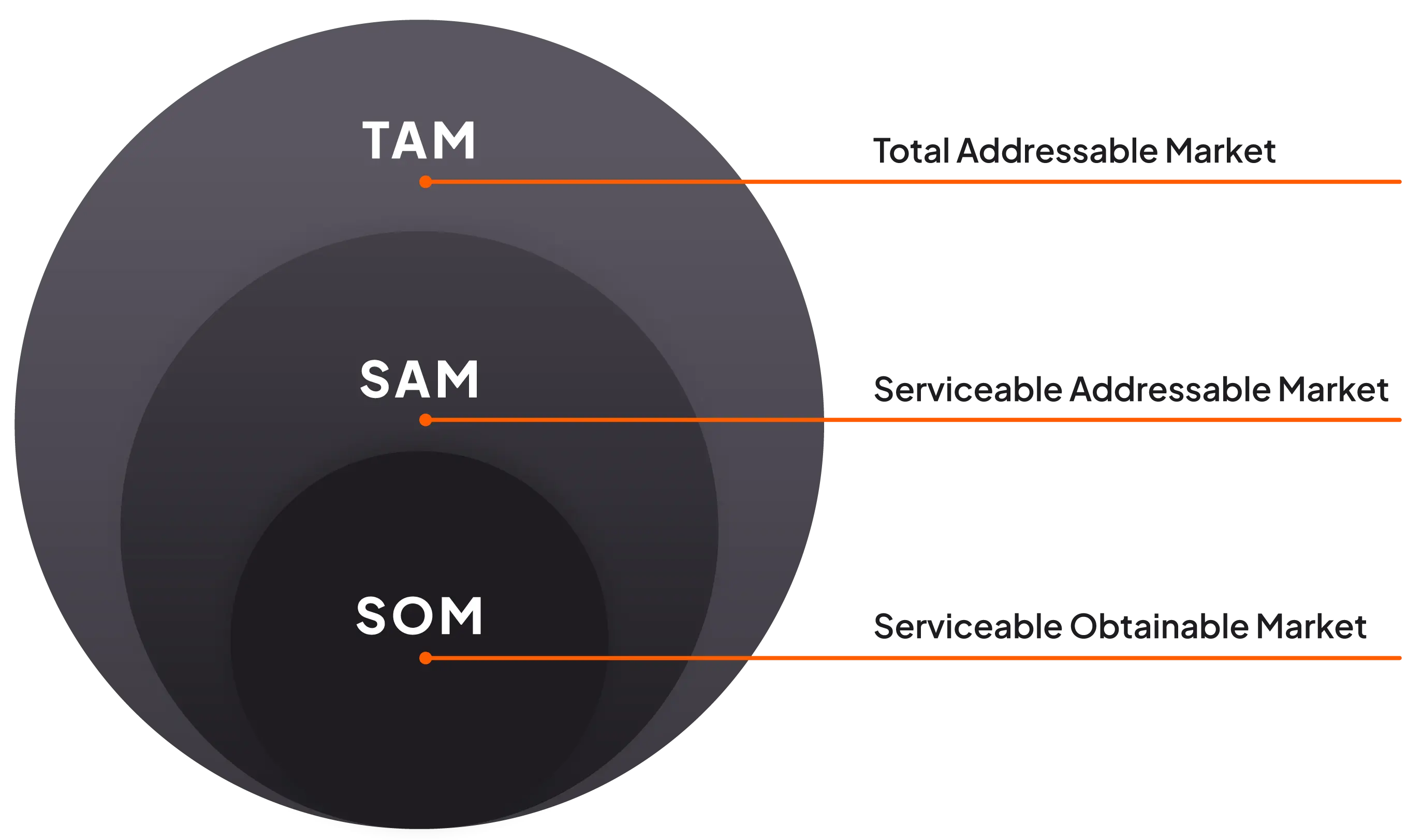
The TAM-SAM-SOM framework is the most common approach to market sizing because it helps founders move from a broad market opportunity to a realistic growth plan. Rather than focusing on a single number, it breaks your market into three layers, each bringing greater clarity to where your startup can create value and capture market share.
Total Addressable Market (TAM) is the total revenue opportunity available if your product or service captured 100% of the market with no competition and no constraints. It is the ceiling, not a target. TAM answers: how large is the overall opportunity?
Serviceable Addressable Market (SAM) is the portion of TAM your business can realistically serve given your product's current capabilities, geographic reach, and target customer profile. SAM answers: who could actually buy from us today?
Serviceable Obtainable Market (SOM) is the portion of your SAM you can realistically capture in the near term, given your resources, go-to-market strategy, and competitive position. SOM answers: what can we actually win? It is the number that should directly inform your revenue projections.
Approaches to Market Sizing
There are two primary methods for calculating your market size: top-down and bottom-up. They are not interchangeable and each has a specific use case, and the strongest market sizing analyses use both.
1. Top-Down Approach
The top-down approach begins with broad industry data and systematically narrows down to your specific market segment. It relies heavily on secondary research, such as industry reports, government publications, and market data from reputable sources. To implement the top-down approach:
- Start with Industry-Wide Data: Obtain the total market size for your industry from reliable sources.
- Segment the Market: Break the overall market into smaller, more specific segments that align with your product or service.
- Apply Relevant Filters: Narrow down the data using factors like geography, target demographics, or customer behaviour to estimate your specific market size.
Fitness App Example:
- TAM: The global fitness app market generates $10 billion annually. That is your TAM.
- SAM: You are targeting millennials in the US who use digital fitness tools; approximately 20% of the global market. SAM = $2 billion.
- SOM: Based on your go-to-market plan, you estimate capturing 5% of your SAM in the first three years. SOM = $100 million.
Top-down is useful for establishing scale and giving investors context. It is quick to produce but weaker on credibility - you are borrowing someone else's numbers and making assumptions about your share of them. Investors know this, which is why top-down alone is rarely sufficient.
2. Bottom-Up Approach
The bottom-up approach starts with real customer demand and builds upward to estimate market size. Rather than relying on broad industry estimates, it uses inputs such as pricing, customer acquisition, and expected sales volume. This makes it one of the most credible market sizing methods, especially for early-stage startups, because it is grounded in how the business can actually grow.
The Core Formula
Every bottom-up calculation is built on one formula, applied at each tier:
Market Size = Number of Potential Customers × Revenue Per Customer
What changes at each tier is the customer universe you plug in. A large universe gives you TAM. Narrow it to who you can realistically serve today, and you have SAM. Narrow it further to what you can realistically win given your current resources, and you have SOM.
Why Use the Bottom-Up Approach?
- Higher Precision: By focusing on specific customer behaviours and business dynamics, the bottom-up approach minimises reliance on generalised industry data.
- Actionable Insights: This method directly ties market size estimates to your operations, helping you make informed decisions about pricing, marketing, and scaling.
- Customisable for Niches: Ideal for startups and niche products, as it allows for scaling from smaller, targeted audiences to broader market segments.
Steps to Implement the Bottom-Up Approach:
The bottom-up approach is a step-by-step method that begins with the coarser data about your specific customer base and scales upward. Here’s how to implement it effectively:
1. Start with a Well-Defined Market Segment
Focus on a highly specific group of potential customers who are the best fit for your product or service. This core segment should be small enough to provide precision but large enough to demonstrate potential.
- How to Identify: Use demographic, geographic, and behavioural criteria, such as age, income, location, and buying habits.
- Example: If you're launching a fitness app, your initial target might be urban millennials who regularly attend gyms and use digital tools for fitness tracking.
2. Quantify the Number of Potential Customers
Estimate how many people exist in your core target market. Use reliable data sources like census data and government reports, market research studies, surveys and questionnaires tailored to your target demographic, and competitor benchmarks or publicly available data.
- Example: If there are 10 million millennials in the US, research might show that 10% fit your target profile — leaving you with 1 million potential customers.
3. Define Customer Spending or Usage Behaviour
Determine how much revenue each customer will generate. This includes your revenue model (subscription fees, one-time purchases, or recurring sales), frequency of purchase or use (monthly, yearly, or on-demand), and Average Transaction Value (ATV) — the typical amount spent per purchase.
- Example: Your fitness app charges $15 per month, so your expected annual revenue per customer is $180 ($15 × 12 months).
4. Calculate the Market Potential for Your Initial Segment
Apply the formula at each tier using the appropriate customer universe:
- SAM = customers you can realistically serve today: 1,000,000 × $180 = $180 million
- SOM = customers you can realistically win given current resources: 50,000 × $180 = $9 million
- TAM = total potential universe across all segments (built up in step 5 below)
SOM is the figure that should flow directly into your revenue projections. If those two numbers tell different stories, your assumptions need revisiting.
5. Repeat for Adjacent Segments to Scale
Once you have calculated the market size for your initial core segment, identify adjacent opportunities to expand your addressable market. Look for geographic expansion into other cities, regions, or countries; demographic expansion to different age groups or income levels; and product diversification through new features, pricing tiers, or complementary services.
- Example: After targeting urban millennials, you could expand to include Gen Z users or older adults interested in fitness. Add each segment's market size together and you build toward your bottom-up TAM — a figure grounded in real customer math rather than a top-line industry report.
6. Validate and Refine Your Assumptions
Your market size calculation is only as good as your assumptions, so it is critical to test and adjust your estimates before presenting them to investors.
- Pilot Programs: Launch a small-scale rollout to measure adoption and refine customer behaviour estimates.
- Customer Feedback: Conduct surveys to verify willingness to pay, purchase frequency, and feature preferences.
- Competitive Analysis: Compare your assumptions with similar businesses to benchmark your numbers.
Example: If initial feedback reveals that only 70% of your potential customers are willing to pay $15/month, revise your revenue per customer to $126 annually ($15 × 0.70 × 12) and recalculate each tier accordingly.
3. Using Both Together
The strongest market sizing combines both approaches and reconciles them. If your top-down TAM is $10 billion and your bottom-up TAM is $9 billion, that alignment strengthens your case. If they are significantly different, that is a signal to revisit your assumptions before an investor does it for you.
A practical structure for a pitch or investor conversation:
- Lead with a top-down TAM to establish scale and context
- Use bottom-up to calculate your SAM and SOM
- Tie your SOM directly to your financial projections — they should match
‘Advanced’ Market Sizing Strategies
Look beyond established markets. If you are building in an emerging category where market data is limited, focus on the spending behaviours you are replacing. What are customers currently paying for existing solutions, workarounds, or manual processes? That spend can serve as a useful proxy for market demand.
Benchmark against competitors. Comparable companies can help validate your assumptions. Customer counts, pricing models, and revenue estimates provide useful reference points that ground your projections in real-world evidence.
Use AI to accelerate research. Tools such as ChatGPT, Claude, and Perplexity can help you gather market data, identify competitors, and build an initial market sizing framework far more quickly than traditional research methods. However, any figures used in investor materials should always be verified against reliable primary sources.
Common Market Sizing Pitfalls
While market sizing is crucial, it’s also prone to errors. Some common mistakes include:
Overestimating market share. Claiming you will capture 10% of a $10 billion TAM signals you do not understand competitive dynamics. Even 1% of a large market is a significant achievement. Build your SOM conservatively — credibility matters more than ambition.
Using TAM as your target. TAM is a ceiling, not a goal. Investors expect to see a credible path to a specific slice of the market, not a claim on the whole thing.
Relying on only one method. Top-down alone produces figures that feel borrowed and generic. Bottom-up alone can cause you to underestimate the broader opportunity. Use both and reconcile them.
Using outdated data. Markets evolve rapidly. A report from 2021 may significantly misrepresent today's opportunity. Always check the date on your sources.
Ignoring competitive forces. Your SOM must account for the competitors already fighting for the same customers. A SOM that ignores this is not a realistic projection — it is wishful thinking.
That’s a Wrap
Market sizing is more than just a numbers game—it’s the foundation for informed decision-making, strategic growth, and investor confidence. By mastering frameworks like TAM-SAM-SOM, leveraging top-down and bottom-up approaches, and avoiding common pitfalls, you equip your business with the clarity and foresight needed to succeed in competitive markets.
Whether you’re targeting a niche audience or a rapidly growing emerging market, a well-crafted market sizing strategy is your roadmap to uncovering opportunities, mitigating risks, and positioning your business for sustained growth. Don’t leave your success to chance; invest the time and effort to build a credible, actionable market sizing plan.
Like what you've read and are ready to supercharge your startup journey? Explore our Founder Resources—the ultimate toolkit for founders, featuring expert-crafted templates, guides, and strategies to help you build, launch, and grow with confidence.
About EWOR
We back the top tech founders globally with up to €500,000 and bespoke mentorship by unicorn founders.
Learn MoreFollow Us

The Energy/Edge Matrix - Understand Yourself First, then Hire Accordingly