

I hear generic hiring advice all the time: “Do not hire a sales role until $1M ARR”, “you should always hire engineers first”, “never hire commercial people until the 20th hire”, or the opposite: “Americans hire 5 salespeople first, Europeans hire 5 engineers first, and that’s why they lose”. The truth is, generic statements are useless. But every company is different, and no unicorn story begins with someone following generic advice.
I believe a company is nothing more than a function of how founders scale their time and resources. Being successful as a founder, in my opinion, is the ability to focus on one’s biggest strengths and passions, as well as making the right hiring decisions in relation to those strengths and passions.
If product & design are clear personal weaknesses, no founder should keep owning them just because Steve Jobs did. My goal in this article is to provide a dynamic framework for hiring that focuses on one’s edge (strengths) and energy (passion) to inform hiring decisions. I developed the “Energy/Edge Matrix” below as a practical framework for any founder to use.
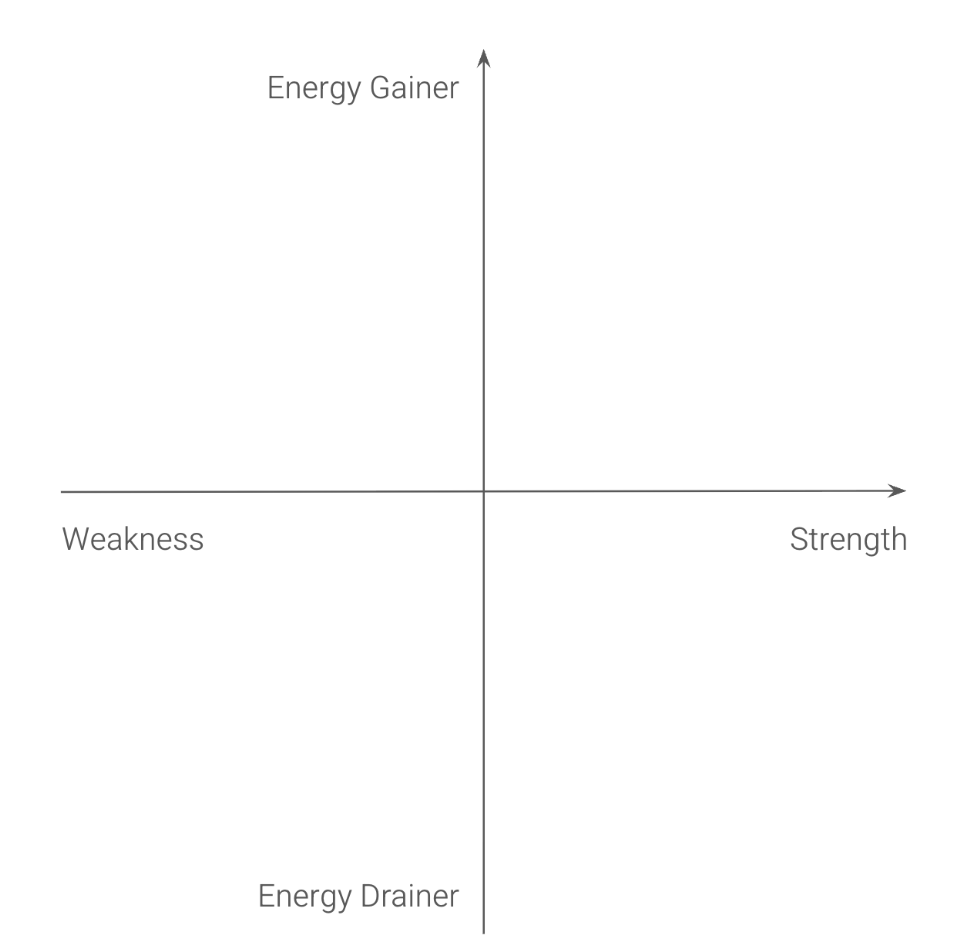
It is inspired by my own experience founding companies worth billions, investing in several billion-dollar founders, and the stories and biographies of global trillion-dollar founders. These founders focus a majority of their energy on what they love and excel at. Many of them also love their changing role as a founder - what excites them today may bore them next year. They do not shy away from hard things outside their edge or energy gainers, but they typically hire quickly for those areas and then move on to where their energy meets their edge.
Steve Jobs, for example, concentrated his highest-intensity attention on what he was uniquely good at and enjoyed: bringing products to perfection. He didn’t avoid “outside-edge” domains, but he staffed them fast, especially when he wasn’t enjoying them. He delegated all of worldwide sales, operations, and supply chain to Tim Cook and remained anchored in product and the functions that reported directly to him, e.g., design and marketing.
To work, the Energy/Edge Matrix needs subjective, empirical feedback. Therefore, I recommend that founders handle everything initially: accounting, customer support, customer success, sales, development, and more. One can only meaningfully measure the degree of personal strength and passion after collecting substantial empirical data. Every function should be tested until one has gained the authority, skill, and right to audit it.
Great founders can judge what is happening on the ground. I have done every aspect of my business at some point, and I regularly launch and own new initiatives, including all project management, writing, calling, etc. that come with them. Because detailed understanding is a hedge against miscalibration. I want to be able to break everything down to the most minute detail. When someone says to me: “This will take 2 weeks; it can’t be done that fast.”, I can respond: “It took me four hours last time, and this is how I did it: [...]. I’m sure it can be done in a day!” - and thus I save two weeks of time.
Especially when hiring people who are much more skilled and stronger in certain areas than I am, I know they can do it even faster than me. I personally believe this was true for many great entrepreneurs: Steve Jobs, Elon Musk, Jeff Bezos, Bill Gates, Mark Zuckerberg and many more highly accomplished founders. Most iconic founders were unusually detail-oriented early and maintained deep functional literacy. They understood what it took on the ground because they had built all functions of the business from the ground up.
Another benefit of this style is that the founder can check anyone’s work at any time. It works like sample tests: Not everything can be checked every time because founders’ time is limited, but anything could be checked at any time. The magic of regular sample tests and, therefore, this leadership style, is that they work almost as well as if everything were checked all the time.
As the business matures, however, the theory of comparative advantage demands delegation. I therefore use the Energy/Edge Matrix to prioritise which roles to hire, when to hire and how to hire.
The Energy/Edge Matrix
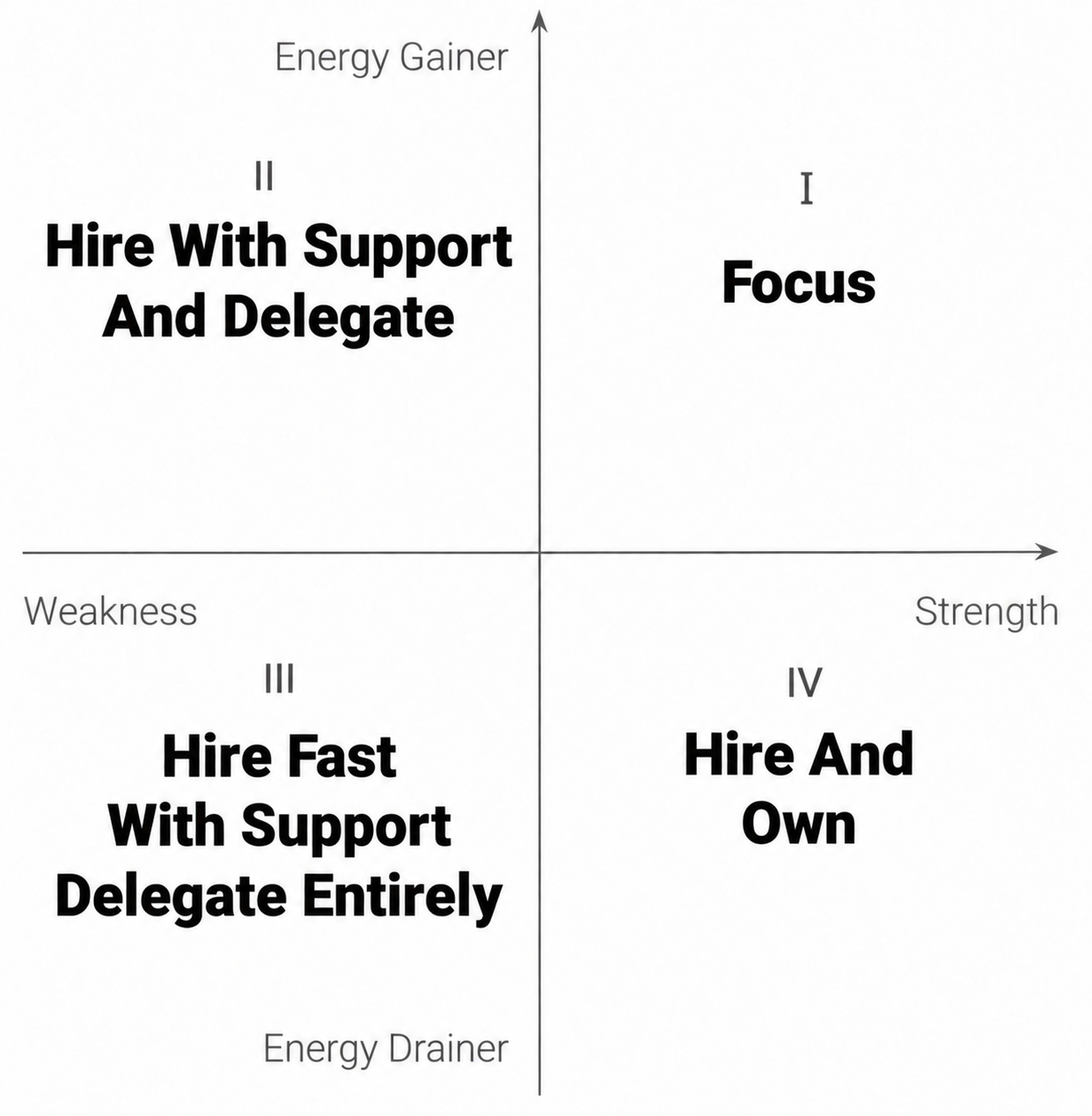
First, I want to comment on the first quadrant, “focus”, which is the no-delegation zone. I believe tasks that are both energy gainers and strengths should account for 30-50% of founders’ total productive time allocated.
Founders who want to build unicorn companies or even global winners need to go above and beyond every single day. It is a common misconception that founders build unicorn companies by delegating everything and remaining minimally involved. I don’t personally know of a single example where this was ever true for all founders in the company. It is sometimes true for one founder, who then has tons of time to tell the internet how proud they are of having created a company that works without them, while their co-founders carry the weight and actually make the company work.
Unicorn founders need to achieve outcomes that no one in their industry thought possible. They are often referred to as “geniuses” in retrospect, which, in my opinion, is only an artefact of someone focusing on their energy/edge combination for a sustained amount of time. Malcolm Gladwell popularised Ericsson's research which suggested it takes 10,000 hours to achieve mastery at something. This was later disproven by a meta-analysis from Ericsson showing that 20-25% of mastery is attributable to sustained practice, whereas the remainder is likely due to age and talent. In short, it is both sustained effort and talent that turn someone into a Steve Jobs-like product guru. Sustained effort and talent are just other words for energy and edge.
Second, I want to comment on area ownership versus area delegation, explaining the differences in the left and right sides of the matrix. Steve Jobs retained ownership of design & product at Apple and hired people “under” him, such as Tony Fadell, who developed the iPod and iPhone and hired people “next” to him, such as Tim Cook, who owned sales and supply chain entirely, with little involvement from Steve Jobs himself.
This is why I distinguish between “hire & delegate” and “hire and own” in the first and third quadrant of the matrix. Founders ideally find a Tony Fadell with whom they work closely for a long time on anything within their edge/energy drainer combination. It would be foolish to entirely delegate an area that is within one’s own biggest talents. This is important because it invites different styles of delegation and communication.
I have supported a founder who raised one of America’s biggest Seed rounds. He hired a whole team of superstars, who were constantly annoyed when he got involved in areas where he was strong. He told me later that he wished he had hired people who wanted to work “with him” in those areas, who wanted to be part of the same team but didn’t feel they were solely owning those areas. For areas of weakness, founders should hire people who want exactly that: to own those areas completely and focus on delivering results. If the results look great, no involvement is necessary.
Third, I want to add a competency dimension: Multiple Sequoia Partners have told me that they believe hiring for important roles is similar to playing chess: It is observed in chess that one can guess the Elo rating (a score measuring how well a chess player plays) quite perfectly with a very narrow confidence interval as long as someone plays below one’s Elo score. For people who play above their Elo, the confidence interval explodes. It is impossible to tell whether one is playing against a grandmaster or someone just slightly better. One cannot tell whether a better move was made by someone thinking 10 steps ahead or 1 step ahead. The calibration is impossible. The same is often true for technical founders hiring their first salesperson or business co-founders hiring their first engineer. A tech prodigy who has never sold a product may be blown away by someone with above-average social skills, but that is a weak proxy for top-percentile sales performance.
I have often heard commercial founders say, “This person has coded their first website at 13, and they’ve hacked the school at 14!” But web development is not hard, nor is brute-forcing your school’s admin password. That person might be coding better than the average population, but the truth is that just-above-average people rarely build unicorns.
People who are in the top percentile of their field, or even far beyond that, build unicorns. And whether those people are in the top percentile, top decile, or top quartile is hard to judge for someone in the bottom quartile in a given function. Moreover, once a business reaches a certain scale, access to top talent increases, recruiting and interviewing budgets rise, and salaries are generally higher.
By then, founders can leverage external advisors and strong recruiters to support hiring decisions and reduce the risk of poor hires, particularly in areas of incompetence. Therefore, I recommend hiring only for weaknesses when external advisors are involved, and rigorously enforcing benchmarking and stack ranking. For example, if you can objectively confirm that your sales hire was the best performing sales rep of your competitor, you can be quite certain that they can be the best performing sales rep in your company, too. Otherwise, you need someone with a proven track record of hiring top talent for a specific function to help you make your hires. For example, the head of talent at Citadel can help you calibrate the best quants.
Fourth, I believe energy should also play a role in hiring for specific roles. Pursuing one’s passions typically entails a steeper learning curve and generally better results, simply because more love and thought go into the task. That’s why I recommend hiring for the fourth quadrant, which combines both weakness and energy drainers, before hiring for the third quadrant.
For anyone who wants to use the Energy/Edge Matrix, the protocol I recommend is as follows:
- List the 20 most important, recurring tasks you touch in a normal month.
- Make a reminder to update your list two weeks later
- Update it again two weeks later
- Make a reminder in 30 days to rate each task Energy (−2…+2) and Edge (1…5) right after doing it.
- Plot the averages on the matrix.
- Apply the rules from this article:
- Focus (Energy+ & Edge+): defend these hours like your cost base
- Hire & own (Energy- & Edge+): keep ownership, offload execution
- Delegate asap (Energy- & Edge-): hire/VA/automation fast
- Hire for scale (Energy+ & Edge-): only after product clarity / initial traction.
- Re-run this process quarterly; later annually.
Keep in mind that the matrix is not organised by department. It is structured around the activities founders undertake. In reality, a company needs to structure itself into departments, but truly, the activities are being delegated & hired for.
Below is an example of how the matrix can look in practice:
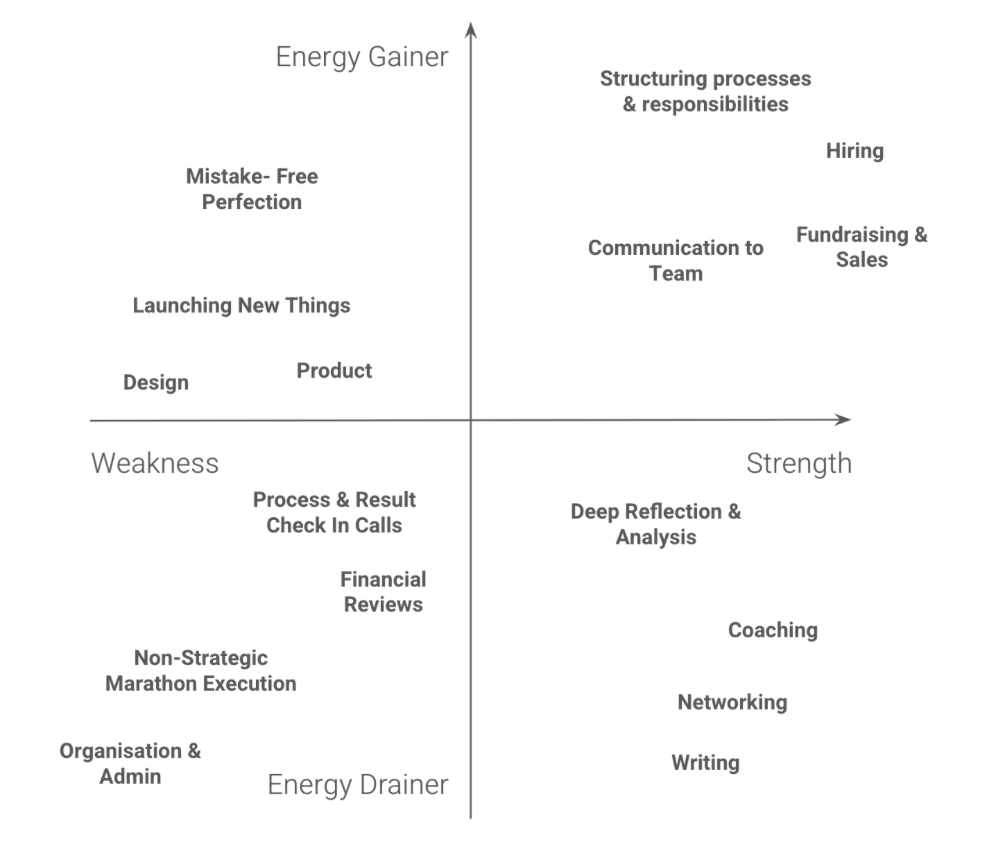
This framework provides portfolio intelligence applied to your tasks. Similar to investors managing their own portfolios and focusing on companies that provide the greatest leverage for the fund, I recommend that founders focus their task portfolio strategy on where their energy gainers intersect with their edge.
This framework is hard work. It helps you hire as a function of who you are. Understanding and mapping this function requires deep introspection and reflection. But if you put in the work, you will see yourself empowered to build the organisation around yourself. This is not arrogant or self-focused. At the date of founding the company, there is literally nothing but the founders. You are the company and as you scale, the company becomes a system that scales you. For lack of a better framework, I invented the Energy/Edge Matrix as an optimisation algorithm for this system.
Daniel Dippold is the Co-Founder and CEO at EWOR, a Fellowship supporting the top tech founders globally with up to €500,000 and bespoke mentorship by unicorn founders (Adjust, ProGlove, SumUp). Daniel raised $100M in his twenties, created (and sold) companies worth hundreds of millions, invested in 50 companies as an angel investor (7 unicorns) and is an LP in roughly 10 funds.
About EWOR
We back the top tech founders globally with up to €500,000 and bespoke mentorship by unicorn founders.
Learn MoreFollow Us