

Starting a software company in 2026 is easy. Building one that lasts is not.
In 2000, my team of six spent almost a full year getting a single website ready to launch.
It took us the whole winter to build the frontend, the backend, the back office. We put two desktop PCs in a cabinet in our office, connected them to the internet, and called them servers.
Every night before bed and every morning after waking up, I checked whether our website was still up and running. If it was down, I drove to the office, restarted the servers, and hoped that not too many customers had noticed in the meantime.
And infrastructure was only the beginning. There was no AWS, no Cloudflare, and no modern DevOps stack that let you deploy, monitor, and scale a product with a few clicks. There was also no Stripe or Adyen to process payments, and no off-the-shelf infrastructure for invoicing or reconciliation.
The same was true across the rest of the company. There was no Zendesk for customer support, no CRM like HubSpot, no modern marketing automation, and no Slack or Notion to run the team. Almost every workflow that can be solved with a tool today had to be built internally.
Obviously, there were no AI coding tools like Claude or Codex either. Every single line of code had to be written manually, reviewed manually, and fixed manually.
If something broke, there was no AI assistant to explain the error, suggest a patch, refactor the code, or generate a first version of a feature overnight. Debugging often took days, sometimes weeks. You would sit with the team, read through logs, test different hypotheses, and slowly work your way toward the issue. Not to mention, we never had enough engineers on the team.
Below you can see our website from February 2001. Building the tech/product was the hard part, everything else was easy.
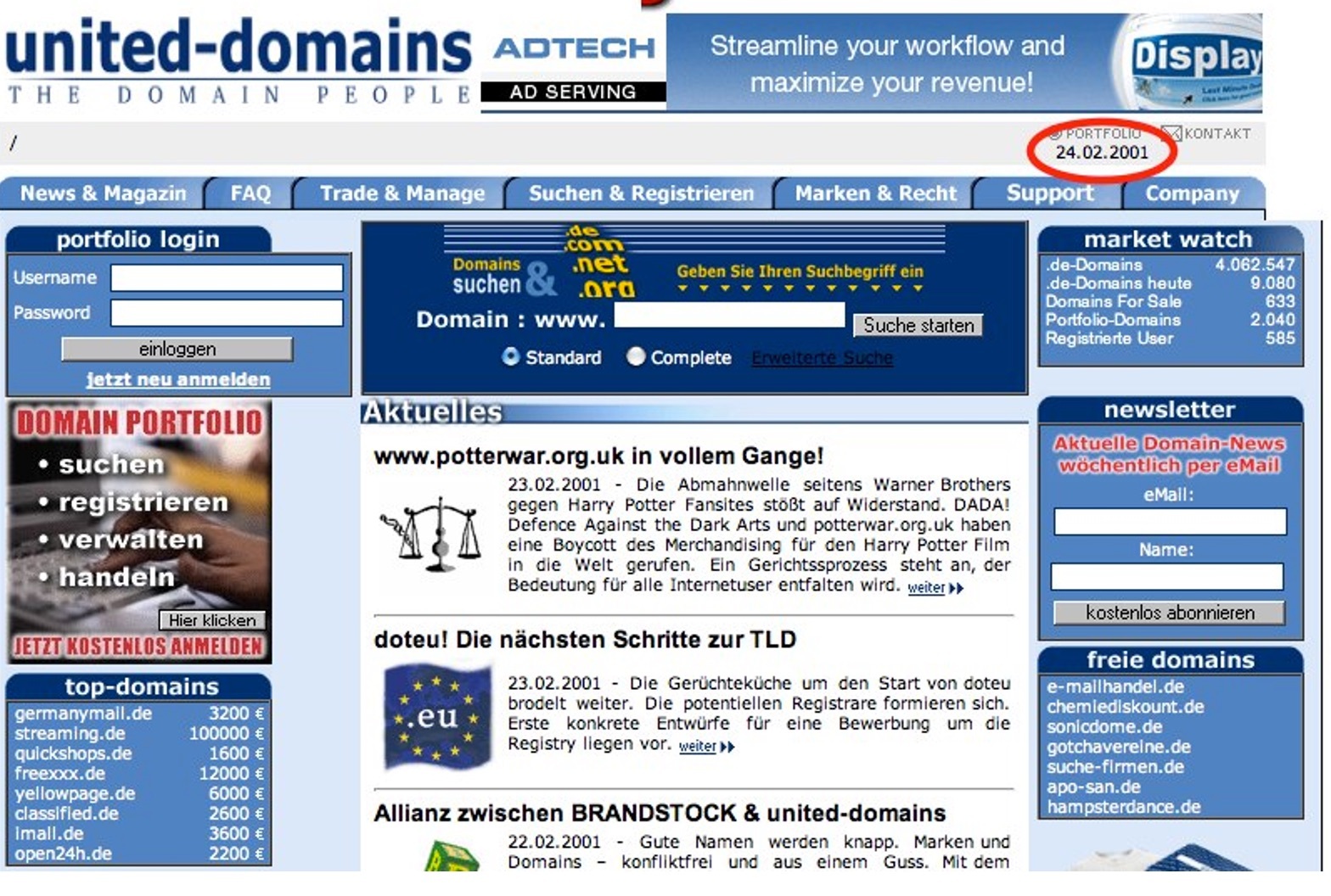
Twenty-five years later, all of this sounds incredibly tedious, time-consuming, and anachronistic.
However, there was a huge upside: the day we launched our website, we had product-market fit. PMF from day one! We put our website live and, within hours, the first paying customers came in. Within weeks, we had more than €100k in MRR, and customer demand just kept growing without us investing much in sales or marketing.
The hard part was building the product, figuring out the tech, launching the website, and making it not break. The easy part was getting paying customers.
In the first couple of years, we actually struggled to keep up with the immense customer demand. Every few days, our system would crash because we could not handle the increasing load. The biggest challenge was keeping our product stable and scaling the technical infrastructure.
The Hard Part Used to Be Building. Now It's Everything Else.
Today, a solo founder with Claude and Codex can build in two weeks what took my team of six almost a year. The infrastructure stack that consumed most of our first year now comes pre-assembled, hosted, and maintained by someone else. Payments, customer support, analytics, deployment – all solved before you write your first line of product code.
The cost of starting has never been lower. The time from idea to working product has never been shorter. This turns building startups upside-down.
But here is the problem: those same tools are available to everyone. The same AI that helps you build faster helps your competitors build faster, too. The same reduction in friction that lets a first-time founder ship a product in weeks lets ten other first-time founders ship nearly identical products in the same timeframe.
Code and product alone are no longer moats. The same tools that make it easier for you to build also make it easier for everyone else to compete with you. As a result, competition is 10x to 100x more intense than it was only a few years ago.
This changes everything about how to start, what to build, and when, if ever, to fundraise.
What makes your startup defensible if the product doesn’t, and what are VCs still funding?
If your digital product can be copied within days, you need a moat that goes beyond product, technology, good UI, or clean design. Instead it becomes a question of what makes your product genuinely hard to replicate. VCs are very well aware and this gets reflected in their willingness to fund startups.
Build atoms, not just bits. The most durable moat remains something that is not purely digital. Hardware is still hard. Energy, robotics, health tech, biotech, defence, and manufacturing still require real technical depth, operational complexity, regulatory navigation, and often meaningful IP. VCs are increasingly drawn to these verticals precisely because they cannot be reproduced with a few prompts and a sharp engineering team.
Own data no one else can generate. In an AI world, if you have access to data that no one else can easily generate, buy, or scrape, that will give you a real edge. Think of patient data in health care, claims data in insurance, transaction data in fintech, or operational data from industrial environments. In an AI world, models matter, but the quality and uniqueness of the data behind them may matter even more.
Distribution is also becoming more important than ever. If everyone can build, the real bottleneck becomes attention, trust, and access to customers. A fintech influencer with one million followers building an AI robo-advisor starts with a distribution advantage that a random technical team does not have. The same applies to founders with deep industry networks, strong founder-market fit, or privileged access to a specific customer segment.
Domain expertise that outsiders cannot fake. If you understand your customer better than anyone else, you can build a product that feels obvious and indispensable to them, while outsiders are still guessing. A team that has spent 10 years inside logistics, compliance, enterprise procurement, or clinical workflows will often see problems that a generic AI startup simply does not understand.
Genuine network effects. When your product becomes more valuable with every additional user, supplier, or data point, you may be able to compound your lead over time. But this only works when the network effect is genuine and measurable.
Finally, brand, trust, community, and storytelling matter more than many technical founders want to admit. In a world where products are easier to copy, customers will gravitate toward companies they trust, communities they want to belong to, and stories that make them feel part of something bigger. This is especially true in categories such as fintech, health, education, and consumer AI, where trust can be the difference between adoption and indifference.
Bootstrapping vs. VC funding
In a world where starting a company and building a digital product has become easier than ever, the capital required to get started has never been lower. For the first time, bootstrapping, rather than immediately raising a seven-figure VC round, has become a viable path for many software-related businesses.
The old playbook, and also my own 25 years ago, looked like this: assemble a team with different backgrounds, build some wireframes and mockups of your future product, create a polished deck, raise a few million, hire additional engineers, and then start building the actual product and hope that 6 or 12 months later, when you finally release your product, customers will like it.
For founders starting in 2026 and beyond, I recommend a very different approach.
The New Playbook for Software Startups in 2026
Given all of this, the old playbook – assemble a team, build wireframes, raise a few million, hire engineers, ship a product twelve months later and hope customers like it – is not just outdated. It is actively counterproductive. It optimises for the part of the problem that is now easy and defers the part that is now hard.
Here is what I would do instead, starting from zero today.
- Build the first MVP of your product. Use GenAI (e.g. Claude, Codex) tools to do the heavy lifting, and to get the UI/UX and design right.
- Come up with a good brand name that is working for your target market.
- Start reaching out to your anticipated target customer group, your ICP (ideal customer profile). Use tools like Clay Origami to build your lead list This is the hardest part. You will hear many no’s, but keep on going! Understand their needs better with every conversation.
- Do almost anything to win your first customers: design partnerships, special deals, hands-on onboarding, bespoke support, or whatever else gets you into the market.
- Validate that you are solving a real pain. Then iterate and evolve the product based on proof and data points, not gut feeling.
- Test different go-to-market strategies to see what sticks. Try hyper-personalized outreach across every relevant channel (conferences, social media, email, cold calls, SEM, etc). Use AI to help you with outreach, but always keep it human and personal. Also work on SEO/GEO. You want to make sure that potential customers will find you.
- Narrow the ICP based on actual traction and conversion signals.
- Now push toward €10k in monthly revenue. Keep in mind: the first €10k in real revenue is always the hardest. Most startups never get past this threshold.
- Once you hit the inflection point of €10k MRR, keep going, but become more deliberate.
- Now start targeting active angel investors who deeply understand your industry. Offer them an attractive valuation for their angel check.
- Limit the round to four or five angels who bring real value and feel like the right personal fit.
- Raise €300k to €500k for 10% to 15% equity to secure 12 to 18 months of runway.
- Aim to reach €1M ARR within the next 18 months.
- Become cash-flow positive within 18 months. That is a real game-changer because now the survival of your company doesn’t depend on your ability to raise additional capital.
- Then decide whether you want to raise VC funding to scale the company as quickly as possible and aim for a unicorn outcome, or keep bootstrapping and reinvest your positive cash flow into growth.
A profitable, cash-flow positive company with real customers and no external dependency is not a fallback. In the age of AI, it may increasingly be the smarter path.
Florian Huber is the Co-Founder and Partner at EWOR, a Fellowship supporting the top tech founders globally with up to €500,000 and bespoke mentorship by unicorn founders (Adjust, ProGlove, SumUp).He has founded three companies and backed more than 50 startups as an early-stage angel investor.
About EWOR
We back the top tech founders globally with up to €500,000 and bespoke mentorship by unicorn founders.
Learn MoreFollow Us

The Energy/Edge Matrix - Understand Yourself First, then Hire Accordingly