
It is easy to forget that stress is nothing but an instrument of the human body, helping us to focus. It often gets confused with burnout, which is more common than ever and has ended the careers of many entrepreneurs and their employees.
I have seen multiple of my friends burn out and have been very stressed from time to time myself. Over the last few years, I came to the conclusion that stress is primarily a psychological experience. I realised that the stress we feel today is very different from the stress our ancestors experienced thousands of years ago. Our environment has shifted and warrants new coping mechanisms. After studying the science of stress, I have decided to see stress as a gift and haven’t experienced any burnout-related symptoms since.
Neurologically speaking, stress activates the amygdala, the brain’s department responsible for fight-or-flight, and tunes down the prefrontal cortex, which is responsible for critical thinking. It effectively reduces cognitive functioning for the sake of fast, snap judgments and habitual responses (Pubmed). It shifts our nervous system: From the parasympathetic nervous system to the sympathetic nervous system.
This is a gift when a tiger is charging. When facing a predator, you absolutely do not want your prefrontal cortex running the show. You don't want to be thinking "Hmm, let me consider my options here... the tiger appears to be approaching at approximately 40 km/h, so if I factor in my running speed and the distance to that tree..." You'd be dead at this point.
Moreover, hormonally speaking, stress is typically accompanied by the release of adrenaline & noradrenaline. Negative stress (distress, e.g., feeling helpless or out of control) adds elevated cortisol, whereas positive stress (eustress, e.g., competing in a sport you love) adds elevated dopamine, oxytocin, and/or testosterone. You recover quickly from eustress and slowly (or not at all) from distress. (Pubmed, see also Science Direct).
Stress is a gift. But chronic distress burns us out and kills us. It leads to structural and functional remodelling in the hippocampus (memory formation, context, learning) and the prefrontal cortex (planning, impulse control, flexible thinking). This means more distractibility, worse working memory, more “tunnel vision,” poorer long-horizon reasoning. (Pubmed) It weakens our immune system. Second, it reduces protective immune functions (e.g., poorer antiviral responses, slower recovery), and increases inflammatory signalling. This is linked to higher long-term cardiovascular risk and even higher risk of cancer. (Ahajournals, Pubmed, Pubmed).
In essence, ordinary stress turning into distress is primarily governed by psychological experience (Pubmed). Chronic stress is a modern phenomenon because in the past, there was no chronic worrying. If there was a tiger, our amygdala took over and either got us killed or saved our lives. Afterwards, things returned to normal. We did not have to keep a calendar and constantly worry about what the next appointment was about and whether we were adequately prepared. We did not have to-do lists that made us feel as if it was impossible to finish all tasks we were given. And we certainly didn’t use those to-do lists every day. We did not have a rapidly changing “social status” that was jeopardised or updated regularly.
Those are entirely new ideas humanity has come up with fairly recently. Chronic stress seems to be mostly triggered by social-evaluative threat + uncontrollability. Anything that threatens social status/acceptance while also feeling uncontrollable is the most reliable cortisol activator in humans. This is the central finding of a major meta-analysis across 200+ lab studies. (Pubmed) Other factors include uncertainty and volatility, conflicting goals (thus reduced effectiveness), and anticipatory stress (primarily constant worrying and rumination). (Pubmed)
All of those are a function of our personal, psychological interpretation engine making sense of what happens in the outside world. Whether a situation feels uncontrollable is primarily our subjective interpretation given our experience of that situation. Uncertainty exists in the big picture, but fades when we focus on what we can control in a shorter time horizon. Conflicting goals are often nothing more than us being too afraid to tell people that we cannot or do not want to do something. Anticipatory stress is a learned behaviour. All of those can be changed. Merely adopting a different mindset can mediate this experience. Consistently responding differently to triggers, as suggested by cognitive behavioural therapy (CBT), can entirely rewire our subjective, psychological interpretation and our physiological corresponding response. Stoic, Buddhist, and Zen literature help us adopt the right frameworks, such as the below (which is far harder to implement in practice than what people think):
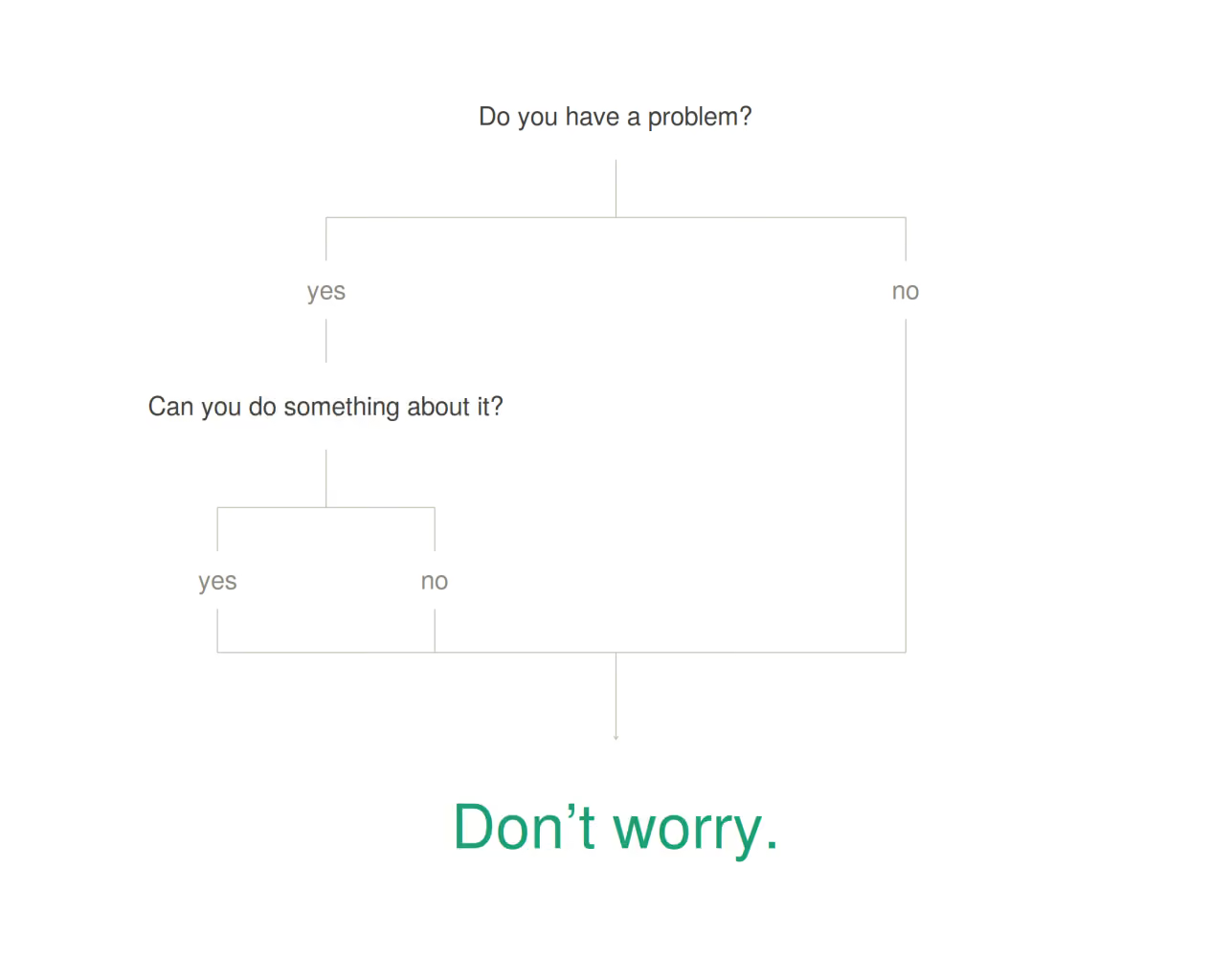
Stress is a gift. It was built to help us survive. Whenever I feel stressed at work, I welcome the physiological and psychological experience at hand and acknowledge my body's incredible response to a seeming threat. I take some time to familiarise myself with the feeling of stress in the body. I trace where the feeling is coming from and accept that there is no need for the amygdala in the work context. It is nothing but a survival mechanism telling me something is a threat. Therefore, in a second step, I choose to reactivate my parasympathetic nervous system. I do this primarily through breathing exercises (e.g. it is shown that 4-7-8 breathing increases HRV, see Pubmed). In a third step, I come back to the psychological stressor: Am I stressed because I feel my time does not suffice to fulfil all responsibilities, tasks, and deadlines? Am I stressed because something external is affecting my business? Has someone written something bad about my company? The next question is: Can I act on it or not? If I can act, I make a plan: I reprioritise, I delegate, I kill entire projects. If I cannot act, I take time to find acceptance for this new situation which I cannot change.
This protocol has helped me be burnout-free while working 16-hour days and taking almost no holidays for more than a decade of my life. It has helped me cope with massive amounts of uncertainty in entrepreneurship, to divide & conquer, and to feel joy in entrepreneurship again. It helped me do the most intense things while feeling incredibly chill. It has rekindled a spark in me, an almost childish, playful enjoyment of life itself.
______
Next to this specific protocol, here is what science, paired with my own experience, suggests to do to cope with stress best:
- Reframing (resources > demands = challenge; opposite = threat, see Pubmed) or adaptive reappraisal (Pubmed)
- Schedule regular sports (esp. cardio), sauna, yoga and massages
- Learning Stoic thinking (e.g. invest no mindspace in what cannot be changed)
- Healthy nutrition + supplementation, esp. Inflammation-reducing, e.g. Curcumin/tumeric, Boswellia extract, broccoli powder, …)
- Breathing techniques (esp. 4-7-8, box breathing
- Excluding avoidance, denial, emotional disagreement and substance coping as coping mechanisms (Pubmed)
- Recovery time & chronicity killers (a “weekend off”, ideally after a planning and coordination session)
- Stable circadian rhythm (same wake-up times, same bedtimes, same meal times)
- Healthy sleep, no longer than 9 hours
About EWOR
We back the top tech founders globally with up to €500,000 and bespoke mentorship by unicorn founders.
Learn MoreFollow Us

The Energy/Edge Matrix - Understand Yourself First, then Hire Accordingly