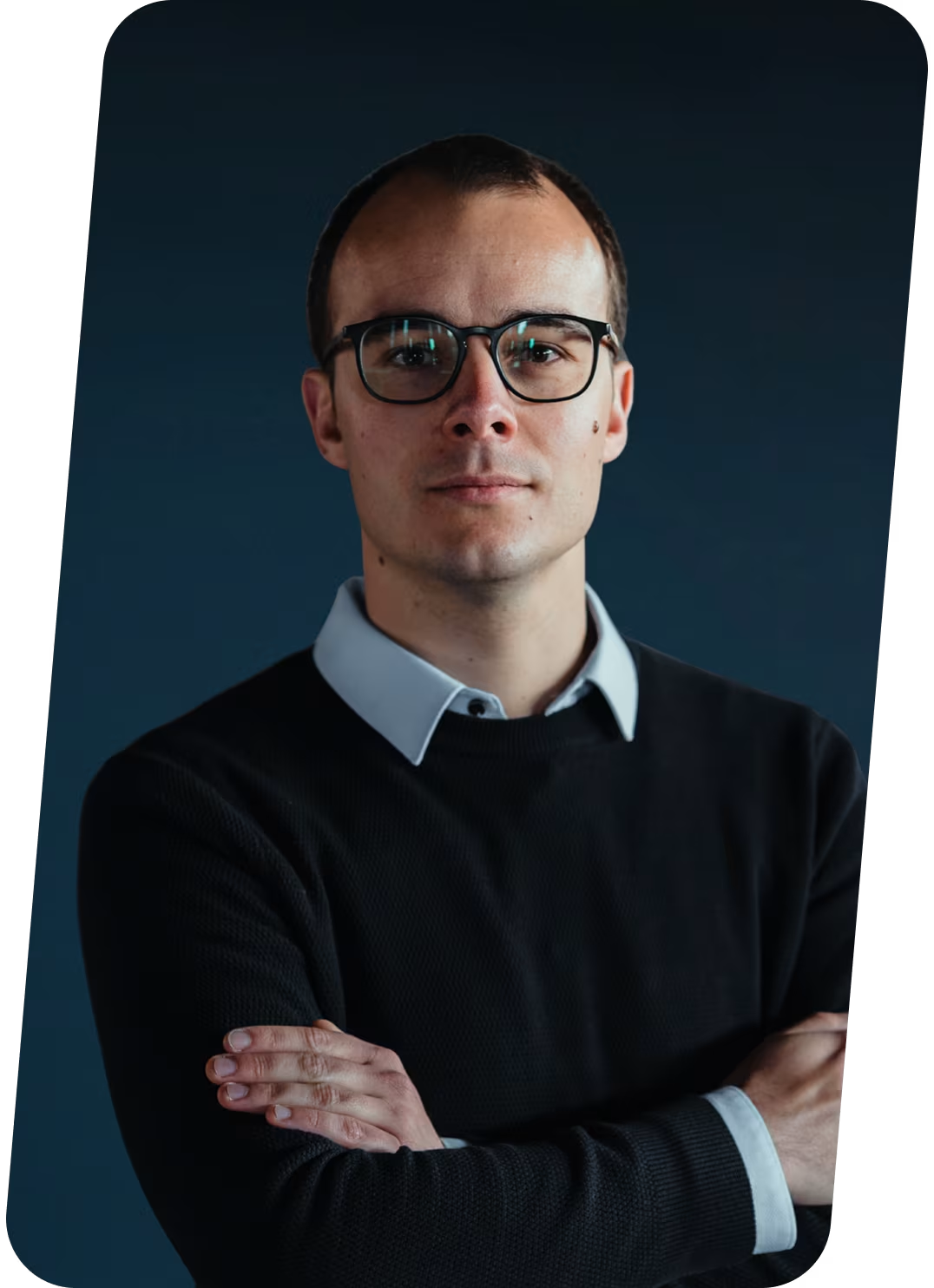
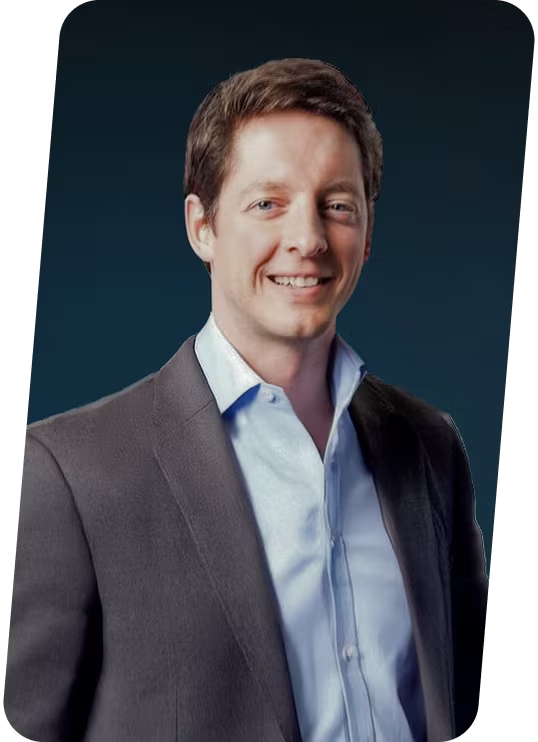
In this episode, Emil Kostadinov, Co-founder and CEO of ManaMind, tells Daniel Dippold about the hardest weekend of his founder journey. On Friday, he closed the first big check of his round. On Sunday, he found out about his divorce. It completely decommissioned him, right when his fundraise depended on momentum.
What restarted his momentum was community. One EWOR Fellow flew from Zurich to London after Emil told him not to come. Another stayed up with him on the nights he could not sleep. And a single post in the EWOR Community Slack took him from a standstill to 15 hours of investor calls a day.
Emil also shares the three things every founder should get coached on and how eight months of co-founder interviews built the partnership ManaMind runs on today.



Emil Kostadinov: I remember being super excited, we got it on a Friday. It was an incredible moment, a huge milestone to close your first check. The very first big check we got was a 100K check.
But as it happened, two days later on Sunday, I found out about my divorce. And I want to say that to this day, this has probably been the most difficult time in my life. And it just completely decommissioned me. That call, when I rang you, I was pretty much ready to give up. I was like, “Daniel, listen. I'm not doing what I should be doing. I know it. You know it. Let's figure something out.” But you just said, “Actually, I think you're doing really well, despite everything.” And that meant the world to me, honestly.
One of the EWOR Fellows who was a very close friend of mine. Claudio, he basically canceled all his meetings after he found out about what I was going through, and jumped on a plane from Zurich to London. And that was despite me telling him, “I'm not really in the mood to hang out. Can you please not come?” Bear in mind, these are people who have their own startups to do. They're entrepreneurs in their own right, great entrepreneurs. So you can easily make the case, I haven't got the time, but it's not about having the time, it's about making the time.
As we were getting closer and closer to the long stop date, okay, I'm now in a position where it's pretty much guaranteed that I'm not gonna make it. And I don't come from a culture where it's particularly accepted to ask for help. And I've always been rubbish at it. So I realized, okay, I'm either gonna learn to ask for help, or that's it. There's no other option.
I made a post in the EWOR Community Slack, going back from having zero momentum to booking calls for 15, 16 hours a day without any break in between.
There will be difficult times. Don't give up, find a community that will support you throughout the process. And know that there are always a bunch of entrepreneurs that are cheering for you from the shadows.And with that, the rest is all in your hands. You're the master of your own destiny.
Daniel Dippold: Welcome to another episode of Been There, Done That. Today in San Francisco, where we're hosting the EVOR San Francisco Residency. I'm here with Emil, who created an army of bots that are playing games, finding bugs, and reporting them. It's game testing on steroids.They've built the best performing VLM in the market. Very excited to have you here today.
Emil: Thanks for having me. Daniel, super excited for this.
Daniel: It didn't start that smoothly. Right now, things are looking pretty incredible. But I remember your raise was a little shaky. Do you want to walk us through what happened?
Emil: Yeah, shaky is an understatement to be sure, but yeah, the story goes, we kicked off the, the fundraise initially with, we got some small angel checks, which was great to get started. And then we were aiming to close about…
Daniel: Let's go into the angel checks a little bit. How did that go? How do you close your first angel?
Emil: God, I think for me, it was just being very clear about who I am as a person, what I want to do, and my vision. When we got the first ones, we had nothing. We had absolutely nothing, but I think the values that I had really resonated with our very first angel, Stefano, and he said, Hey, whenever you're ready, I would like to invest. And that was his only personal investment because he now has this huge fund. He doesn't do personal investments. The only one he's ever done is in ManaMind. And I am so, so grateful for him.
Daniel: It’s pretty incredible, right? I think a lot of like the early decisions of angels, they're very emotional. They're very subjective. It's easy to forget about this. And for you, I remember you didn't even have the case back then, right? Like it was purely an investment in you as a person. And I think a lot of early stage founders forget this.
They're pitching themselves as a person and not necessarily the venture in the very beginning, but then afterwards, I guess this changed, right? You started formulating the vision. Walk us through the rest of the raise.
Emil: No, eventually a lot more things became clearer and we were heading towards doing a full round. We were looking to close about a million dollars pre-seed. And the very first big check we got was a 100K check. I remember being super excited. We got it on a Friday. It was an incredible moment, a huge milestone to close your first check because it really indicates that I'm really heading for that big milestone of closing your first round. I was super excited. One caveat was that it came with a four month long stop date, which at the time, technically four months shouldn't really be an issue to close your round. So I was like, okay, no, it's not great that it's there, but it's fine. I should live with it.
Daniel: Do you want to explain what that long stop date is?
Emil: Yes, so for those who don't know, a long stop date is a point until which if you haven't closed your round, the investment converts at a predefined value. And obviously that would be a very low value and it was a very low value for our check, but no, regardless of that, it was a great time, closed the big check. I remember calling my co-founder super excited and I was really looking forward to the week after because I had plenty of calls scheduled, but as it happened, two days later on Sunday, I found out about my divorce and I want to say that to this day, this has probably been the most difficult time in my life and it just completely decommissioned me. I just went from having so many calls scheduled and us having such great momentum, which I was so proud of myself for managing to establish, to not being able to take a call and not being able to keep it together.
And you know how it is in this environment, people know each other, people talk, so if at some point you lose that momentum, it is so hard to put it back on track and I think very few people have actually managed to do that. But we did. So yeah, I remember there was this basically two months at which I wasn't taking investor calls, I wasn't doing anything whatsoever. I lost a lot of respect for myself and I was really harsh on myself at that time as well, because I thought, wow, this is not what I should be doing. You know, this is not what that angel Stefano who gave me the first check would have expected of me as a performance. It's not what Daniel and you would expect of one of their fellows, how they would perform, so it was a pretty hard moment.
Daniel: I remember you us calling during that time.
Emil: That call was actually, I don't think you realize how much that call was for me, because that goal, when I rang you, I was pretty much ready to give up. I was like, “Daniel, listen. I'm not doing what I should be doing. I know it. You know it. Let's figure something out.” But you, you just said, “Actually, I think you're doing really well despite everything.” And that meant the world to me, honestly.
It was you and there were a couple of other people who really showed me kindness and perhaps love at a time when I was really struggling. And it was so invigorating. And it meant so much to me because I was like, well, how can I ever possibly not do my best to make these people proud who believe so much in me? At this point, a lot more than I believed in myself. So there was that moment, for sure.
Daniel: Yeah, which brings us to the power of community, right? It can, you typically don't realize how powerful a community around you can be until you really need it, right? And suddenly you're like, wow.
Emil: For sure, and I can't say how much that helped me because I have some incredible stories of that period of time. I had one of other EWOR Fellows, who's a very close friend of mine, Claudio, he basically canceled all his meetings after he found out about what I was going through, jumped on a plane from Zurich to London to spend time with me just because he was like, “Dude, I'm worried about you.” And that was despite me telling him, “I'm not really in the mood to hang out. Can you please not come?” He still did it.
Daniel: Claudio is in your EWOR Circle, right?
Emil: Exactly, the EWOR Circle is six people very close together. And, you know, there were others from my circle who also helped loads because I couldn't sleep at the time.
For example, and I was getting these really intense panic attacks at the time. And I even had a couple of psychotic events as well. There was Olive who lives here in San Francisco. So when it was night and I couldn't call anyone in Europe, she'd be on the phone with me and she'd be like, okay, now we're going to breath. And she'd just breath with me for an hour, two hours, however long it took. And, you know, these are people who I could never possibly repay them for the kindness that they showed me in a moment when I was really down. It's those people who build me back up.
Daniel: Yeah, and Claudio just showed up, right? Like he was just at your door, if I recall correctly.
Emil: Yeah, he just showed up. Bernard also came, he lives in London, so they both spent a couple of days with me, but they were with me from morning until evening and bear in mind, you know, these are people who have their own startups today, they're entrepreneurs in their own right, great entrepreneurs. Um, so you can easily make the case, I haven't got the time, but it's not about having the time, it's about making the time and they made a lot more than needed for me, which I really appreciate it.
Daniel: Yeah, wow. And that triggered a, I would say a reincarnation, right?If I, if I recall this also, like the, the kind of pre-Emil and the post-Emil to the situation, right, as a two very different people. You, from what I understand, got a couple of coaches that helped you at like different areas in life, there were many areas in which you absolutely revamped yourself, right? How did you do that? How did that get started?
Emil: Well, there were a couple of things that really led to it. Um, one of it was the realization as we were getting closer and closer to the long stop date that, okay, you know, I'm now in a position where it's pretty much guaranteed that I'm not going to make it and I don't come from a culture where it's particularly accepted to ask for help and I've always been rubbish at it. So I realized, okay, I'm either gonna learn to ask for help or that's it. There's no other option.
So I started learning how to do it. And I remember I made a post, uh, in the EWOR Community Slack. At some point there was an army of other entrepreneurs just making intros for me, um, suddenly going back from having zero momentum to booking calls for 15, 16 hours a day without any break in between. Um, I have since learned that it's helpful to have a bit of a time block in between so you can follow up, but, um, you know, it was, it was a critical situation at the time and in terms of revamping it, it was a very long process. It didn't happen overnight. It was, I think many intentional small steps.Um, one that I always speak about is, um, I love this saying of, or remember who you are, but, um, I believed before you can do that, you need to learn who you are. And I knew coming out of this situation, I was going to end up with one story or the other, and the first one was going to be an excuse, which was, okay. Um, my fundraise failed because of my divorce, which is a valid excuse, it's a good excuse, but it's an excuse nonetheless, or I could come up with a story of we raised around this point it, and when you frame it like that in your head, you get to make a choice. What type of man do I want to be or what type of entrepreneur do I want to be? And for me, it was very easy to say, okay, I want to be the guy that gets the job done no matter what.
And since at the time he was very 50, 50, whether I didn't think it was going to go ahead or not, I also knew, okay, actually the outcome is irrelevant at this stage, I want to be the guy who just fights till the bitter end and who doesn't give up no matter what. And that's what's, um, prompted all that self growth that came after it. And I think it's still ongoing. I don't think I'm ever going to stop evolving in the way that I started since the situation. So in a way there's a gift in everything because it just prompted me to start learning and growing in a much faster rate than I did before that.So I did plenty of things. I hired, I started doing a lot of therapy, obviously as you should. I got a coach who really helped me clear my mind on what my priorities are, what I want to do, how I want to get there. And that helps give me a bit of a map in my head about what it is that I needed to do. And of course, I'm very fortunate to have all these friends and family who care deeply about me that were there with me throughout the entire process.
Daniel: I think entrepreneurship is a little bit like, you know, you're going through a tunnel, but you don't know how long that tunnel is, right? And like it's so easy at one point to just say, okay, let me, you know, like, let me turn and go back, right? And then pushing through is just, just so incredibly hard, right? And coaches can actually be a fantastic torch, you know, like in your hand and like that lighten the way a little bit and help you through that, especially, you know, people who've seen journeys like this before. Most founders, I would say struggle even, you know, to find the right coach. Like how, how did you find your coach?
Emil: Yeah, I agree fully and for me was again, an interesting intersection in life because around the same time, I also got diagnosed with ADHD and I got diagnosed with autism as well, roughly a couple of months apart. Um, so suddenly I was going through this big period of my life. I was learning a whole lot about how my brain operates. Um, and I was just very, very lost, I think. And that is a feeling that if you're an entrepreneur, you got to get very comfortable with it because no matter how much support you have, there are always going to be moments where you're very, very lost and you need the correct setup to go through these periods. Um, so the way I found my coach was through you Daniel, because my coach just so happens to be your coach as well, or one of your coaches.
Daniel: And it is Ravi.
Emil: It is Ravi, and he had done, I think maybe a year before that, he'd done a session with all the EWOR Fellows. And I just made a mental note of that guy's really cool.
And what really helped is at the time, I was really dealing with quite a lot of self-doubt, a lot of self-criticism. It was very much on the extreme end. And I think what Ravi taught me was, okay, maybe you shouldn't always be so harsh towards yourself. And maybe there's a better way to look at it. And what I specifically loved about him is he started giving me all these racing driver analogies because as you know, I race cars. So she was like, okay, I was like, now we're gonna do a mental pit stop. And you're gonna come in and we're gonna change your tires and we're gonna refuel and then you go back off. So he really tailored it for me. And if there's one thing that really helped, it can sound strange, but he told me, I work with a bunch of entrepreneurs. You are all the same in those self-doubts and in those self-doubts that you have. And that strangely helped so much because at the time I felt, God, no one can understand me. At least no one from my non-founder circle could understand what that was going through. But then when he said those words, actually like you all have the high achievers avatar. Like it's kind of pretty obvious. So that's a good insight. I'm glad I'm not unique in that specific thing.
Daniel: Yeah, it's also crazy how well familiarity works, right? Just by making entrepreneurship a little bit more familiar mentally with what you were used to raising, for example, right? Like suddenly it felt way easier. Suddenly you had the right analogies to draw from, right?
Emil: Couldn't agree more. Same thing goes for, for pitching, you know, um, yeah, because I was struggling quite a lot with being myself at that time, I picked up acting, um, throughout it and actually doing a lot of acting really helped my pitching because I knew how to speak publicly. I didn't feel any sort of pressure pitching in front of 200 people. And that just really helped make the whole journey a lot more manageable and eventually a lot more fun as well. Because it can be a lot of fun being on stage in the spotlight, pitching to all the top, uh, all the top investors in Europe.
Daniel: What would you say are the top three skills like any entrepreneur should get a coach for?
Emil: Number one, definitely mental capacity, mental discipline, learning how to master your own mind. Number two, I'd say it's a bit of a hot take and having range and building up your mindset outside of the standard entrepreneurial skills. So for me, that is racing, that is acting, that is skiing and other extreme sports. I think they bring, they allow me to bring a lot of things outside of entrepreneurship into entrepreneurship that I wouldn't have known about otherwise. And number three would be learning to confront the difficult conversations and the challenging times head on, not with fear, but with resolution and with clarity to go out and solve them early on rather than letting them fester.
Daniel: Hmm. So both prioritizing those difficult conversations and having them.
Emil: Correct, it's not enough to just have them top of mind, but you need to have the capacity to go and actually execute on them as well. You need to master your mind. And that goes on to discipline and that goes on to your long-term performance. So I think we are all born and raised with certain misconceptions that is very normal, that is the society that we live in. So you need to rewire your brain, which is a very difficult task to do. And it takes a lot of effort and a lot of consistency to do that. But if you want to be performing over a long period of time, you have to do it.So get someone who can teach you how to do that. Get someone who can teach you how to do correctly about yourself, about what you do and about what you want to achieve. Stop thinking about, I had this big issue where any sort of joy I could get was based on milestones. OKRs, OKRs were the only thing that brought me joy. Now, the issue when you work like that is it's a very adrenaline based way to feel happiness. Adrenaline is unfortunately very addictive as a chemical and also unfortunately has diminishing returns. So to experience the same high, you need more and more and more and more. And it also isn't very long lasting. So learning about how to enjoy the inputs versus the outputs was crucial for me. Previously, a great thing would have been, OK, I closed this round or I closed this customer. Now, I think it is, wow, I'm waking up every single day. I'm surrounded by some of the most incredible entrepreneurs on the planet. I'm working with an amazing team of outlier people who are infinitely smarter than I can ever dream of that. That is something that's worth celebrating and it's worth being joyous about.
It's not easy to do, especially if you have had that way of thinking since you were a child, for example, maybe you only really felt any sense of accomplishment by getting a certain grade in school or anything like that, that can be very dangerous in the long term.
Daniel: So how do you do it? Like do you do CBT? Like whenever you see like your brain is in a certain loop, you consciously rewire to another loop or what's your protocol for anyone listening who wants to do that for themselves?
Emil: I think different things work for different people and also different things work at different situations and different points in time.
Daniel: That's where the coach is. Yeah.
Emil: Exactly, and I didn't know how do I need to think about those different situations. And because it's all neurons and strong connections that you've built over time, they're the ones that kind of have to establish the new ones.
Daniel: That's neurons that fire together, wire together.
Emil: Exactly, yeah, and get you to think, oh, maybe there is another perspective that you could be thinking of. Maybe there is an additional way that you may be missing and it's those perspectives where we can really get ingrained in ours, but that doesn't make it right. It just makes it ours.And I think now I've managed to have a much broader view about how things are. And that's really helped. I think it's helped my performance as well. Moving away from these milestone based way of experiencing joy, just being very appreciative because even people in my team notice it and I think as a CEO, you have to go there and you have to be able to show great energy. And if you cannot learn to be very energetic day in, day out, even when things aren't going your way, I don't think you're going to be genuine.
Daniel: Yeah, okay. That's number one, right? We still have number two and three. And then I want to chat a little bit about your, your, your team, your co-founder in a second, but like, maybe it's a number one thing, get a coach that helps you with like discipline, motivation, sustainability. What's number two and three? Your subjective recommendations, right?
Emil: Number two would be a bit of a hot take, I would say, which would be get yourself a way to build your creative, non-entrepreneurial type of brain as well. Having range can be very, very helpful. And I think that's where a lot of my additional hobbies really come in. I love extreme sports and that helps me perform really well under pressure. Um, if I get a difficult question, say by an investor, this doesn't bring me into a panic mode because I'm very used to it. Um, I think with acting, you know, it, it helps me go and present really well in front of, be it investors or now more commonly potential hires for the team, because one of the greatest superpowers you can have in an entrepreneur is closing an incredible team. Right now, that is my, my job. Yeah.
Daniel: I remember you to go there straight away, right? Like I remember you first of all being super disciplined about who your co-founder is. You've went through so many, right? And like at one point you settled or reached whatever word we wanna choose, right? And you also put a lot of effort into developing your team, right? So I wanna chat about both of that a little bit in the right order.So let's maybe start with finding the right co-founder, right? So many people have an issue with this and there's the people who I think constantly over-optimize and then they're never saying, okay, this is it. And then there's a lot of people who just go for the first person and that's also not great, right? So how do you strike that balance?
Emil: Yeah, I love the saying variety is the spice of life, isn't it? I don't think being in either of those two extremes is great as you say yourself. But there are certain thresholds that you need to pass. And also at the same time, you cannot take infinite time to make a decision because one of the things you have to be doing as a CEO is making decisions quickly when they matter.My search was incredibly long. I don't think I ever want to go through it again because it wasn't easy. And for anyone searching for a co-founder, I'm cheering for you because it's a very difficult thing. But it's incredibly fulfilling as well. Once you go through it, once you get that magic connection together, you will feel it. It's difficult to explain, but you will feel it. I ended up going through eight months of co-founder interviews. And that was Monday to Sunday, 10 plus hours every day, just sorted on this one project of finding a co-founder. And I went through loads of people, some of whom could have had a great skill set that was really complimentary to mine, but not the value alignment. I went to other schools, perhaps had a great value alignment, but not the same ambition that I had. I went to others who had the same ambition that I had, but didn't have the right skill set or the right idea of what it was that we wanted to achieve, or didn't want to build the same culture that I wanted. And these were things that I was just not willing to compromise on. Still, I'm not willing to compromise on to this day.
Daniel: So many filters, right? I think we have this 50 questions exercise on our website still, right? And saying like, you should ask your co-founder all of these questions.
Emil: So top tip, and this would be number three even, I would put it is when you're getting a co-founder or, or now I've, I've stolen that resource and I'm using it much more broadly, use it because it's so helpful to get all the difficult conversations out the way. Also, it may sound silly, but sign it and send it to each other.If someone ever deviates from it, just bring it up on screen share. And I think this is something very, very helpful because it says the rules of the game, this is how we're going to act. This is what's going to happen under all of these circumstances, and you have to be genuine to it and you have to commit to it. And if you commit to it, I will hold you accountable to that. And I expect to be held accountable on my end should I deviate from our agreement. So, um, I'm even using that very same co-founder questionnaire for the other actors in the little TV series that I'm doing as well, because it's a, such an incredibly powerful resource. And yeah, there's a lot of filters. It can feel at moments like a fool's errand, but trust me, it is worth it. Even if it takes an extra month, two, three, six, however long it takes, it's worth to align that from the get-go, because once you have that team, that initial team established, you will move much faster anyway, than if you had a mediocre co-founder.
Daniel: A lot of people think there's a long time, eight months, but I think, you know, given you may be going to spend the next 10, 20, 30 years, even if it goes really well together as co-founders is quite of a commitment, right? And if, if someone tells you, you need to find your future wife in two months, what the hell, right? Like you would say at least give me eight months, right? And that would maybe be the bare minimum.So I think it, it makes a lot of sense to, to invest the time and just wanted to double down on that and say, yes, like it's a great example that you took the time because that can create the foundation for a relationship that lasts for a long time. And you just need to go through those filters. Now, though, that doesn't guarantee that the combination is always magical and it'll just work out no matter what you do, right? You also need to invest in the relationship.Maybe you can walk us a little bit through how you do that with your co-founder.
Emil: Absolutely, and I think it's something that we've carried through the entire team now We really put a huge amount of emphasis on having a growth oriented mindset I think Sabtain and I as founders, we also have to live it because it's not enough to just say it I'm signed up to six courses right now for that very same reason but I don't think Neither me nor Sabtain Were performing at the level that we do we are right now when we decided to become co-founders however, there was always that mutual unspoken agreement of We we appreciate we are not the best CEO and CTO on the planet and therefore we will always grow and they will always strive to to get better and I know for a fact, you know, there were plenty of things that I was doing wrong there were plenty of things that Sabtain was doing wrong we had this one moment where at some point we were Trying to report on our progress to our initial investors and we'd come up with this plan and it was a three-month plan Three months in with two months behind So I was just chatting to Sabtain. I was like, listen, this is not okay you know, this is a timeline that you gave me and I've put our names behind it and I don't want us to be the type of people who say one thing but do another Yeah, and we just realized we had a massive problem with how we plan We didn't work in any buffers.We were wildly optimistic in anything that we ever did So There was this distinct moment where we just had to have a really difficult hard-to-hard conversation. At which point I said listen right now as things are the trust that we had a month ago. We haven't got it anymore. And that's not a decision I get to make because trust is something that you develop with people and It was a very rough conversation.I think it was probably 5050 whether there was going to be a founder breakup going into it, but I knew either we sort it out now or No, again, that's not the type of CEO want to be and I'm very grateful for him because he showed me a great deal of respect by Actually going and doing something about it. Yeah, and not getting
Daniel: EWOR Productivity Module, I remember that.
Emil: Yes, he went to the productivity module and he came back, what I can only describe as a changed man, and he just became this absolute productivity machine. His planning became infinitely better than my own one, which was another source of inspiration for myself to then go and do it as well.
Daniel: I remember you complaining initially. You were like, what the hell happened? This guy is outworking me now.
Emil: Exactly, yeah, and that wasn't quite sitting well with me. So I was like, okay, now it's my time to up my game, but that's exactly what you want. You want to be pushing each other up rather than pulling each other down. And because we have that great relationship, we know that any feedback, even if negative, that comes from one person to the other is meant with the utmost amount of respect and love.And there's always that understanding, hey, I'll help you if you need any help with this. I just think you need to work on it. And we are now in this beautiful phase where I know that if I say something like that, you'll fix it. And I have utmost trust. I didn't back then, but I do now because I have a proof point for it.
Daniel: Yeah, pretty incredible. So that works on co-founder level. If you have a high level of trust, how do you carry that into the entire team?
Emil: I think strangely it gets easier and easier with every new team member if you really live it and if you really mean it. I think the moment when you're saying things that you may be a little bit disingenuous about, people will say it straight away.So if you really are passionate about having that relationship with your team and about jointly together building something incredible, people will buy into it. Right now, probably the most critical part of my work is to build an incredible team of outliers. And I think we've been very fortunate because we have some absolute superstars. I'm currently the only person without a PhD on the team, but even next month we have someone joining us from the original Adjust Mafia, which is obviously a Deca-corn, you know, completely without the salary, just for equity because they're just so brought into not simply what we do, but how we do it as well. And that just creates an incredibly fun and fulfilling environment. And that is how we carry it and it is a set of principles. I advise everyone to steal from us because I think there'll be a lot more really good companies if we get that.
Daniel: Yeah, this was a really incredible podcast. We went from developing yourself to developing your co-founders to developing your team. Like a whole like org development 101 masterclass I would say. Are there any final words you want to give away today before we wrap up?
Emil: Um, I think if there's one thing that people listening to this podcast should take away is there will be difficult times. Uh, don't give up, find a community that will support you throughout the process and know that there are always a bunch of entrepreneurs that are cheering for you from the shadows. And with that, the rest is all in your hands. You're the master of your own destiny.
Daniel: Thank you very much for that incredible episode. That was a really nice conversation. Thank you.
Emil: Thank you, Daniel. Cheers.
In this episode, Nico Dehandschoewercker, Co-founder and CEO of minitap, tells Daniel Dippold why founders chasing product-market fit shouldn't reinvent the wheel. He learned it the hard way, after trying to find PMF his own way cost him months building products no one wanted. Once he and his co-founder Luke switched to design thinking, they found the solution within days. Today, apps used by millions are tested by Mini, minitap’s AI quality assurance co-worker.
The raise followed the same logic. Nico spoke to over 100 funds for an oversubscribed $4.1M round and logged every rejection in a Notion database, sorted by "bullshit" and "not bullshit". Every rejection that held up went straight into fixing the business.
In this episode, Wiktor Stanislawek, Co-founder and CEO of Reactive AI, tells Daniel Dippold why European VCs called his pitch deck a red flag for naming OpenAI as a competitor, and why the angels he met in San Francisco called it ambition.
Wiktor's team are young founders from Poland who had never worked at an AI lab. YC passed on them twice. EWOR said yes after a one-minute demo: Reactive AI's token count stayed flat as other LLMs kept climbing. When Wiktor approached an OpenAI researcher to join the team, the researcher asked to invest, and the deal closed within 24 hours. The founder of Snowflake and a 5x unicorn founder followed. Now, Wiktor is challenging Silicon Valley's frontier labs from Poland with Reactive AI’s Large Awareness Models.
In this episode, Chris Fox, serial entrepreneur and Co-founder and CEO of Nimbus, talks with Daniel Dippold about treating profitability from day one as a repeatable strategy rather than a milestone.
Chris does not start a company until he knows the one channel that will get him to profitability. For Nimbus, that was referrals, and it carried the business to millions in ARR. He explains why the old playbook of raising big and chasing product-market fit for years is gone, why that window has collapsed from 18 months to 30 days, and why he deliberately raised almost nothing when he could have raised far more.