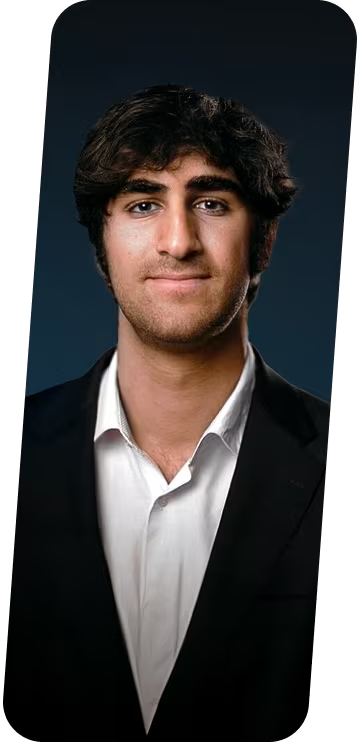
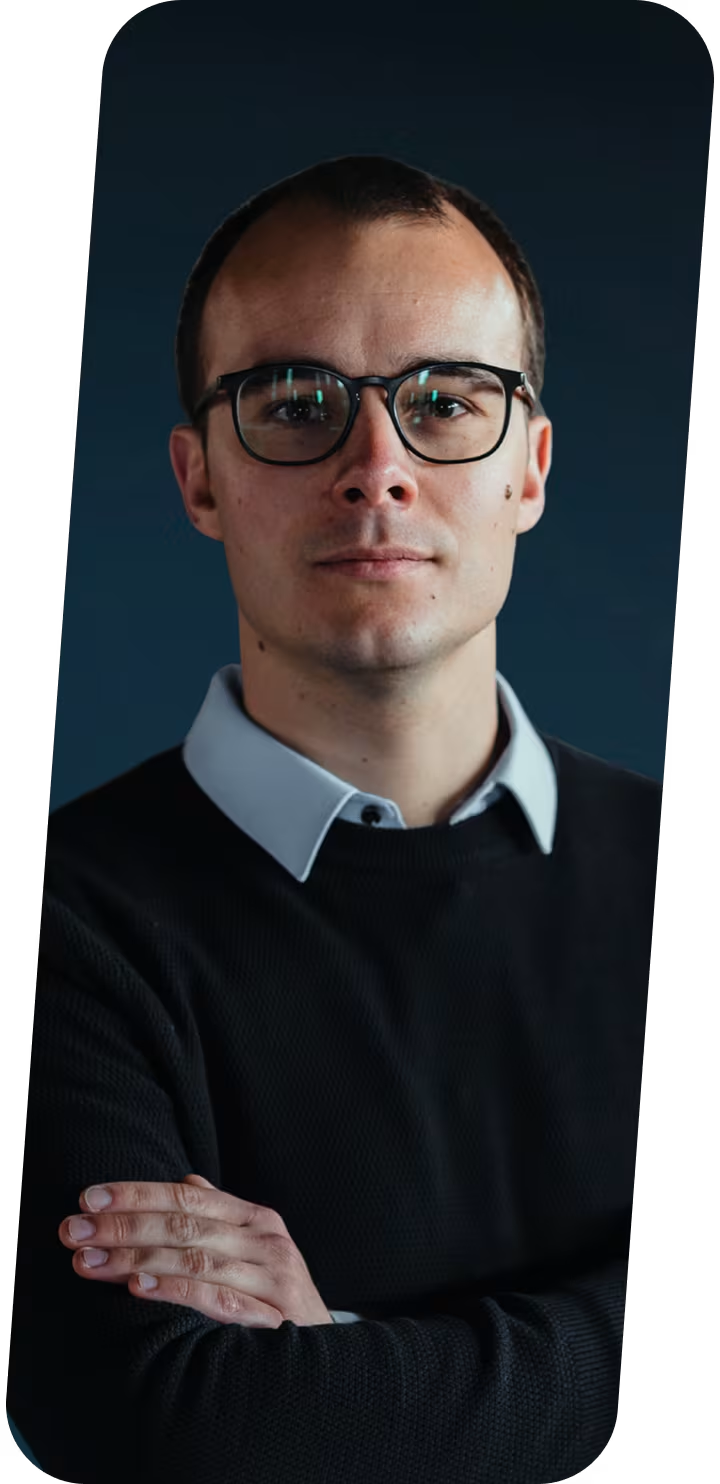
In this episode, Bjol Frenkenberger, co-founder and CEO of Sybilion, talks with Daniel Dippold about the structural decision at the heart of his $4.2M seed raise: whether to wait for EU Inc or flip to a Delaware C Corp.
Bjol entered university at 12 and finished with an Oxford PhD on uncertainty and decision-making. He’s now building Sybilion – forecasting infrastructure that turns over a trillion data points into the signals decision-makers need.
When the seed round came, it forced a decision every European founder building for global markets will eventually face. Bjol makes the case for why EU Inc, however promising, was not ready – and why Delaware's consistency and reputation ultimately won out despite the political climate and the four months of confrontational shareholder negotiations it took to get there. He also opens up about the investor traps most founders only discover too late, and what it actually cost him to close a round while still being the only person selling: an emotional limit he did not see coming.



Daniel Dippold: Welcome to Been There, Done That. A podcast we launched to talk about raw, unfiltered founder stories. We listen to so many podcasts ourselves, and we figured that most of them talk about success stories – after they happened. And facts and figures get distorted, plus strategies that worked 10 years ago don't work today anymore. We at EWOR wanted to launch something that tells raw, unfiltered founder stories today.
And we believe we're in a unique position to do this, because every year we support 35 founders to build $10B+ companies. We do that as founders ourselves. 40% of our full-time team have launched companies valued between 100 million and 10 billion. Therefore, we want to talk founder to founder with people on how they got from zero to a million ARR or from zero to a seed round.
I'm Daniel Dippold, and I'm the host. I'm not a professional host, but I'm a former techie, a mathematician, someone who's built tech ventures for the last 10 years. And I want to talk techie to techie, founder to founder, with people who have what it takes to create a 10 billion dollar company. And I want to uncover the specific things they did in order to achieve that. And I hope that I can help you with those examples to build your own companies.
You’re listening to Been There, Done That, welcome to the show.
Daniel: Welcome to today's episode with Bjol. Bjol, you have a rather incredible story. You started obsessing about piano at seven. With 12, you went to university. With 15, you won a national music prize, then you went to Japan, you got your Oxford PhD. I would say on all dimensions, very non-linear. You did a lot of different things. You now combine them all into something really incredible that in my opinion will completely disrupt forecasting. We will talk about this later down the line, but if someone wants to understand who Bjol is, like how would they do it? What do they have to know?
Bjol Frenkenberger: Thank you very much for the kind words, Daniel. It's great to be here. The core of what drives me is not something I can usually control. So it comes very much from at least early childhood where I was obsessed with certain things. So it was music when I was 12 years old, when I discovered Beethoven's Sonatas. And it was sort of a late night radio show by Joachim Kaiser. So I still remember as a famous music critic, he died recently, now actually a few years back. But it was so intense and gripping that I really thought, oh wow, I need to listen to all the 32 piano sonatas, to really understand them.
And then with that I made the decision, okay, music is very, very fascinating and I want to spend a lot of time on that. When I was older, I was in Japan actually, and I got into Japanese comedy of all things. And I picked up the Japanese language by watching those comedy shows and skits. And that later enabled me to go to Japan when I was looking for my first opportunity to work.
Daniel: Right? You speak fluent Japanese, huh?
Bjol: Yes, yes, yeah.
Daniel: I remember this the first time I recommended my favorite onsen to you, right? And the way you pronounced it, I'm like, do you speak Japanese? And it's like, yeah, I do.
Bjol: I have an advantage as a half Korean, right? So there's some similarities, but I think it's, it's just being sort of caught by things and wanting to get into them. And that's what in the end also drove me to entrepreneurship because I think there's no other, I was always kind of frustrated when I was employed because I felt I didn't go deep enough, right? I don't have the ability to fully understand what's influencing the decision makers, what's influencing the success of an organization. And with entrepreneurship or being a founder, I understood that's where if I don't do that, right? It's certainly not gonna work out. So I need to do that. And yeah, and I think in a way it's a nonlinear path which I could not have planned, but also couldn't have resisted it in a way, because it was, I have the luxury of following those obsessions through life. Yeah, and that led me here.
Daniel: All right. So it was just obsessing until you found the possibly final one, right? Because the beauty, I also obsessed about a lot of things. The beauty about entrepreneurship is you can do it for a long time, right? Yeah, you can't really complete the game or anything, right? Like it just really continues.
Bjol: Yes, you’re always trying to chase the next goal. Exactly. Extinguish those three burning fires that might take over the house. Right.
Daniel: And you know, I have like, we at EWOR, we get asked a lot of times the question, like, oh, what, you know, if I want to be an entrepreneur, what can I do, you know, more effectively? How can I cut my time towards entrepreneurship to do it faster, right? And this, this is one way of looking at it. Another way is like that the exploration you did, speaking multiple languages, exploring music, being in Japan, being at Oxford, right? Like led to some combination, some bricolage, right, that no one else can do. And from that breadth, you are now able to do something that no one else in the world can, right? Which viewpoint do you ascribe to?
Bjol: Interesting. Yeah, you mean between being highly specialized?
Daniel: Or going a very, you know, like rational trajectory and breaking it down and being like these are the steps and I now only do what is useful, in anticipation of a goal or you do the things I mean, how is playing piano or going to like Oxford or like, you know like scaling in Japan related, Right? Maybe not in the highest proximity, right?
Bjol: That’s true, No, I think, I mean, there's this core principle, there's just this academic Sarasvathy who, yeah, analyzed the core principles of founders, right. And one is, if you have lemons, make lemonade, right? So you understand what you have and how you can use that to your advantage. And, and I think that is also part of the journey, right? It's not a very linear journey. I was always interested in getting different things together and seeing how I could combine them without worrying too much if that would actually make sense. I just remember what, I don't remember who said it, but they said essentially, you know, they always trusted their future self that their future self would figure out what to do with what the current self is doing. And so that's kind of what I'm always also following. I think it was the Dropbox founder actually who said.
Daniel: And I think also you need to trust your future self, and you also need to fool your current self, don't you, right? Like, I think Jensen Huang, as a quote, you dropped during our last conversation, right? And what's your take on, you know, like, fooling yourself and that necessity to, you know, to, to kind of be a little bit overly optimistic, is that the right word?
Bjol: I'm pretty sure it's different for different people but for me it's an instinctive feeling that there's something real and I think it comes from talking to people, seeing the reaction of customers, potential customers, and even if they haven't yet committed something I feel there's something real like you know that the temperature is there and it's sort of willingness of taking that feeling although it's not hard facts yet and committing to it and then even if things don't work out there's still, you can still rely on that feeling and you keep pushing until you bend reality to your will to some extent, right? But it's not something made up. It's like you perceive a potentiality that is real. And you can push and push to make it your reality, right? And so and I think that's maybe the superpower and it works sometimes and sometimes doesn't work, but without that I think it's quite hard to do it.
Daniel: Yeah, it's a really nice way of abstractly, you know, describing entrepreneurship, right? You have your right part of the brain that is figuring out something there, but the right part is always blurry. And then at one point you push as much with your left side, you know, until you're there and until you have logically and perfectly figured it out, right?
So I think that is a very cool recipe to trust your intuition when there's no data yet. And then get to the point where there is data and then from there on, you know, continue data driven. So, you know, maybe introduce a little bit more of what your venture does and how you also came about, you know, like the innovation or invention or however you want to call it.
Bjol: Yeah, I mean, the core of Sybilion is essentially that we believe there is a lot of external volatility. Decision makers do not understand how to use that when they make key decisions. And so we say, you know, we turn that external volatility into the confidence necessary to make the right decisions and to stop losing millions and so on.
And we do that by collecting more than a trillion data points from all kinds of data sources that we source, we clean, we buy, and we make them ready and help people understand how external risk, for example, in one case, it's the movement of coffee consumption in LA that predicts the garment sales of a customer we have in India, right? So this kind of relationship which a customer would never anticipate, unearthing that and making that accessible to the decision makers that we're serving. That is actually the core of what we're doing so that they can then say, hey, those 10 million in procurement spend, maybe we should delay that by two or three months, or we should do it now. Or we should make a better decision on our production cycles and our inventory, where we allocate our people. And so these are the core decisions that we support with this technology.
Daniel: Yeah, it’s a love of statistics, right? Like the skeptic in me, of course, screams, is this a spurious correlation? Because there will always be these spurious. So how do you like the everyday customer of yours? How do you explain that there are no spurious correlations? Like what does your system actually do in order to figure out these causal like or somewhat causal relationships?
Bjol: Yeah, I mean what we do is actually we look at all the different market regimes over a course of 10 years, right? And we see which factors have consistently helped us predict the movement of let's say a certain price of a raw material you buy like acidic acid for example, right? So what is predicting that movement consistently over 10 years? And at that point, you know, if you can see in different market regimes there have been those five or ten factors that have been consistent. Well, then it's not only spurious correlation that you're looking at right? So there's something consistent. And of course, there's still a chance that it is spurious. But you're minimizing that chance right because over 10 years if there was a consistent relationship. You're as close to a causal relationship as you can be.
Daniel: Yeah, incredible. What were the early struggles of getting this off the ground, right? Like we, the listeners of this podcast, want to build their own ventures, right? How did you close your first customer? Like did you just magically come up and you know say, I figured out your demand! How did that process happen, how did the first sale go down?
Bjol: Yeah, that's a really good question. I mean, I don't come from the field of enterprise sales at all, right? So I came fresh from university. I was a PhD. I had basically no clue as to how to sell to decision makers in the industry, right? People that are in charge of a $500 million budget and so on. So it was kind of a lot of learning and figuring out things. But now retrospectively, it just came down to trust in the end, right? So even if you're an early stage company, even if nobody knows you, if you can say, this is who I am, right? This is what I bring. And this is why I believe we can make a difference for you, then you will find people who are willing to listen. And the key is, of course, to be very good at communicating that. And that's a learning process, right? And you will not get it right the first, I don't know, depends on you, but 50 times, let's say. And then you need to continue until you find that person that is open to taking the risk. And I was really lucky for us, right? Because, you know, I mean, it was a longer story with our founding story, where we had a first version of the company that really didn't work out. And finding these first customers and first people who were willing to believe outside of my immediate team was actually one of the key components for me to continue. Because it meant that what we were imagining was not an imagination, right? There was an actual need, there was an interest, right?
Daniel: I think this is what a lot of entrepreneurs do, right? Like at least if I think about my own journeys as well, I look for validation on all dimensions, right? And then you get some validation here and so on. And that kind of pinpoints where you need to put your attention, right? And you get at one point enough signals from externals to just have a rough idea. You never have a perfect idea, but a rough idea of where you need to go,. right?
Bjol: Yeah, definitely.
Daniel: So, that's what you did. And how did, I don't know if you can specifically say this, but can you say who exactly was your first customer? How much did they pay?
Bjol: Oh, that's a really really good question. Yeah, so the very first customer paid us 500 dollars.
Daniel: How much do they pay you now?
Bjol: Now it's an average of $50,000 a year.
Daniel: $50,000. All right, so the first one was 500. It's very easy to increase right by a factor of a hundred. A lot of people asked me about pricing in the early days and I was like, first customer doesn't matter. Get your foot in the door, right? That seems to be what you have done as well. So 500 bucks. Continue.
Bjol: Yeah, and it was extremely easy. So we closed the sale over email. You've never never talked to them. We added them on LinkedIn. It was the managing director of a chemical distribution company. And he was like, “So what are you guys doing? And, okay, sounds cool. How much is that?” I was like, how much should we write?! 200, 300, let's just write 500. And then he went for it. And I was, and you closed. And the guy was probably laughing. It was like 500. These guys were real. Yeah, exactly.
Bjol: Yeah, so it was $500 and they got an Excel-based forecast, right? So they got an Excel sheet with one, two, three, four, five, six, which is the number of months that we look into the future, and the number of prices that we forecast, right? So that's it. But it is, you know, really strong validation.
Daniel: The ultimate MVP!
Bjol: It was the ultimate MVP. And all the heavy lifting happened on the back end, of course, because that was a real forecast based on machine learning and, you know.
Daniel: And that was programmed.
Bjol: And it was set up. So that was real. But yeah, the front end certainly was lacking.
Daniel: It was just an export.
Bjol: Yeah, so rather than faking it, we actually built it and then we didn't care enough about the front-end, but it worked because we understood that our customers would buy because they really value the information. And actually the key question to this day is still, can you get us the right information before they start to care about how it is packaged? I mean, that's very important, don't get me wrong. But if that part doesn't work, then the rest is just nice to have.
Daniel: And then the packaging can make a big time difference and so on. Big time difference, of course. I remember this, I was chatting with Paul [Müller], right? Because you're working with both Paul and me, and he told me about something you implemented where like originally you had some export function, right?
And then people exported this, and then it was like they copy and pasted it, and they pasted it into some PPTX or something, right? Like to present it to the board, and then you just did a PDF export or something as a feature, right? And suddenly these guys internally saved two to three hours of time per export, right? And this is the stuff one often as a founder doesn't talk about, right? So how did you figure that out? And how useful was that change?
Bjol: Yeah, but I mean, this is a classic thing where different generations, because our customer base tends to be a bit older than most of our team is, right? So one of the most requested features was an Excel export. So yeah, I mean, we needed to just build that and give it to them. It wasn't really that hard to figure it out. I mean, at some point, they're just disclosed to us. Actually, this is what I'm doing and that cost me two hours, and then we circulated in the team, and they were like, oh, don't worry.
Daniel: A line of code. Yeah, yeah, yeah, amazing, which so many people forget though, right? Because they don't talk to the customers. They're not constantly in touch. And that leads to them continuing doing stuff like this for sometimes months, right, without it being noticed. So okay, of course, one of the key lessons, be close to your customers. I think that is one of the best examples to run this home. And so after this one customer, you made 500 bucks. How did you close your second one? And what did they get?
Bjol: So the second one was actually going to a fair and talking to many people there. And that fair was really important because we had a lot of very good conversations, C-level, you know, decision makers. And I think we got actually four pilots out of that. And it was just me preparing on my own and going there. And then they paid around 1,500 per month. So it wasn't that one off anymore. We moved to recurring revenue. So that was a big improvement.
Daniel: How did you do it? Like did they already ask for IT procurement? Did you have to be ISO licensed and all this kind of stuff or how did you?
Bjol: No, luckily enough, not. So the customer is also like a $500 million company actually. So they're still a customer, but I can't name them. And they didn't have those requirements. We also work quite smart, if I may say, by limiting the amount of integration that we have to do. So we could work with their Excel files instead of us integrating with SAP and similar things.
Daniel: Which always sounds like a feature in the beginning, right? But it might actually be the opposite because it requires you to go through these long procurement cycles. So he's recommended that, clever.
Bjol: Yeah, we never had to talk to IT until quite late when they were already working with us for more than one year.
Daniel: Incredible. Okay. Yeah. So that's how you scaled customers, right? Let's, and of course from there it picks up, but I think it's a very practical story for anyone to implement. So let's go a little bit towards team. You, of course, need better people who built this, who sell this. Yeah. I would be really curious if you can do this in your own order, but I think we should touch on topics such as, who is the first person to sell? Was it you, the founder? Was it someone else in the team? Um, so, so who sells?
And then of course, how did you go about building the product? Right? Like how was the structure? Did you just hack it away? Or, you know, like do you do scrum? Do you do waterfall? Like, how do you manage the tech team? All these kinds of things, but I leave the specifics to you.
Bjol: Right. That's a very good question. So, I mean, most of the sales I did purely by myself and with our CCO until the end of last year, more or less.
Daniel: Yeah, who was your CCO and was he there from the beginning?
Bjol: Oh, yeah. Well, Fritz Weninger. He joined mid of ‘23 and he joined because the original founding team wasn't particularly stable, right? So one of the original founders actually left at that point.
Daniel: So he was almost a co-founder replacement.
Bjol: Basically, yeah. So I mean what happened was that we founded the company actually in Norway and we had a first iteration. Yeah, then for different reasons…
Daniel: Can I ask why in Norway? Like the story gets more and more international. You live in Porto and you're now selling to San Francisco.
Bjol: Yeah. So we started in Norway because I was living there and actually I got into one of these incubation programs in the beginning. And that's how the first founding team came together. Anyway, it sounded like a great idea. You know, if 10 weeks you ideate with different people and you found a team. But retrospectively, I don't think that's my preferred way of doing it. And one of the reasons it fell apart was, of course, because people saw this program as a way of doing like a mini MBA, for example, right? So it was kind of a sabbatical between jobs, but they weren't maybe necessarily really looking for that founding experience.
Daniel: Yeah, the wrong motivation.
Bjol: It's sort of the wrong motivation.
Daniel: For the listeners of this podcast, do you think you can scan for this or do you just have to co-work with people to find it out?
Bjol: So one thing I would say I wasn't tuned in enough into my own gut feeling in some ways, so I picked up some things and I chose to ignore them. I don't do that anymore. I think you can trust your gut if you feel something is off with your teammates, with your co-founders. You know, bring it on the table. Yes If it's a clear red flag, obviously don't do anything with that person or that team or that candidate. Yeah, I think for me now, definitely the gut is very reliable when it comes to those decisions
Daniel: So I want to talk about trusting your gut and gut feeling a little bit afterwards, right? We also shared this experience at this deep dive retreat, right? That I want to relate to this a little bit.
But before that, maybe what's this, how do you go about building the co-founding team? Most people believe I build it and then it's there, right? In reality, it's like I recorded podcasts today where pretty much there was dynamics in like all founding teams, right? Like there's always something. So how did it work for you? Like tell us about all the co-founders there were and like who left and who stayed and Fritz and what, which hole he filled and so on.
Bjol: So yeah, so we started with two co-founders that came out of the incubation program we did in Norway. Yeah. And out of, you know, different reasons, they quit within one year of starting. The second one around 16 months in. Yeah. And the first one who quit was the CTO. And so we found a replacement.
I went to my great cousin, Petra, who has a sixth sense for people and asked her, do you know anyone who could help us? This is a crisis, we don't have a CTO anywhere. And she introduced Nuno, who is our CTO, and my co-founder. And he joined within two weeks. Yeah. So we had a chat. Good feeling. And he was ready to take the risk and he jumped in two weeks and flew to Norway. And he had a job. He was already head of development of another company actually at the time. But yeah, and so that was the first one. And then when the second original co-founder quit, I needed a commercial person because that was the mold that person was filling. Yeah. And I knew Fritz, Fritz Weninger, who is our current chairman and also the CCO. And he was kind of an advisor at the time. And I said, Hey, Fritz, you know, this person quit, what should I do? Then he said, oh, well, how about I go in and take on a more operational role until things settle and become, you know, more calm?
And at that time, right, we are basically falling apart. I mean, from any angle, this is not an investable business, right? Yeah. And he's someone who has a very long career in the industry. He was an executive of a 2.2 billion revenue company in the space and in the material space. Yeah. And it meant a lot to me, obviously, that at that point, he was willing to step in. Yeah. I was like, okay, so what you're doing here is not crazy, right? So it's not only the customers…
Daniel: It's also another point of validation.
Bjol: Exactly. Getting validation from people who really understand the industry, who could do anything?
Daniel: Yeah, you know, but they chose to spend their time is an even bigger validation. People spending their time rather than their money. Because money is mostly abundant especially for companies but spending your time is a super strong signal.
Bjol: Yes, yes. Exactly. And then the fourth part of the core team, well that's a strange story. We advertised the position of LinkedIn for a senior data scientist and that's how Jonas applied.
Daniel: I didn't know you can actually hire people through LinkedIn! Especially on that level, right? Because he's awesome. I met him.
Bjol: Yeah, his PhD in machine learning with a focus on combinatorial optimization and forecasting. And so it was, yeah, we're like, no, that's perfect. I mean, but is this person serious? I mean, does he know our runway, you know? And then actually before he finished his PhD, before we concluded the funding round that we're raising at the time, he signed the housing contract in Portugal. And he can't exit that contract before at least a year is passing, right? So that's when we understood, okay, there's real commitment.
And, you know, most of all, that was what I was looking for at the time, because I felt, I mean, of course, outstanding people are highly skilled. But I understood that also, you know, some of the people I found initially had the right credentials, but they didn't have the commitment.
Daniel: And it's always relative. It’s very different from your current situation for Fritz, very different to Jonas.
Bjol: Of course.
Daniel: Yeah so you felt the commitment?
Bjol: Yeah, and that completed the picture for us. And so we knew we could build on that team. And they're all still in the company.
Daniel: So you experimented with different co-founders, you experimented with different customers, right? And I think the last piece of experimentation, probably two last pieces right are location and investors.
Bjol: Yeah.
Daniel: Can you walk us a little bit maybe through like your first raise and then the current one that you did that is $4.2M and maybe you can also go a little bit into the complications that no one talks about.
Bjol: Yeah, of course. I think, so the first raises were smaller, right? So we did like a 600,000 Euro raise, which included EWOR. And at that stage, well, and retrospectively, I think actually one of the key things is to get an angel.
I mean, there's several ways of doing it. But if you get buy-in from an angel that is well connected, they can help you pull others and 600,000 serves as some you can actually do with, you know, smaller funds, well-connected angels, right? So that’s one thing people tell you, but that's really true. I mean, it's all about connections, right? And, and finding the person that you connect with. And if that person has others they connect with, then that can pull the round together.
Now, for the seed round, which is larger, right? That's where definitely you need to have more proof points, right? So you need to have customers in place. Testimonials are much more important at that stage. Growth rates are important.
Daniel: What did the people in the first round, I mean, what yeah I know what we cared about right but what did the people care about in the first round like what did you show them?
Bjol: I mean at that time actually it was also the way in which we presented the company, the pitch. They liked that we were all actually not 20 year olds but more in our 30s. They liked the fact that we were risking something. That was direct feedback.
Daniel: They got your commitment.
Bjol: Yes, yeah it was our personal commitment.
Danie: I guess it was the vision?
Bjol: The vision, of course that it's a real problem so everyone who invested understood the industry to some extent. And felt comfortable with the space we're serving, right? Yeah and then of course the way you present the pitch and represent the opportunity to people.
Daniel: Yeah, and so how did that change for the seed raise?
Bjol: Yeah, I would say that at the seed stage it's also still about, you know, you need people who know other people, you need the network still because you need some kind of validation that you're not some random person. But of course you still have a shot also with cold calling if you have the numbers, right? So you need, now you can much more make a case about the vision, where it's going, why you're the right person, why you're the right team. You have usually more proof points in place, but I would still say it is very much also about you as a person, the team, I mean it's still very much about the team, right? That's a combination of those things.
Daniel: And much more about the metrics, I guess. And the metrics at the same time. So it was about the growth of your ARR, right? It was about customer lifetime values.
Bjol: Did they churn or not, right?
Daniel: So now you had zero churn, right?
Bjol, Churn, exactly this.
Daniel: Which is amazing. All right. So you found, eventually you also went to the [EWOR] Grand Pitch, right? Like you found two lead investors who in the end, closed in on the $4.2M. How, how did you decide for them? Right? Like, why did you choose those specific guys? And then what happened? Like, how long did it take to complete the process?
Bjol: Yeah, that's a very good question. I mean, we also did our due diligence on the investors, right? So we asked around and talked to some of the founders they had invested in. And generally, the feedback was very positive on them, right? So yeah, yeah, I was talking to you and others and, and that was one of the core reasons. And then we also understood they also just raised a new fund, they were actually well positioned. These are not people that will just disappear, because that's an important point as well, right? So if you're one of the last tickets, and the fund hasn't raised a new fund, and that's something founders often overlook, then you might be left with a skeleton team. Yeah, because the fund is actually shutting down. And they're only, you know, they're not many people left.
Daniel: Which is a real problem. No one talks about it, right?
Bjol: Definitely. Yeah. Yeah. And I think also during the fundraise, you need to be very careful to talk to funds that actually have closed their funds, right? Because there are enough funds that need to show deal flow.
Daniel: In order to raise themselves because they don't have the money.
Bjol: Exactly. Right.
Daniel: This is so important. Yeah, I think so many people don't scan their investors well enough and don't research them well enough. And they're just wasting their time pitching people who we objectively can already know will never invest. It's a really good insight there. I think another one that I quickly want to mention is like the storytelling. I know that I don't know if that was an eventual reason for the investors, but like one thing we twitched in the end was, hey, like at one point, there's going to be an agentic economy, right? Like they will plug into your forecasts, which I believe is definitely a plausible thing to happen, right? And I think it showed how what you do fits into like a big trend, right? And it got a lot of people excited. And that is also something that you figure out about. It's not there yet. It's purely the future, right? But it makes a huge difference in terms of how people look at this. So I think you need to invest a lot of time into figuring that out.
Bjol: Yeah, we really stressed that, right? Because investment in venture is very much hype driven, right? So there's fashions, there's trends. And I'm not saying that every investor is riding the wave, right? I mean, but to some extent, they almost can't ignore it, because that's what people, their own investors, want to invest in. And, you know, and if you're investing in something that's not in the wave, how likely is it that it will be in fashion in two years that nobody knows that, right? So the best guess you have is what's currently in fashion. And nobody knows when it's not in fashion anymore. So yeah.
Daniel: So you need to somehow, of course, without, you know, like artificially twisting it too much, right? Explain like, hey, how am I part of this, of this wave?
Bjol: Yes, fully agree.
Daniel: Alright. And so you figured out those two and then afterwards, what happened, right? Like, how did you maybe invite us a little bit into the negotiation and the due diligence.
Bjol: Yeah. I mean, the negotiation was, I think generally, if they are a good investor, you can push back on many things. You can talk about many aspects of the term sheet. And if they are not willing to engage, I would say that's already a red flag, actually.
And we had a very good process with them. And I think on most things, we found a solution that both felt comfortable with. And what was then also a requirement was to actually look at the location of the company, the legal location where we are headquartered. And we are still at that point a Norwegian company that has a Portuguese subsidiary where most of the action is happening. That has historical reasons, right? Yeah. So the investors wanted us to streamline that and said, okay, why not Delaware, right? So a US entity, widely accepted.
Daniel: You wanted to sell in the U.S. anyway, and you have this, a lot of people don't talk about this, but just the unified law, right? And Estonia Corp offers the same benefits in terms of you can also register shares online and everything, right? But the unified law around it, this is just not there, right? So anyone understands at a Delaware C Corp, there's clear settlement procedures, right? It's a good choice. So you settled for one of those. Would you have instead chosen the EU Inc?
Bjol: It's a very good question.
Daniel: If it would exist, it doesn't at this point of recording, but would you have?
Bjol: Yeah, I would say the EU Inc is a fantastic initiative. It focuses on some of the core issues around different labor laws in different countries. You need to open separate entities to actually employ people, so you need to manage in the worst case 28 different EU entities just to have one employee in each state or you need to outsource that to another entity like a service provider. So that's super promising. And of course the overall spirit is promising, meaning we need to unify everything around the European Union, so from financial markets to the overall labor laws and regulations that we face as startups. And so to answer the question, it really depends on what the outcome of EU Inc will actually be, because it's just going to be an entity that can employ people everywhere, which is already great, but there's no unified financial markets and there's no unified labor law, which is most likely not going to be unified. Then I still have a lot of issues, so I still have a lot of paperwork I need to go through. And that is of course one of the reasons why we are not waiting for the EU Inc, but it's also one of the reasons why we're excited about the EU Inc, because in two or three years it could be very different.
Daniel: Employee stock options is another thing. If you could unify that, right? That would be incredible. And like onboarding global investors, if you don't have to go to a notary anymore, like you have to do in Germany, right? Like that could be a big one.
Bjol: Yeah.
Daniel: Okay. But you chose Delaware C Corp. How did you just flip? Did you just say, okay, tomorrow we're a Delaware C Corp. Or how did that go down?
Bjol: I mean, yeah, right, touching on the EU Inc, right? So that's something where you have to go through quite a process to flip a company, right? You need the alignment of all existing shareholders. And practically, every shareholder has a veto right? Because they need to sign the documents.
Daniel: Not in every jurisdiction, but in yours.
Bjol: In our case, definitely, right.
Daniel: Because we go through a lot of those processes and a lot of the pain, right? So I wanna hear a bit of the pain.
Bjol: Yeah, it was a good learning experience to some extent because some shareholders felt very comfortable with the level of information they got because they had done it a few times. Others felt like they didn't get at all what they needed and they demanded an explanation and it was actually quite confrontational in some ways.
Although it wasn't necessarily personal, it was saying, hey, I don't feel informed, I don't know what's happening here. And so for me, who has never done it before, it was quite humbling, but at the same time, I understood, OK, so this is the way you have to structure this process. And I mean, there will be more complicated things in the future as well, right? So an exit is also a complicated process or different other things when you have a bigger shareholder structure, general assembly meetings and so on and so forth.
Daniel: I love that framing, right? Like instead of saying, oh, this sucks now, it holds me back, you said, okay, there's nothing I can do about it. And on top, it's a learning experience. And I will benefit from that learning when I exit my company and what not. So lovely. I think that framing makes a big difference for coping, right? So great framing there. And how long did it take?
Bjol: Well it took one month more than we hoped so it took us around 3-4 months in total I would say.
Daniel: A lot of legal work.
Bjol: Yeah, but we combined it with the financing round itself. That also takes time. The plan was to finish it before New Year's, but it took until February. So that was the truth of the process.
Daniel: That’s why you raise before you are out of money. Ideally 6-9 months, right? Because the raise itself can go for a month and if you can't pay your employees anymore because the people cannot put the cash into the new entity you are screwed, right?
Bjol: Absolutely.
Daniel: So it's amazing to see you were in a great position there and and and pull it through. I think a lot of people don't talk about how long that actually goes down.
Bjol: Yeah, yeah, definitely. I mean, there was also pushback, right? On why moving to Delaware now, in this political environment, right? But what I would say is that the environment is unpredictable. Politics change very quickly. Yeah, and the numbers as well as the reputation of Delaware are quite obvious and they've been very consistent throughout the years, as have been the investment numbers in Silicon Valley, right? Which are on a much higher scale than what we have in Europe. So that was the several factors why we still pushed for it.
Daniel: Alright, so before we wrap up: Do you want to give us the kind of three lessons of like these last 6-7 months of completing this raise or actually kicking it off? What would you have done differently? Like what would be your number three things you would have done differently today?
Bjol: Yeah, actually, retrospectively, we started our fundraising in San Francisco, and then went with it to the European counterparties. Ideally, I would actually flip it around, you know. But it's, it's kind of hard to say, right? The thing is, the more you pitch, the more you understand what resonates, what doesn't resonate. So I think, you know, in some ways, this first targeting tier, your tier two targets, and then your tier one targets, and then your dream investors kind of is logical. In practice, it's not that easy to implement, right? But I think there's a sound point to that. Secondly, for the Delaware flip itself. Yeah, I wouldn't underestimate the amount of work required, I might have even hired a part time CFO to help me facilitate all the legal things and inform the shareholders. Because, you know, that definitely took up a lot of time on my end. And so to put it distinctly, I would say don't underestimate stakeholder management, especially coming from a very early stage to a little bit more mature.
Daniel: Which is also something a lot of especially great technical founders hate, right? Because they're like, why am I, you know, doing like stakeholder management? I build a great product, and people should be happy that they're part of the journey, right? And no, like, people are emotional human beings, they want to be talked to, they want the 1:1, right? Why are we doing a group call? Like, I've heard this so often, right? If you have a lot of shareholders, it's a lot to deal with, you know. Great point.
Bjol: Yeah, but they also can actually help you ,right? So if you keep them informed…
Daniel: Exactly. That's a positive way of better framing, right? Like it's not just that people need this and that it can be like as many people often describe an annoyance, like if you, if you leverage it in the right way, your shareholders are like such a massive asset, right? And it's wasted potential if you don't leverage it.
Bjol: And the third one, which is quite important, I would say is, if possible, if you are the founder raising and your main job was sales, try to automate some part of that before you start raising, right? Because it will impact your ability to sell, it will impact your ability to be fully focused on your customers because you are focused on fundraising, right? So don't underestimate the redundancies you should maybe build up if you have the resources.
Daniel: Yeah, I would even say, ideally, you delegate everything, right? And then you just go full throttle on the raise. Is that what you did in the end?
Bjol: That's what we failed to do. We still had to juggle both. And at the end of last year, I would say, I hit sort of the emotional limit. And we talked about holidays. And now I think it's quite important to understand where your own limits lie.
Daniel: Yes. It's that quote everyone talks about, but I think it's so true. It's a marathon, not a sprint. So you've got to manage your energy sustainably throughout the whole journey, right? And you can't just say, sprint all the time. That's just not how the human body works, right? So you realise this and just after the raise, right, you went on your first holidays for a while, right?
Bjol: Yeah, I took a week in the Canary Islands. Relaxing is very important and it also overlapped with Christmas. But yeah, I think as a founder you actually also have a duty to do that, because you all cannot always do. Sometimes you need to reflect. And if you fail to reflect, you know, you might just run into the wrong direction and reflection requires a certain state of mind, which is not always possible if you're constantly running from A to B to C to D.
Daniel: Yeah. You can't do it under stress and you can't do it if it's not for a certain amount of time, right? Like if you have five minutes to reflect, it's not a reflection. Even if you have it multiple times a day, five minutes each, you won't ever land somewhere.
So you need, as you say, the proper mind space. I love it. That was incredibly insightful. Thank you so much, Bjol, for sharing this and you've all been listening to and watching, Been There, Done That. Thank you for being here today.
If this conversation resonated with you, there are three things you can do to support.
First, you can subscribe and whichever platform you're listening to this, there should be a subscribe button. It would mean the world if you subscribe.
Secondly, you can share this with someone you believe would benefit from the content of this conversation.
And thirdly, you can go to ewor.com/signals and stay up to date on all things EWOR by subscribing to our newsletter. Well thank you very much for listening today and see you at the next episode!
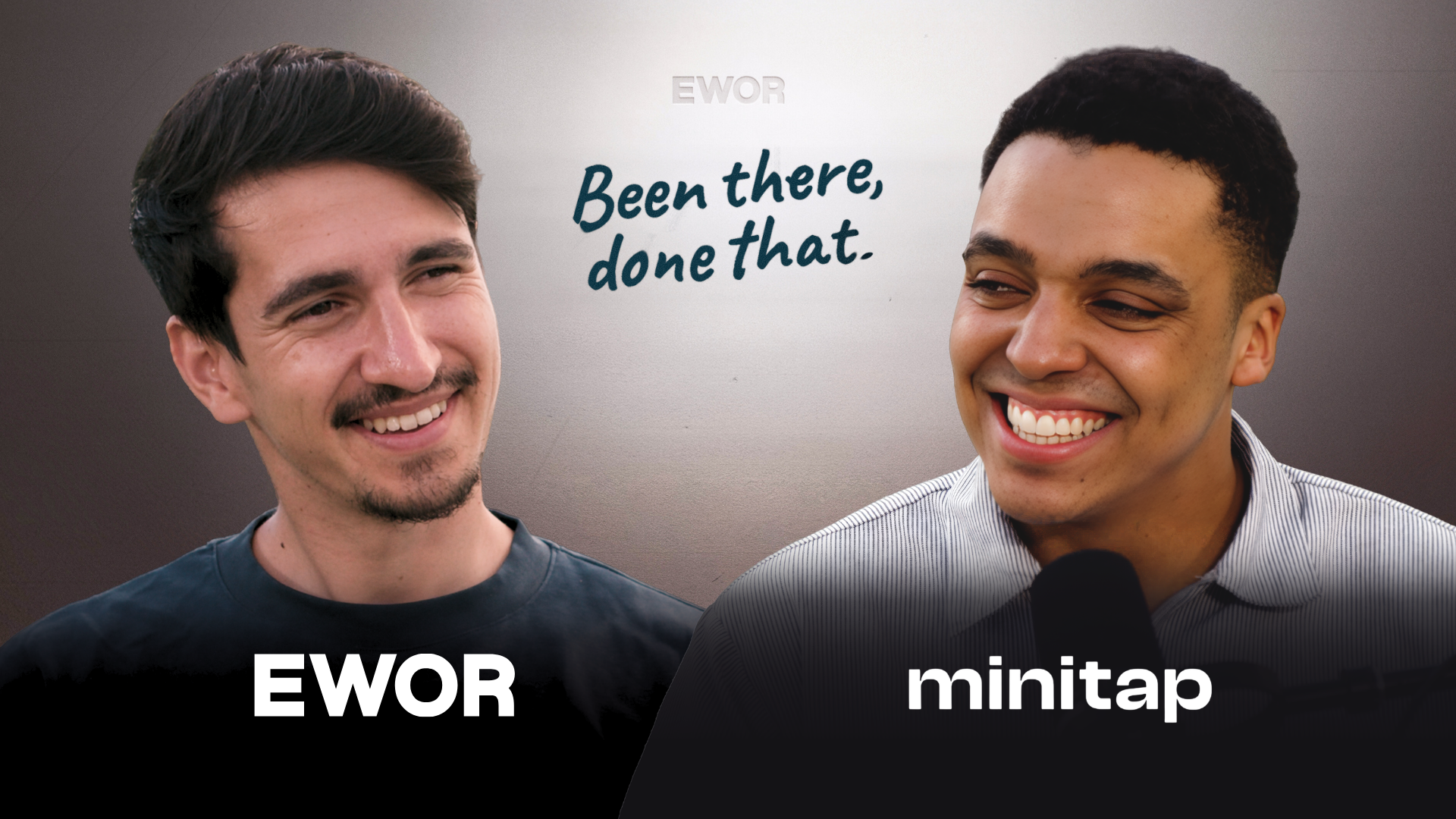
In this episode, Nico Dehandschoewercker, Co-founder and CEO of minitap, tells Daniel Dippold why founders chasing product-market fit shouldn't reinvent the wheel. He learned it the hard way, after trying to find PMF his own way cost him months building products no one wanted. Once he and his co-founder Luke switched to design thinking, they found the solution within days. Today, apps used by millions are tested by Mini, minitap’s AI quality assurance co-worker.
The raise followed the same logic. Nico spoke to over 100 funds for an oversubscribed $4.1M round and logged every rejection in a Notion database, sorted by "bullshit" and "not bullshit". Every rejection that held up went straight into fixing the business.
In this episode, Wiktor Stanislawek, Co-founder and CEO of Reactive AI, tells Daniel Dippold why European VCs called his pitch deck a red flag for naming OpenAI as a competitor, and why the angels he met in San Francisco called it ambition.
Wiktor's team are young founders from Poland who had never worked at an AI lab. YC passed on them twice. EWOR said yes after a one-minute demo: Reactive AI's token count stayed flat as other LLMs kept climbing. When Wiktor approached an OpenAI researcher to join the team, the researcher asked to invest, and the deal closed within 24 hours. The founder of Snowflake and a 5x unicorn founder followed. Now, Wiktor is challenging Silicon Valley's frontier labs from Poland with Reactive AI’s Large Awareness Models.
In this episode, Chris Fox, serial entrepreneur and Co-founder and CEO of Nimbus, talks with Daniel Dippold about treating profitability from day one as a repeatable strategy rather than a milestone.
Chris does not start a company until he knows the one channel that will get him to profitability. For Nimbus, that was referrals, and it carried the business to millions in ARR. He explains why the old playbook of raising big and chasing product-market fit for years is gone, why that window has collapsed from 18 months to 30 days, and why he deliberately raised almost nothing when he could have raised far more.