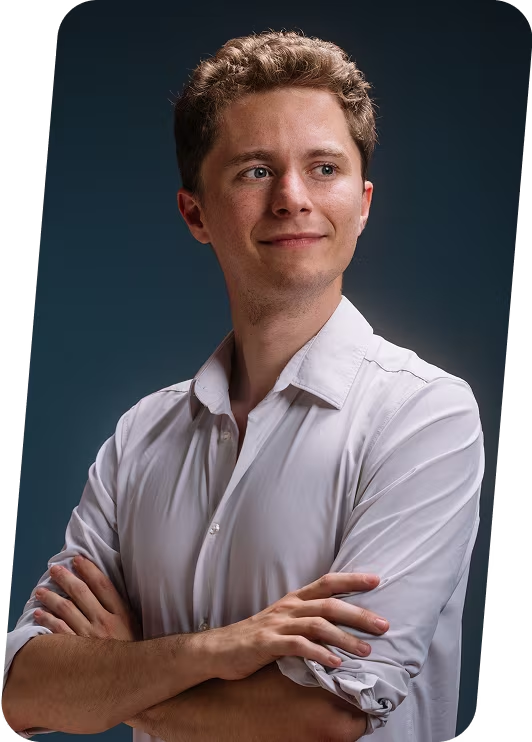
In this episode, Jan Löwer, Co-founder and CEO of deeplify, talks with Daniel Dippold about the unfiltered reality of pre-seed fundraising that never makes it to LinkedIn. Jan is one of the rare founders who successfully transitioned a service business into a product company – and the fundraise that followed was anything but smooth. 2 months after joining EWOR, his CTO became seriously ill and left overnight, forcing Jan back into engineering himself and bringing sales to a complete standstill. Four weeks of back-to-back investor meetings passed before he realised a single framing error had been making the market sound 80 times smaller than it was. Then, in the final week of signing, one investor dropped out having misread the term sheet for months. Jan tells the full story in this episode, every messy step of it.


Daniel Dippold: Welcome to Been There, Done That. A podcast we launched to talk about raw, unfiltered founder stories. We listen to so many podcasts ourselves, and we figured that most of them talk about success stories – after they happened. And facts and figures get distorted, plus strategies that worked 10 years ago don't work today anymore. We at EWOR wanted to launch something that tells raw, unfiltered founder stories today.
And we believe we're in a unique position to do this, because every year we support 35 founders to build $10B+ companies. We do that as founders ourselves. 40% of our full-time team have launched companies valued between 100 million and 10 billion. Therefore, we want to talk founder to founder with people on how they got from zero to a million ARR or from zero to a seed round.
I'm Daniel Dippold, and I'm the host. I'm not a professional host, but I'm a former techie, a mathematician, someone who's built tech ventures for the last 10 years. And I want to talk techie to techie, founder to founder, with people who have what it takes to create a 10 billion dollar company. And I want to uncover the specific things they did in order to achieve that. And I hope that I can help you with those examples to build your own companies.
You’re listening to Been There, Done That, welcome to the show.
So today I'm here with Jan. Jan, you are a physicist by training, right? A technical founder originally. You built a service business and then you transitioned to CEO of a product business, right? And that transition happened within the same company. You literally transformed the service business into a product company. And I believe a lot of founders try to do this, right? They either start with consulting or agency work, and then they try to manage this transition and most people fail. You are one of the ones who made it. So I want to spend some time today uncovering how you made that work. So maybe you want to invite us a little bit into the start of the service business actually, how you made your first revenue and how that turned into what deeplify does today.
Jan Löwer: Yes, thank you Daniel for having me. I think the original story actually evolved as naturally as it can be without the big ambition to build like a great company, but just some passion about data science, solving actual problems, which started as a let's say, ‘let's try it out’ project with a comrade from university, then transitioned into founding the first legal entity, doing first project with customers. And I think the potential of building something bigger really evolved over time. It wasn't that ‘aha moment’ in the early days. So a service company, as trivial as it sounds, was basically just talking to customers, talking to other companies we had in the network, asking if they have any problems that can be solved or addressed with software development or data science.
And then, yeah, actually, they started problem-oriented acquisition. And just just framing, hey, which is maybe a unique trait of us back then, not today, today's rather commodities, hey, we can do AI and software development as a whole. These are two things that are often not covered by traditional agencies or large consultancies.
Daniel: Yeah, back in the day, for sure not, right? Like AI was more of a niche.
Jan: 100%.
Daniel: It was mostly tabular machine learning. LLMs really weren't a thing.
Jan: Nobody understood how it actually works, so that was actually quite a unique trade back then, right?
Daniel: Yeah, funny, right? So today you couldn't do that anymore, but like back then that was like quite a unique combination. So that got you started. How much revenue did you make with that company originally?
Jan: We rather quickly got to six-digit ARR, like within the first year after finishing university. So it started as a side business during university. Then we went full time. We went to six digit ARR, but during that time we already had first ideas about potential product roads we could take.
Daniel: So how did that happen? Like, tell us about how those first ideas came about. Like, how did you notice those were great ideas?
Jan: Yes, so having a project in industrial quality inspection was basically the kicker of everything. And the first project actually just happened by chance. My co-founder back then had a personal relationship with a professor from a local university. They were doing some, let's say, student-run experiments with a client and they wanted to have someone that actually transitions those more research-type of results into an actual product. So he connected us and then the task was to actually build a computer vision application for detecting safety critical cracks on images. So classic computer vision problem, but in a more niche space, it wasn't just to check the camera image, I don't know if there's something complete, but actually something that is a little bit more related to material science. And yeah, we ran that project for, I think, over a year.
And the thing was, the customer that we were doing this project with wasn't just one manufacturer that does this once, but it was actually an inspection device manufacturer. So from their perspective and through their eyes, we really got to know the market of non-destructive testing and quality inspection as a whole. And it was really evident that there's a pattern that quality inspections are insanely manual. So back then we thought, hey, actually, we always will do the same for each new client. We get a dataset, we train an AI model, the software looks roughly the same. So there is definitely a repetitive pattern in there. And we thought, okay, instead of trying to go project after project, let's just try to standardize 90% of our work into a product. That was the original idea. Still really early, still without a lot of customer validation or interviews, just the hypothesis about this potential, which got confirmed by our manufacturing client.
Daniel: Yeah, I love it. This is the third really interesting aspect right at this point. It wasn't just software and AI. It also was non-destructive testing, which almost no one knows about. It's very back in the B2B value chain in a very specific niche, right?
Jan: Yes
Daniel: It’s huge, right?
Jan: Like nobody knows it.
Daniel: How huge is inspection globally or asset integrity?
Jan: Asset integrity. You can go different layers, depending on how you count. Is it like a multi-billion dollar business like asset integrity alone is a 200 billion market? Yes.
Daniel: It’s insane, isn’t it? And almost no one talks about it. And through service, you discovered it, which is, I think, a great means of exploration, but then we're now working together since one and a half years, right? A lot of data. I know that the next challenge was not only to say, hey, we figured out the specific problem. The challenge was also like, what is the big mission? How does this, the moment you raise VC and now you've raised like a seven-figure round, right? So now you've closed this round and you have told the vision, but was the vision always clear?
Jan: Not at all.
Daniel: Not at all, huh? You just figured, so step two from service to product was you figured out one specific thing that could be automated.
Jan: Yes. Right.
Daniel: What was step three?
Jan: There was still a long road and now I want to say that there was also like an official cut or break between doing a service-oriented business and doing what now is deeplify.
We actually founded another legal entity and really said hey today we are starting deeplify and deeplify has a mission of really automating industrial quality inspections. It was the original mission, still really different from today, but so there was a multi-step process. So what I was saying we discovered, okay quality inspection, especially non-destructive testing, is a hugely overlooked problem but we still weren't sure of can that get big enough? Is this a VC case? We didn't even thought about those terms back then we were just two data scientists that thought, hey there's actually a problem that is worth dedicating some time to.
Then we really realized okay there are different directions you can go about non-destructive testing you go into manufacturing or which also most people don't think of if they hear inspections they always think about the conveyor belt image, right? You have serial production and you have to check everything for small details, sometimes just cosmetic but actually what is even more critical and where non-destructive testing plays a huge role is making sure existing assets remain safe such as chemical plants, bridges, all the critical infrastructure yeah the entire energy market essentially consists of infrastructure that needs to be maintained at all times. So you have a high repetition of inspections and so we were already at the first decision route should we go into manufacturing? Should we go into existing assets? Because we quickly understood although you use similar like inspection methods that look similar on the first lens, the application actually looks quite different and there are different routes that you can take yeah and we said this is actually really important decision we should actually spend some time talking to customers understanding those markets in depth before making that decision. I would say the first like almost a year at deeplify was basically just talking to all aspects of markets that apply non-destructive testing, figuring out how easy is it to get into it? How closely tied is it to hardware manufacturers? Like how large is the value chain? Are we just solving like a tiny tiny part of the the problem or is there a larger problem that you can expand into? So these were then all the questions we were starting to ask ourselves and then I think we had one ‘aha moment’ where we actually were convinced, hey this is actually this has the potential to be huge which was when we were this time talking with an inspection service company. So again we didn't look from the perspective of the companies that like buy-in this technique but more from the eyes of a company that provides that as a service because they have a wider view and then we understood we were talking back then about automating some radiography testing so that just to give some context every chemical plant, every refinery, every nuclear power plant, you name it they have to make sure that there are no like areas of undetected corrosion or flaws in their wells or whatever and you cannot look just look at it and and know if it's safe. You actually have to use some techniques that give you inside vision and one of them is radiography testing, for example. And they were asking us hey we have these huge volumes of radiographic films that we have to analyze each year. Can you help us develop an AI to give us more safety and also more efficiency? And then we did a workshop and we were thinking about okay, how can we best train an AI model that helps detecting certain things on an X-ray film? But in that workshop, we actually asked them more more questions. Like how does the whole process look like like? Where does it start? Where do you get like a contract or where do you get the actual inspection task from? Like how is your communication with the actual asset? And then we learned this is actually a multi-step, fully manual process where there are multiple engineers that write large inspection plans in Excel fully manual. This is then edited by experts that have to decide okay what inspection technique to use, what do you have to consider, who does it all manual? This is then communicated all via email or even via phone then you have people going out, actually carrying the data you have people analyzing the data, you have people handwriting reports, manual reviewing it so there's like a 10-step process behind it, where every step is manual, fully error prone – you have revision cycles and we realized, holy shit this is actually not about detecting only something in an X-ray image this is about actually transforming an entire industry and how things have been done for like 20 years without any innovation.
Daniel: Yeah, which is a bold vision.
Jan, Yes, this is coming back to what you said in the beginning the reason is I think because this industry is so hidden that a lot of innovation has been I feel like kept away from this industry because it's too niche people don't deal with it within that industry they don't have AI knowledge or software.
Daniel: It’s niche, right? A $200 billion niche.
Jan: Yes, but it's really insane, yeah. And that was the ‘aha moment’ when we thought, okay, we can actually build a huge co-pilot that actually transforms the entire process, not just build that small computer vision model.
That's one part of the puzzle, let's say. And from that moment, we really had that vision. We, of course, refined it. Every half a year, we reflect on it, are we still in the right direction? This is, I think, something that naturally develops. But yeah, it wasn't until then that we were on the course we are today.
Daniel: Crazy. So you had this I remember having these early discussions with you. It was a little bit more abstract.
Jan: Yes, 100%
Daniel: We were like should we go horizontal? Should we go vertical, right? So at this point you had that ‘aha moment’ as you described it, but how did you like go from there, right? Did you just build the 10-step process? And say, well here it is.
Jan: No.
Daniel: What happened?
Jan: Yes. So obviously, here you have to balance out a strategic approach and one that is just pragmatic. So obviously you are positioned at a certain way, you are recognized in a certain way in the market, you have to gain your trust in some area. People won't just buy a solution that promises them a 10-step process where there was not a single step solved before. So obviously you have to sell your expertise in a certain area, while having the overall vision in the back of your mind. And I think there's actually quite a tricky thing, especially for DeepTech startups, like balancing out a long-term strategy with a really short-term plan because you cannot just try to build something that takes ages before it is actually tested or validated by a customer. You have to start somewhere. And I think this is a hard balance that you have to do between being pragmatic on solving a problem right now for your customer and still being a little bit explorative, talking to customers also about different parts, knowing that you cannot solve it right now, but to make sure you are on the right track. And I think this is a really careful balance between having explorative calls with the customers and trying to sell something right now.
Daniel: Yes. And especially when you bootstrap, right? Because back then,EWOR invested 100k, right? Like this was before our 500k offer. So you guys were very much bootstrapped at this point and needed the cash from the customer, right? To like grow. So you needed to make sure you got enough cash. You needed to make sure that there's something to sell in order to get it, right? And then still you needed to build that vision, right? And I assume you did this all in parallel, right? You push those things consistently. Is there any advice you would give to people who are like in a similar situation, like managing this process of like, you know, having to distribute your focus over so many things?
Jan: Yes, I think as you said, bootstrapping means that you are obviously on a tight budget and that you also have to sometimes take the route where the money is. That means doing the customer project, which maybe isn't perfectly aligned with your strategy, but it will make the company survive for another few months. And I think in the beginning, that was possible because like I said, we transitioned out of this service company phase. So we had quite some companies that we were in touch with and where we had projects, but I think you have to learn to carefully say no to the wrong projects.
Daniel: Because if you're good, people will always knock on your door and be like, hey, can you solve this? Can you solve that? Right. And I see a lot of brilliant founders in there that then say yes to all of those things. Right. And as you say, you need to learn to say no.
Jan: Yes, exactly. And actually, I think there's no uniform advice. We also did some mistakes where in retrospect, we say, yeah, we really went way too much into let's say big shiny logo chasing. We just tried to please one certain client because they have a big famous logo, knowing that what we would build for them is not that much aligned with our strategy. It will involve a lot of sales effort. In the end, they turned us down anyways.
Daniel: Yeah, crazy.
Jan: And then we spent all this time doing something we were not 100% convinced with. And I think learning to say no earlier actually is really crucial. And I think we didn't manage that balance too badly, but you can always improve. Sometimes you have to do a project that is kind of aligned with your vision. But you know, okay, it is more a step of maintaining your runway. But I think, yeah, this really needs careful attention. And I would say you should rather tend to say no more often than you would think. But this also, when I have to say that having funding is a real luxury because that allows you to be more strategic about the projects and customers you choose and not only run after short term money.
Daniel: I want to talk about the raise a little bit, but before that you guys had a I remember this right because we assisted in finding your new CTO, right? You had a co-founder breakup and I would love to go there a little bit because most ventures do, right? I guess it's rarely talked about but I recorded three podcasts today in which people had co-founder breakups. Right? So it's just out of four. So in 75% of today's sample it happened, right? I would say It is incredibly important to make sure you get this right, right? And therefore I want to make some time so that we can talk about your experience And maybe you can also give us your learnings alongside talking us through the breakup.
Jan: Yes, so while I was saying all the other stuff, that was obviously a big hurdle.
Daniel: And happening at the same time, right?
Jan: Yeah, I mean it happened right after we joined EWOR, right? So you were basically inviting us into EWOR, assuming that is the team that is gonna do it and then I think two months later I had to approach you and say, hey we are losing our CTO. We need a new one. This will put us back quite behind our schedule. I have to dedicate quite some resources to it which was definitely far from optimal. It definitely also set us back. So yeah, that put a lot of pressure on the company. In this case, it was something where I think yeah, we could have done a lot of things better. But also sometimes life just happens. So in this case, there wasn't a big conflict or something. My co-founder just got sick, unfortunately to a degree that he couldn't work anymore. So it was really like a severe thing, unfortunately. So at least I was not confronted with conflicts that I had to navigate, so at least it was always possible to have honest conversations. And I know there are a lot of co-founder teams who also have to deal with that, which makes it more difficult, right?
Daniel: Yes, toxic co-founders who push back, who sue you, who like, yeah. Fortunately, that didn't happen to you. Yes. But you guys took the new search super seriously.
Jan: Yes.
Daniel: I remember this, one of our EWOR advisors who also invested in you guys then, right, did a LinkedIn post. And suddenly you were talking to the director, former director of PayPal, right? Like, and all sorts of incredible people. And one thing I loved is there, you didn't go for the brands, right? Like you said no, like because it was too high level, right? And you went through hundreds of profiles, right? And interviewed dozens of them probably, right? And tested them, right? So can you walk us through how you approached the co-founder search? So the first co-founder is gone, right? That's a given, no conflict. How did you, which channels did you use to fill the funnel? How did you read through the funnel, right? How, whom did you invite for an interview? How did you test whether they're good co-founder and how did you arrive at your current one?
Jan: Yes, So it is until this day the most difficult decision I think we ever made at deeplify. So yeah, it was the two co-founders left, Christoph and myself. So he has like the commercial role at deeplify. And we were doing a DeepTech product and then the CTO went off. So obviously knowing this is actually not a nice to have position. This is an absolutely must-have position. And it will probably determine our future for the next few years, maybe decades to come.
Daniel: Had you not been technical, I think it might've killed the company.
Jan: Yes, yes.
Daniel: You could jump in and you can code, right? But like, if that wasn't the case, I think you guys would have been over.
Jan: Yes, 100%. We had a small engineering team and I could coordinate with them, so we had a way to manage through that crisis mode and didn’t tell every customer, hey, sorry, cannot deliver anymore, so we were able to maintain. But it definitely took all my resources that are supposed to be in sales and brought them back to product and engineering. And that was definitely a challenge. And then, like I said, the decision is so crucial that we didn't take it lightly. So, that's why I also dedicated a lot of resources to actually finding that CTO and talking about channels. I think, like, we weren't too sure, to be honest. I think it's also hard as a startup who knows, hey, at some point in the coming year, we'll need funding. So, you also think about everything from a fundraising perspective. I don't want to communicate too openly that we are kind of fucked and need a co-founder, so how public should we make it on LinkedIn? How, let's say, hidden do we make that we actually look for a co-founder? So there are all those strategic thinking. So first of all, we definitely try to leverage our personal network. So luckily, we were already with EWOR, but we asked existing angels, we asked you guys, we asked you to also share from your network. You have a lot of applicants, right, where there are a lot of talented technical people. So that was a huge help to look there. But we also did some, like, LinkedIn posts ourselves. We asked you to share it. We went on to, like, classic co-founder matching platforms, and that actually worked for me in the past. So my first co-founder, Christoph, I met through Y Combinator co-founder matching pool. So there it worked, and I also had the feeling there are quite a lot of highly skilled people, but to be honest, more on the commercial side. So finding a highly skilled technical person there, that wasn't that easy. So for us, not really a successful channel on that part. And then, yeah, it was the post of one of EWOR’s advisors and our angel, who actually, which I went crazy viral. I think he sent me 50 or 60, like...
Daniel: Those were the filtered ones!
Jan: Yes.
Daniel: Sixty were incredibly strong profiles.
Jan: Yes. So the post got crazy recognition. I think he pre-filtered that for me, everything that looked not high caliber. He already filtered them out and it was still like 50 people.
Daniel: Yes. Incredible. He did that. That is what you want from an angel, right? So many people don't talk about like, how can an angel be helpful? One with a strong LinkedIn following, technical person, right? Like that person sold their company to Meta and had a huge following and then made the effort, put in the time, right? To look through those people, send you the list. And then funnily through that list, he then came to us and said, look, here's the list. We found some other co-founders, some other fellows.
Jan: I shared that, at least afterwards with you.
Daniel: Yes. Right, right, that's how it happened, yes. So this was incredible. Thank you again for that. And that's what you want from an angel. So a great example. So eventually you started interviewing those people, right? How did that, how do you interview for a late co-founder?
Jan: Yes, so one thing I can be transparent about is that we didn't try to be political about the late co-founder and only give him like minority shares, label it late co-founder, but actually make it a more well-incentivized employee note, it was an actual co-founder position. So we actually gave him all the shares of the co-founder that left the company, which is also something that maybe not all people will do, but we were serious about knowing, hey right now, this is actually a really generous offer from our side, but long term it will pay out because we also talked with some startups that were not that intentional about maybe those things and at a later stage when you are diluted a little bit more with your investors, suddenly motivation can really go down for people who have a really low incentive of actually working their ass off.
Daniel: And there's two super important points here, I think. The first one is the fact that you gave all of this away again showed that you're generous, right? And it motivated the right people to apply. Like the director of PayPal and, you know, like all of those amazing, like high level engineers at like Meta and Google, and it's like the person we will talk about, the person you eventually chose, right? Who's also a serial founder who built a robotics venture with six figure revenue before as a one man army, right?
And they would have not applied had they not known, you know, like was it a 5% position or something like this, right? So that was the first thing. It filled your funnel in the right way for the right people. And I think secondly, what you described, right? Like you, it's a 10 to maybe even 15 year journey. And if you go for a deca/centicorn, it might be longer than that. And if you want people to stay for that long, that's where the magic happened. Not in the first year, you know, in a 15 year journey. And that's what we optimized for in the end, right? Like the outcome after 15 years, the first year is 1/15th. Right? So having 1/15th less equity, okay. But the entire rest, right? Like it's yet to come. And if you disincentivize people, because of that, I do think that is a problem.
Jan: 100%.
Daniel: Super well done there. What did you do in order to then find this, this person like that you now went with? Like what was the process looking like?
Jan: Yes, I think the one advantage that you have if a co-founder break up happens later in your journey, not in the first few weeks, is that until then you have gathered quite some experience about what works and what doesn't work in your co-founder relationship. You learn about certain traits of people to look out for. So, we really said, okay, there are essentially 3, let's say, big categories and the CTO and co-founder needs to check all of them so that, like, that’s a no brainer, they need to be like excellent technical person. Obviously, they need to do that. But as a CTO, especially a DeepTech company, you will really soon manage a lot of engineers and then your other skill sets are becoming more and more relevant, not only your engineering knowledge. So, you have to be a good leader, good people's manager and you have to be a good engineer. This is already a rare combination that not many people have. And then the third aspect is it just needs to be a good personal vibe between us existing founders and this person.
No matter how good he is, like, if you have the feeling there is no good vibe between the co-founding team that can also kill, I think, a lot of joy. It sounds like it's not that important, no, it is actually important to have joy doing what you're doing because, like you said, you're doing it like 15 years and basically all day and you have to do it with people that you enjoy this journey with and that you can also get along with.
Daniel: But how did you test for that? It's easy to say, right? But, like, how did you test for that?
Jan: Yeah, that's a good question. So I think I really didn't focus that much on interviewing on technical skills because I think from the profiles that applied, it was already clear they are good engineers. So I don't need to do, like, a coding interview or something. It was more testing about, like, general intelligence and I think we used, from you guys again, I don't know how many, like, 50+ questions that only ask for, like, the right mindset, right ideas. So... Yes, you always talk about DNA, right? Like, founder DNA.
So all questions were basically oriented towards that and also talking about all the annoying stuff. What would you actually say if we were in a big conflict? How would you behave if things really look bad and you really have to talk about that unglamorous stuff early on. And that's what we did. We really focused on that. And we really also been transparent, hey, we expect this and this work ethic. We expect you to be at a certain location. We expect, like, really don't sugarcoat things because, for example, even some candidates that look perfectly, whereas, like, when they applied, I gave them a ranking, I said, okay, they are 10 out of 10. But then talking about all those details, you realize, ah, okay, they’re maybe in the wrong phase of their life, not willing to do this and that or to see things differently. It has a different priority from their view and you really have to test for those things.
Daniel: Yeah, I couldn't agree more. It's like that. It's by the way for free on our website, right? Anyone can download this listening to the podcast going on ewor.com founder resources and just looking for the co-founder conversation.
Jan: And there are also some public resources. Like there's a thing called 50 questions to discuss with a potential co-founder. Should be the first thing that pops up if you Google just that. And it also goes through all those, those things.
Daniel: Incredible.
Jan: Yet most people I talked with that were in a similar situation didn't know that.And I say, yeah, just, just look for those resources. The DNA stuff is actually more important.
Daniel: All right, and then eventually you settled for a superstar that had the right founder DNA, right. And that allowed you to go full throttle on the raise again. And then rather quickly after that you did the raise. Can you go a little bit into into that dynamic and how you found that that perfect investor in the end, and what it took and how long it took throughout the entire process?
Jan: Yes. So what I can be transparent about it, that it was really tight and not an easy ride because the CTO, he onboarded in July and the EWOR Grand Pitch was scheduled for September. And up until this point, I fully focused on the CTO topic. Then I basically kicked him into product said, you're on your own. Beginning of August, I have to start preparing for that. So we were really late with the preparations for the fundraise. That has to be said. And I think in hindsight, retrospectively, we would have needed another two months, closing some customer deals that were still open, preparing the right narrative. But we wanted to try it. We wanted to squeeze it in knowing that around Christmas, nothing is happening. And what you learned pretty early on is there are certain times during the year where you can raise and where you cannot raise. So we said, okay, let's do it because otherwise we have to wait until March, which is a little too far out.
Daniel: You can't really raise in November, December, right? That's at least super tough.
Jan: So, first mistake I did, because what I have to say, the EWOR Grand Pitch really gives you great, this is the best intro channel I think you can have in Europe, to be honest, right? After the Grand Pitch, my calendar was booked out three weeks in advance, like fully. So, I was hyped as hell, and I said, okay, it's all about momentum, and the first mistake I did, I think I squeezed too many meetings in those three weeks.
Daniel: Classic, everyone does it.
Jan: Yes, because you feel like you're energized, and you are, so you don't, I don't lack the energy in the meetings, yes, but I lack the time to reflect on those meetings and how they went.
Daniel: And prepare and follow up, and push, and what not.
Jan: Yes, and after the first meeting, it is easy to follow up, but then after second, third, suddenly it takes more of your time, and what completely was basically, I think it didn't happen, and it's stupid, you should reflect on how your calls are going, occasionally, to adjust your narrative, your story, your data room, your resources, and I think first time I did that was like four weeks in, like way too late, so that was.
Daniel: So, what were some of the common rejections you got in the beginning and how did you adjust the narrative?
Jan: Because one really early reason was basically not understanding the potential of the market size. That was just one little framing that we did wrongly, like also one angel that later invested in us gave us that as a feedback, they originally thought the market is really, really small. Because what I said, like we're selling to big chemical companies that sometimes have 80 assets. And then I talked about the annual contract value. And everybody just assumed I'm talking about an annual contract value for that entire client. And then there are just a certain number of those chemical companies. But I was really not emphasizing enough that, no, there's this annual contract for a single asset. So you can multiply that by 80 if we scale across that company.
Daniel: Suddenly it’s 80 times bigger. Yes, yes. It's crazy. Huge difference.
Jan: That was one mistake we didn't really clearly highlight in the beginning.
Daniel: Right? An investor's intention span is so small. So they're like, oh, not big enough, next thing.
Jan: Yes. That it was just not clear enough so it's really not about yeah it's somewhere in your data room yeah but it's not clear enough you really have to make it as easy and clear as possible.
Daniel: It needs to be clear in one minute, right?
Jan: Yes. December was approaching yeah we signed the term sheet on 23rd of December on the evening before Christmas the final term sheet I have.
Daniel: I have signed a lot of term sheets on 23rd it's like it is a thing right and I think so many people don't talk about this, but I know unicorn companies that are now unicorns their seed went exactly like this right? It's thin, it gets stressed, runway gets exactly like this and then BAM everyone wants to invest. So tell me Jan,like what did you do like to get this closed on 23rd what did you say what did you write?
Jan: The easy answer would be, be lucky. No, but honestly.
Daniel: Okay, I could do that.
Jan: There was a pipeline where there were people in for a couple of weeks and we were at a certain stage. It was none of them. It was an intro that got into our channel within that deadline timeframe. It was an intro from one of the other EWOR Fellows. I talked with actually Bjol, who was here just the interview before. And he made the introduction to that other investor and said, hey, yeah, and we basically decided within three meetings. I didn't see it coming. It was just, I think the right vibe, the right introduction.
Daniel: Incredible. And then you know, like you made it happen. And two days before like the very eventual, not the term sheet, right? Like the eventual, another one just jumped off.
Jan: Yeah, we had another smaller institutional investor and we were already like term sheet was signed in December, we were already talking with lawyers, finalizing the actual contract, like all the details with third round of iteration, finally all parties agreed, okay, lawyers from investor side said, yes. We said, yes. I can send out the contract tomorrow to let everybody sign and then like really close the round efficiently.
Then I got a call from this one investor saying, hey, we are out. And that really shook things up for a bit. That is a punch in the face like at this point. So yeah, another crazy thing that happened when we were already kind of almost celebrating was like in the week of signing the final fundraising contract, one of the investors dropped out, it didn't crash the whole round luckily, it was a rather small ticket still like we were already three iterations with the lawyers and we already had all the costs from the lawyers, we signed on all the details, the lawyers from the other investors already agreed on everything. So I was about to send out the final contract for signing it. And then that one investor dropped me a message that they're out, out of nowhere.
Daniel: What reason?
Jan: I mean, they gave me multiple reasons, not 100% sure like in the end they said crucial for them was the deal didn't turn out to be as lucrative as they initially thought. First to a misunderstanding, they were the only one in the entire group of investors who understood the terms in the term sheet differently. So they did a different calculation than everybody else and assumed another valuation basically. They figured that out in the week of signing the contract.
Daniel: That is your job. Not a great time.
Jan: And recalculated. So, that was one of the reasons they gave us and then saying, hey, yeah, we have certain metrics that we have to achieve. It doesn't fit our metrics anymore. So, we are out. And obviously, I was not too amused. I immediately called the other investors, the lead investor and the co-lead investor. Luckily, they were fully on our side. I was obviously afraid that they would now rethink everything too, right? And if they would have cut off, that would have killed the company.
Daniel: I've seen an entire rounds crash because of stuff like this, right? And I think many people don't think about the second order consequences.Of course, I as a shareholder care about stuff like this and this is just not something I would intro again.
Yes. So it is somewhat weird to do this, but it happens and it needs to be shared. Yes. 100%. It can happen at any point in time and you need to manage it. You need to due diligence your investors, right? In order to see if they do this kind of crap, right? And if they do, you know, like they, but how would you know, right? I hope that everyone, like I certainly didn't know during my raises. And so I hope the people who listen to this podcast, at least they know, and they can learn from, you know, like our experiences.
Jan: If there's one learning I take from it is like to do even more like hand-holding, stakeholder management and really talk things through like best of 10 times, right?
Do we all have the same understanding about the terms? Like how like let's assume this and that scenario. How would you really talk about all the freaking details like I cannot go into all the details but let's just assume I thought there would be a common understanding of what pre-money, what post-money, what a cap means. And I figured out that yeah, a lead investor had the same understanding as we did but apparently there are different interpretations of it. We as first-time founders were unaware of it so obviously we weren’t double-checking it. But now I know don't take anything for granted or just assume yeah, that's best practice. Don't always think from best practice perspective but really make sure everybody has the same understanding, keep everyone in the loop, check in with them like every week, hey, everything still going good for you? Do you still have any questions? And I think I could have checked in with them more so I also don't want to take like no responsibility. I probably could have done better with communication in that case. So I think I definitely can take this as a learning, yes. But luckily it didn't kill us and luckily the other investors were even more convinced to support us and stick with us. And we're also fully supportive and that was definitely a blessing, yes.
Daniel: And massive congrats to your round.
Jan: Yes, thank you.
Daniel: Do you maybe have one other exotic learning for us before we wrap up?
Jan: Yeah, maybe once and I think we talked like outside of the podcast. We talked about this a couple of times and as if you are let's say a first-time founder. you just stumble into things/ You're not from the startup ecosystem 10 years in. You think what you like most is a good network. And it is kind of true. But I think there are different points of view on how to build a network and I think what many startups as well as we did do is attend all those glamorous startup conferences. It's startup conferences. It's other events. But I think many startups do the mistake of getting too distracted with what everybody does or what screams the loudest at you. Obviously those events are always announced you get discounts if you are in some startup ecosystem They will invite you to all those events, but I think over all the years I realized, that you really have to be as protective as possible of your time as an early-stage startup. You should obviously spend most of your time on building your product or talking to customers. This is trivial if you're not fundraising because you have to yeah, right but usually you should always focus most of your time on one of those three things.
Daniel: There’s just no ROI, right? Like going to conferences. It is an easy escape because your imagination tells you, oh, I could get all of these results, right? But if you track, like I tracked everything I got out from conferences and the comparison to whether it's sales or investors to deliberately just asking for warm intros.
Jan: Yes.
Daniel: It's just, you know, you can get this done in two hours, you don’t need three full days.
Jan: And many startups track the wrong way or they look at it the wrong way. Of course, if I go to a big startup conference, not to name any, but you get some contacts out of it. Ah, there's this investor or this guy from the ecosystem. You get some intros. So you think, maybe not too bad, but you don't compare it to what you would have done in this entire week otherwise, because usually it takes a week.
Daniel: A week, yes, it has really high opportunity costs.
Jan: You could like, I don't know, approach 30 more customers during that period. You could have done so many other things and you really have to compare those two things and really only go to an event if you have a really clear goal, you know, at this one person or there are those 10 people, they are only at this event. I have no channel of getting a warm intro. So this is the best shot. But if you just go there for, yeah, maybe I meet someone, this is definitely the wrong approach and you should avoid those events.
Daniel: And there's always a warm intro. Worst case, you need to get a person to introduce you to someone who can introduce you to them, right? Or maybe even introduce you to someone who introduces you to someone who can. But there is always a way, and that way, in my opinion, is always faster than conferences. I have not been to a single big conference in my life that had a positive ROI on my time, right? Like the only thing we do at EWOR is where we bring the entire community together. So we go to START Summit and Bits & Pretzels to just, not to get an ROI on the conference, but like to bring the whole portfolio together and the team and spend facetime, right? And build culture. And that is something, but we could also do that somewhere else, right? So it's like, that is, I think, I couldn't agree more. I'm so happy you shared this as a last.
Jan: So the biggest network leverage was definitely EWOR itself. And our way to EWOR was a chain, I really went back, I was a chain of connections that didn't require me attending a single event until then.
Daniel: There we go.
Jan: So in my university, there was a student-led VC. There was this one guy I was talking before we even had a product idea, I later connected with him, hey, I have a list of angel investors, do you know any of them? I don't, but my boss knows, he knows this guy called Daniel Dippold. He made an intro to you. We talked, I got into EWOR, EWOR made all of the most important connections and introductions so far. So none of the startup events I attended over the course really led us to the big successes.
Daniel: What a beautiful ending statement, thank you for the flowers, thank you for this awesome episode, you've all been watching and listening to “Been There, Done That.” Thank you for being here today with us.
If this conversation resonated with you, there are three things you can do to support.
First, you can subscribe and whichever platform you're listening to this, there should be a subscribe button. It would mean the world if you subscribe.
Secondly, you can share this with someone you believe would benefit from the content of this conversation.
And thirdly, you can go to ewor.com/signals and stay up to date on all things EWOR by subscribing to our newsletter. Well thank you very much for listening today and see you at the next episode!
In this episode, Chris Fox, serial entrepreneur and Co-founder and CEO of Nimbus, talks with Daniel Dippold about treating profitability from day one as a repeatable strategy rather than a milestone.
Chris does not start a company until he knows the one channel that will get him to profitability. For Nimbus, that was referrals, and it carried the business to millions in ARR. He explains why the old playbook of raising big and chasing product-market fit for years is gone, why that window has collapsed from 18 months to 30 days, and why he deliberately raised almost nothing when he could have raised far more.
In this episode, Fryderyk Sitnik, Co-founder and CEO of Margin, talks with Daniel Dippold about the radical frugality that kept his company alive long enough to find the idea that worked.
Fryderyk and his co-founders spent a year iterating and living on €300/month each in the Polish suburbs. Living on low burn meant that turning down money got easier, not harder. The team later said no to a €2M preempt offer over a single term, and to an acquisition offer, because neither fit the scale of what he wants Margin to become.
In this episode, Bragadeesh Suresh Babu, Founder and CEO of Tattvam AI, tells Daniel Dippold why he walked away from a role at Google to build his own startup. He decided the cost of not trying was higher than anything he was giving up, even risking his UK residency to do it.
Getting there took a year of thinking, running simulations, and hiring interns on his own money before the company existed. Now, Bragadeesh is building the intelligence layer for chip design to enable a Cambrian explosion of chips. He also shares why startup success is never luck, and why convincing yourself is harder than convincing any investor or customer.
In this episode, Moises Barbera Ramos, founder of CLARO Surgical, talks with Daniel Dippold about the investors who tried to steal his company. The day before signing, with a government grant on the line and nothing left in his bank account, they sent back a revised term sheet designed to take control from him. He chose to walk away.
What saved the company was a 15-minute conversation at a conference in Spain. From there, Moises shares how he mastered the art of storytelling in his investor updates, why he urges founders to think twice before dropping out of university, and why this Forbes 30 Under 30 honouree believes awards matter far less than the one thing that compounds: your progress.
In this episode, Emil Kostadinov, Co-founder and CEO of ManaMind, tells Daniel Dippold about the hardest weekend of his founder journey. On Friday, he closed the first big check of his round. On Sunday, he found out about his divorce. It completely decommissioned him, right when his fundraise depended on momentum.
What restarted his momentum was community. One EWOR Fellow flew from Zurich to London after Emil told him not to come. Another stayed up with him on the nights he could not sleep. And a single post in the EWOR Community Slack took him from a standstill to 15 hours of investor calls a day.
Emil also shares the three things every founder should get coached on and how eight months of co-founder interviews built the partnership ManaMind runs on today.
In this episode, Lukas Koestler, Co-founder and CEO of SE3 Labs, tells Daniel Dippold why he joined EWOR after Paul Graham called it "intellectually dishonest", and why it turned out to be one of his best decisions yet.
He also discloses something he has never shared publicly: the last time he screamed at the top of his lungs. For Lukas, that is not losing control but a system, because bad shit happens all the time as a founder and your body needs an outlet before you can solve the problem. That system got tested mid-fundraise, when a Big Four consultancy called to admit they had failed to submit the tender his round depended on.
Additionally, Lukas shares why he turned down Tesla's autopilot team to found a startup in Germany, and how he achieved an oversubscribed pre-seed with Lakestar and Seedcamp in June 2026.
In this episode, Elias Malm, Co-founder and CEO of Epiminds, talks with Daniel Dippold about the craziest Friday of his life: a customer called to say he'd just been fired. That phone call was the moment Elias knew he’d found PMF.
Getting to that moment started with closing the first 15 customers using an animated Figma file and crafting an offer so good it felt stupid to say no to. Following a $6.6M raise with Lightspeed in just 10 weeks, the hard work began: months of shipping 30+ features only to kill a third of them, learning the hard way never to outsource hiring, and quietly rebuilding almost everything while customers kept using the product.
In this episode, Allegro Sprute, co-founder and CEO of Brio, talks with Petter Made about what it actually takes to lead an AI company as a non-technical CEO, including the moments when the co-founder wants to go in a different direction and every mentor in the room is suggesting something different.
Allegro started selling before the product existed, which led to early customers and enormous pressure to deliver. When the founding team's vision split in two, what followed was one of the rarest outcomes in startups: a co-founder breakup handled so professionally it didn't cost the company a single investor. He also opens up about hiring an engineer when what the company truly needed was a founding engineer, and why the difference matters more than most founders realise. When two people he deeply respected gave him completely opposite advice in the same week, Allegro had to find a third option: his own.
In this episode, Wael Abdelmalek, CEO and Co-Founder of Uthereal, gets brutally honest about what it takes to build a technical moat in the AI era – when anyone can ship a competing product over a weekend. Together with Paul Müller, Wael discusses why vibe coding without understanding the architecture can kill a product at scale, selling before the UX existed, spending $12,000 on sales emails with zero replies, and an enterprise demo that collapsed when a manager handed it to the wrong users without context. Plus the mindset shift that keeps Wael building through guaranteed failures and painful execution – this is not a journey for someone optimizing for happiness.
In this episode, Ravi Teja Chadalavada, Co-founder and CEO of Sapios, talks with Petter Made about his signed $5M US government contract most VCs told him would never happen.
Ravi is a PhD robotics researcher who built the world's first fully automated driving test system – autonomous car technology squeezed into a phone with no examiner required. Getting there meant cold-calling 100+ driving schools to get one yes, then throwing out the entire sales strategy afterward.
It also meant turning down a 3 million Krona grant while unemployed, because accepting it risked losing his most important future customers. When visiting his sister in the US, he drove several hours to the DMV headquarters in Richmond, Virginia for a meeting that got rescheduled 10 minutes before he arrived. Ravi walked in anyway and waited 6 hours in the car park until they could fit him in before his flight back to Stockholm the next day.
That 30-minute meeting turned into a $300,000 pilot, 2+ year partnership, a $5M contract, and 27 states in the pipeline. In this episode, Ravi breaks down every step of how he proved the B2G skeptics wrong.
In this episode, Bjol Frenkenberger, co-founder and CEO of Sybilion, talks with Daniel Dippold about the structural decision at the heart of his $4.2M seed raise: whether to wait for EU Inc or flip to a Delaware C Corp.
Bjol entered university at 12 and finished with an Oxford PhD on uncertainty and decision-making. He’s now building Sybilion – forecasting infrastructure that turns over a trillion data points into the signals decision-makers need.
When the seed round came, it forced a decision every European founder building for global markets will eventually face. Bjol makes the case for why EU Inc, however promising, was not ready – and why Delaware's consistency and reputation ultimately won out despite the political climate and the four months of confrontational shareholder negotiations it took to get there. He also opens up about the investor traps most founders only discover too late, and what it actually cost him to close a round while still being the only person selling: an emotional limit he did not see coming.
In this episode, Jan Löwer, Co-founder and CEO of deeplify, talks with Daniel Dippold about the unfiltered reality of pre-seed fundraising that never makes it to LinkedIn. Jan is one of the rare founders who successfully transitioned a service business into a product company – and the fundraise that followed was anything but smooth. 2 months after joining EWOR, his CTO became seriously ill and left overnight, forcing Jan back into engineering himself and bringing sales to a complete standstill. Four weeks of back-to-back investor meetings passed before he realised a single framing error had been making the market sound 80 times smaller than it was. Then, in the final week of signing, one investor dropped out having misread the term sheet for months. Jan tells the full story in this episode, every messy step of it.
In this episode, Julian Rothenbuchner, Co-founder and CEO of Tumbleweed, talks with Daniel Dippold about the real cost of rejection before you break through. Julian is a rocket scientist building the infrastructure that could make manufacturing in space as accessible as mailing a package, with a SpaceX partnership to show for it. He opens up about the mental breakdown that followed SpaceX's initial rejection, six co-founder splits including a romantic relationship that didn't survive the pressure, and getting rejected by EWOR twice before finally getting accepted. Getting to yes cost more than anyone saw, and in this episode, Julian doesn't spare the details.
In this episode, Alfons Huber, Co-founder and CEO of REPS, talks with Daniel Dippold about what it actually took to protect his invention when the people he trusted most tried to steal it. Alfons invented energy harvesting technology 200x more efficient than anything on the market, with 90,000 trucks already driving over it at the Port of Hamburg. Getting there meant walking away from his degree after four university professors threatened to destroy his career if he didn't hand over his work. He left to start over in a 20 square meter lab with almost nothing on his bank account, ripped the motor out of his own washing machine to save €5,000 in research costs, and went two weeks without washing his clothes as a result. The people who tried to stop him were his role models. Succeeding required him telling them to fuck off in order to bring his invention to life.

In this episode, Josiah Senu, Co-founder and CEO of Zuba, shares the difficult decisions he had to make to go from being a Harvard law prodigy to building the payment infrastructure Africa’s never had. Together with Petter Made, Josiah discusses receiving hate mail after turning down a magic circle barristers' chambers in the UK, a failed business partnership that cost serious time and capital, the psychological whiplash of switching from crisis mode to investor pitch in five minutes, and why optimizing for hiring ‘nice’ people nearly cost him everything. Plus the fundraising insight that changed how Josiah sees the game entirely – there are no rules.