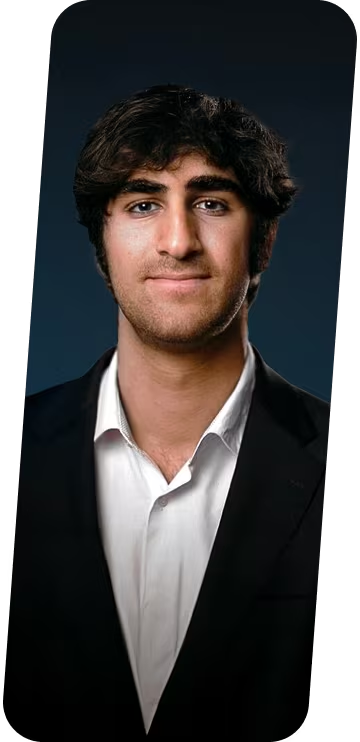
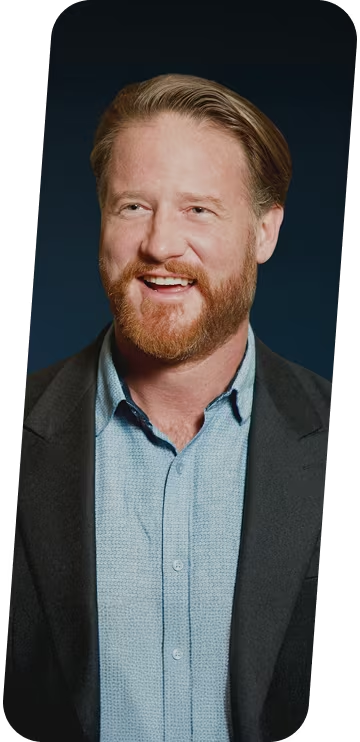
In this episode, Ravi Teja Chadalavada, Co-founder and CEO of Sapios, talks with Petter Made about his signed $5M US government contract most VCs told him would never happen.
Ravi is a PhD robotics researcher who built the world's first fully automated driving test system – autonomous car technology squeezed into a phone with no examiner required. Getting there meant cold-calling 100+ driving schools to get one yes, then throwing out the entire sales strategy afterward.
It also meant turning down a 3 million Krona grant while unemployed, because accepting it risked losing his most important future customers. When visiting his sister in the US, he drove several hours to the DMV headquarters in Richmond, Virginia for a meeting that got rescheduled 10 minutes before he arrived. Ravi walked in anyway and waited 6 hours in the car park until they could fit him in before his flight back to Stockholm the next day.
That 30-minute meeting turned into a $300,000 pilot, 2+ year partnership, a $5M contract, and 27 states in the pipeline. In this episode, Ravi breaks down every step of how he proved the B2G skeptics wrong.


Daniel Dippold: Welcome to Been There, Done That. A podcast we launched to talk about raw, unfiltered founder stories. We listen to so many podcasts ourselves, and we figured that most of them talk about success stories – after they happened. And facts and figures get distorted, plus strategies that worked 10 years ago don't work today anymore. We at EWOR wanted to launch something that tells raw, unfiltered founder stories today.
And we believe we're in a unique position to do this, because every year we support 35 founders to build $10B+ companies. We do that as founders ourselves. 40% of our full-time team have launched companies valued between 100 million and 10 billion. Therefore, we want to talk founder to founder with people on how they got from zero to a million ARR or from zero to a seed round.
I'm Daniel Dippold, and I'm the host. I'm not a professional host, but I'm a former techie, a mathematician, someone who's built tech ventures for the last 10 years. And I want to talk techie to techie, founder to founder, with people who have what it takes to create a 10 billion dollar company. And I want to uncover the specific things they did in order to achieve that. And I hope that I can help you with those examples to build your own companies.
You’re listening to Been There, Done That, welcome to the show.
Petter Made: Hi, welcome to another episode of Been There, Done That, EWOR’s new podcast series. My name is Petter Made. I've been building in FinTech for the last 25 years. My biggest success was SumUp, which is a $10B company. Now I am working full-time at EWOR and I'm giving founders an unfair advantage when they're building their companies. So thank you so much for joining me here today, Ravi. I hear this is your first podcast episode, amazing. Why don't you tell us a little bit about yourself and what it is that you're building?
Ravi: Thank you, Petter. This is actually my first podcast. I'm very excited to be here. My name is Ravi. I'm the CEO and Co-founder of QTPie (now Sapios). At Sapios, we are building the world's first fully automated road test system so that the transportation authorities around the world can do a driving test without examiners.
Petter: Which is incredible because that way you can get an unbiased evaluation every single time. I have three sons and two of them, they had some complaints about the road test evaluator when they failed the first time they drove. And you have experience of this yourself. Maybe you can tell us what was kind of the original idea around building Sapios and your own road test examination experience.
Ravi: Absolutely, so one day before my Swedish driving license test examination, the driving school teacher told me that it is impossible for me to pass the test because I was not turning my eyes and head enough and I was not really convinced with this explanation. So I went and did the test anyway, and I passed with the perfect score. That's when I asked myself the question, are the driving tests really objective? At the time I was doing my PhD in robotics focusing on an area called human-robot interaction using eye tracking as a tool to understand people's intentions and predict these intentions. And I asked myself the question, what if I use that in driving evaluations? And that's how Sapios was born.
Petter: How do you predict humans who are fundamentally unpredictable?
Ravi: Very interesting question. That's the answer you will have to find out from a PhD thesis. But to put it short, we have targeted environments like logistics, industry logistics, where you have a lot of forklift robots, which are very smart, but they are usually restricted to a predefined path. But the robotics is getting more and more intelligent, so they can actually take more optimal paths. But they are often not allowed to do so because it can create chaos in the human cohabited environments. And that is where my research comes into play. So we investigated how do we make these robots more safely perceived by the people, so that the whole environment would become more optimal for those operations?
Petter: So, what you've been studying then is how humans and robots can coexist in the same spaces with some sort of measure of safety. But now there's no robot in the company that you built, or rather, the computer vision is surveying the surroundings of the car during the driver's test, and it's also looking at the human and how they're acting and reacting. So, where's the robot in this equation?
Ravi: The robot is the new examiner. So we basically squeezed an autonomous car-like technology into a phone, which is acting as a robotic examiner to evaluate your driving skills.
Petter: This is very cool.
Ravi: Thank you.
Petter: Probably the first time I saw the demo, it was really interesting. So last summer I was in San Francisco and I took a Waymo ride for the first time ever, which was a very scary experience for me because I like cars and I really enjoy driving. Not so much being the passenger when someone else is driving because the feeling of not being in control is kind of unsettling at times, but here, yeah, you step into the car and you realize that you're sitting there and the wheel is turning and no one is there. It's like the ghost driver. And that was, that was pretty scary, but I felt like after a couple of minutes, somehow you start trusting it. I think the thing that did it, was the monitor that you had in the middle. So you have this kind of an iPad, a touchscreen, and there you're seeing what you think the car is seeing in some respect. I guess this is an output of the camera in the front. So is this the computer vision? I think as a person in the car, the cars are blue, the bikes are yellow and the pedestrians are yellow and the bikes are green. And so you're kind of sitting there seeing what you think the car is seeing. And as it's navigating and reacting, somehow you're imbued with some sense of security. And I looked at the demo. It was very reminiscent of what I was seeing on the screen in the Waymo. And so it felt, it felt like, okay, here, here is a driver that's being evaluated by, by this AI and the connection there between autonomous driving and what you're doing felt very felt like there was a very strong connection there. Could you speak to that?
Ravi: Absolutely, I think visualizing this sensory information improves the perceived safety for a passenger in the car. That really goes back to my PhD research as well. So we built augmented reality-based communication systems for these box-like robots. So there's no anthropomorphic features that we can communicate in the way that we intuitively understand. So what can we possibly do with it? So we address these perceived safety elements in other ways of how this robot can optimally communicate such intentions. And we bring the same thing also into Sapios, but not for the driver in this case, but it is more for the examiner side. So the driver goes for a driving test without the examiner. And when the examiner wants to evaluate, in case there is any edge case upcoming there. And then we can flag this particular test. And then the examiner can manually evaluate to make sure that everything is done correctly.
Petter: Okay, so sort of a human in the loop.
Ravi: Exactly. So we have done a lot of this testing during the pilot project, which we had in the US for a couple of years. And this is exactly what we have done to establish this trust to the examiners and the governmental authorities.
Petter: So when you have this robotic examiner squeezed into the iPhone, I mean, which is a very small piece of hardware, and it coincidentally has cameras going both ways, it was not always so that this was kind of the hardware solution that you were looking to use to implement your solution. Can you tell us a little bit about sort of, what was the R&D story behind it? There's nothing like an overnight success five years in the making. So what did it look like?
Ravi: Yeah, we have come a long way and we have had many, many interesting conversations with the customer. And one of the things that I'm very grateful for the opportunity that we had with the Virginia DMV in the US is that they had given us uninterrupted access to talk with the customers and the end users. And that I think is extremely valuable. And that is how we figured out what is exactly needed to be able to execute this. So when we first started this pilot project, we had, you probably won't believe it, we had 3 dedicated hardware setups just for this. So we had a 360 degree camera mounted on top of the car. That's looking 360 degrees, pretty much close to what you would see on a Waymo. And we also had an OBD port connector that connects to the vehicle to get to access all the sensory data from the vehicle itself. And an eye tracker that's looking at your eyes 200 times every second. So we basically started it out that way. And we had a researcher bias in the team. We had a team of five researchers in the team, including three professors. So we were convinced that this is how it should be done, which we then later realized was stupid. And what we realized, so during this pilot project, what we have very carefully done is that we have, as we always kept ourselves open to the feedback that we were getting from the customer side. And also in terms of usability, to be able to handle these 3 pieces of hardware is a nightmare for somebody that's going to a DMV to get a driving test. It's not reasonable. But we have done it in conjunction with the pilot project as we started to build the system. And then we have gotten rid of the hardware piece by piece. And then the customer was happy we removed it. So they were not pissed off. Why are we getting an inferior quality? That's not at all the case. They were fully convinced that they could get a reliable result without having to use all this excess hardware.
Petter: So simplification and the customer is happier at the end of the day as well. So tell me a little bit more then, what is the story behind the DMV? How did you come into contact with them and how did they become your first kind of design partner?
Ravi: You know, from all the things you hear about, DMVs in the US, it's from the movies, right?
Petter: It's the flash of the DMV, it’s a flash of the South American sloth that moves super slow. Everything moves slow, exactly.
Ravi: Exactly,This was my impression. Absolutely. I am guilty of that. What happened was that so I was in the US for a summer break to visit my sister. I wanted to stay there, spend time with the family and relax and then come back to Sweden, continue the building. And after a couple of weeks, I was like, oh, this is too boring to just sit and do nothing. I can't do that. Let's go out and talk to customers. And I thought DMV, because at the time we were running a pilot project with the traffic work in Sweden, which is the DMV, Department of Motor Vehicles equivalent in the US. And we already have a pilot project running with them. And my initial thought was that should we try to run a parallel to that with the DMV in the US? And then we realized that maybe the DMV is not the place to go. Let's go talk with the driving schools. The US has so many drivers, more than 200 million drivers in the US. And they are going to the driving schools to get their driving licenses. So I started reaching out to driving schools. I contacted more than 100 driving schools in Virginia around my sister's residence. And very few of them responded. And then I started to make phone calls, started to drop in and started to show the demos, took them out on the road and have shown these live demos to them. And we had one yes. So one driving school said, this is super interesting, Ravi, we would like to have it. But we are a certain type of driving school. And if we need to buy this technology from you, it should be approved by the state. So you need to be on the list of the vendors that we can buy from. Because they are the kind of a driving school that can actually issue a driving license. So they are under a special scrutiny. So they can't just go off and buy whatever they want. So they said like, yeah, if you can get yourself on this list, we can buy it from you. And then I started to look into, okay, how do we get onto this damn list? It's so much work. And at some point, I realized, okay, this is not going anywhere. I started to make phone calls. And that was still quite complicated. And then one fine night at three in the morning, I started sending an email to some people in the DMV. Among them is the commissioner of the DMV, the top guy in the organization. And the next day morning at eight o'clock, I get a response from him saying that that sounds interesting, Ravi, why don't we have a meeting and talk about it.
And there was also something happening in this process. So that was the day that they invited me for a meeting, was one day before my flight back to Sweden. And that's about three hours away from where my sister lives. So I rented a car. I started to drive there. And as I was maybe 10, 15 minutes away from the DMV's office, DMV's headquarters in Richmond, I got an email saying that they needed to reschedule this meeting. I was, I was not happy with that.
Petter: Are you kidding me?
Ravi: I didn't stop. I kept going. I parked the car, went inside. I signed up and said, like, I have a meeting. I got in touch with the executive assistant of the commissioner. And I also sent an email, like, right away that, like, I'm coming from a very long distance. I drove for three hours just for this purpose. I rented a car just for this purpose. And I'm going back to Sweden the very next day. Is there any chance you can give the meeting time today and I can wait for the rest of the day? So if there's any slot available at all during the day, I would be very happy to do it. So I, and then I got a response from them in a few minutes. They said, like, yeah, they can squeeze me in for 30 minutes, but I had to wait for six hours. And then I said, no problem. I will wait. So I went back, sat in my car, and I parked my car just in front of the area where the cars that come for a driving test park. So in the US, you have to bring your own car for your driving test. And there's a dedicated parking spot for this. So I sat there while waiting. I was working on my computer and I was paying attention to the cars that are coming in. And I was calculating how much time it takes for them to arrive. And in how many minutes do they get the actual test done? How much time does a test take? And how long time until they leave from the DMV’s parking lot? And that's a very long time, which came in very handy for my meetings.
Petter: Yeah. And you had six hours to burn. So that was a very good day.
Ravi: So I used the time there very wisely, but I was still not hopeful that the DMV would be the one to take it on. So I went into the meeting. My agenda was only to get into this vendor list.
Petter: Did you have more data than they did after the sitting there for six hours in the parking lot?
Ravi: No, I'm sure they have a lot more. But it was funny observation like I had nothing to do. I was just sitting there. Went to Starbucks, got a coffee and continued as if I'm a spy or something like that. It's funny.
Petter: You’re on a stake-out. So how long did it take for a person to show up at the DMV, and have their drivers test?
Ravi: I've seen the waiting times ranging between two to four hours.
Petter: What?!
Ravi: It's a really long waiting time there. That's crazy. Yeah, and this is the pain point that we came to realize that the DMVs have, because at that point I was very ignorant to this. I didn't know that this was all a completely new learning experience for me. And then finally the meeting happened. I went to the meeting.
To this day, this is something that I always tell myself, like before the meeting starts, like don't open the slides, start with the demo. I did that. I have done other meetings where I started with the presentation and then went to the demo. But on that occasion, I started with the demo and that changed everything.
So I showed the demo for a couple of minutes and the commissioner said that, Ravi, this is very exciting. I need to go check if there is somebody else available to join us.
Petter: Oh, so he pulled someone else into the room.
Ravi: Exactly, he goes out, gets the deputy commissioner, the number two in the organization. She saw the demo and then he asked her the question, Linda, if we have access to all this data, why don't we fully automate a road test? Why do we even have to send the examiners into the car? And that was like, that was so shocking for me to hear because they were pitching me back what our vision was. It's beautiful.
Petter: But in Sweden with all the additional regulatory overhead might not be willing to take such a risk, right? Here instead, you have the Americans are kind of from the point of view of accident insurance of the examiner in the car, which they can't control. There's a lot of different sensibilities and the context in the US compared to Europe there.
Ravi: That was an eye-opening experience for me because I was told during this meeting that they had an accident just a week prior to my meeting. An examiner got seriously injured during a driving test.
Petter: That's terrible.
Ravi: And they were going to be paralyzed for the rest of their life.
Petter: Oh my goodness.
Ravi: And a few years back, somebody even died during a driving test. So this was a pain point that I was absolutely not aware of. But I got to understand it during that meeting. And I had to take a pivot in the middle of the meeting. So my next slide after the demo slide was about how do we get onto this vendor list? I didn't want to show that. So I shut down my computer and we started to discuss a pilot project instead. And four months after that meeting, we had a pilot project worth over $300,000.
Petter: Amazing, but that was with the sort of the clunky hardware?
Ravi: Yeah and that pilot went on for two years and that is when we have proved that this works without having to use all this clunky hardware. But we collected extremely important data using all this clunky hardware and because of that only we are able to do what we can do today.
Petter: I understand. So it was, it was kind of an enabling technology step with the greater fidelity allowing you to train the model, squeeze it into the phone.
Ravi: Yep.
Petter: Amazing. So Ravi, in VC, B2G, business to government, is seen as the toughest category of go to market with regulatory overhead, very long lead times and sales cycles and so on. When you know, I've come into a partner meeting at EWOR and I'm excited, you know, we got this really cool founder, you guys got to take a look at him. And then every time it's actually, I don't know how many times this has happened. I think you're the first one that I really got excited about that was B2G. And then the other partners were like, “Oh, come on, B2G, really?” But here you are with the DMV of Virginia, turning out to be some sort of like a pioneer in terms of technology. Can you speakto their mindset and how they looked upon this opportunity, also within kind of their peer group of all the DMVs in the US.
Ravi: For me, from the founder side, I am focused on the mission. I do not think whether it's B2B or B2G or B2C. For me, like this is the goal. What do we need to get it done? So we have spent a lot of time with the driving schools, for example. And driving schools are extremely hard to sell to. This is what I realized after speaking with hundreds of them.
And then we had to switch our go-to-market strategy. We thought that, OK, it's very hard to sell to the driving schools first. But if we can sell it to the governments first, we become the state-approved driving evaluation standard. Then the driving schools would want this. So that is how we inverted this. And that is why we were focused on the B2G segment then.
I was not explicitly thinking of it in terms of B2B or B2G. But it was just our go-to-market strategy at the time. And in this meeting, I was super impressed by how Virginia was thinking about it at the time. The commissioner's name is Gerald Lackey. He asked me this question. So Ravi, have you spoken to any other DMVs about this in the US? I said, yeah, a while ago, we spoke with the California DMV. We had a couple of meetings, and we are waiting. And this was a very unexpected response for me at the time: he was super competitive. And he said, “Oh, we want to be the first ones to launch it. If you can promise me, Ravi, you will not talk to any other DMVs. We will do everything in our power to get this done as quickly as possible.” And they stood by the word. We stood by the word. And that's how we established a fantastic collaboration with Virginia.
Petter: That's amazing. And you've had lots of conversations with them, getting to know them. I mean, there's a lot of relationship building in B2G sales and sales in general. But I imagine here that this commissioner and him being so futuristic in his approach and his thinking, what did you learn more from speaking and interacting with him that kind of convinced you that this is the right go-to market, and I need to put in the effort and the time here. This is the way that we're going to capture this market? What were sort of the proof points or some of the things that you discovered while getting to know him?
Ravi: I would say the first thing would be to understand the problem and the pain points that the DMV has. Now, I grew up in India. We have a particular type of driving evaluation system. And then I moved to Sweden, spent a lot of time there. And I've gone through the driving evaluation system there. And then I'm looking at it in the US. So I have seen three different, very different driving evaluation standards. And we felt that in the US, they have a very specific set of problems in comparison to Sweden. So we cannot apply the same solution approach in the US. So it was very good to listen to the customer. And I eventually became the Sapios guy in the DMV testing offices, because they were really looking forward to using this technology so that they don't need to go out and do the driving tests. Because that's a part of the examiner's job that they don't really enjoy. Because in the US, for a driving test, you have to bring your own car and the examiner sits in your car to do the driving test. So the examiner doesn't really have any control over what happens in this car. And the first thing I told an examiner at the beginning of the pilot project is that, I don't know if anybody ever told this to you, but your job is extremely adventurous. And they're like, yeah, I know, I have many stories.
Petter: They're sitting there in abject terror, while they're being driven around.
Ravi: We can think about it in so many objective terms of like, for example, how much time do we save? How much money do we save?How do we solve their turnover issue? But like the biggest pain point for them is life.
Petter: Being terrified.
Ravi: We cannot put a number on that, this is extremely important.
Petter: Yeah, it's emotional. It's literally life or death.
Ravi: Exactly, I mean like things like this like we really understood the pain points from the user side and something very funny happened recently. So this was two years back when we started this pilot project and we are at the end of the pilot now we are moving towards a deployment and during the last few months I have been talking to other states and at the moment I don't need to talk about the advantages of our system when I go to a meeting with a commissioner of another state. So I show them the demo now I know what to show to them from all the research results that we have and they are pitching back the vision to us and they are pitching the advantages to each other during these first meetings. That was so beautiful to see. I think it was you, Petter, I think at some point when we were talking and you said like that is the definition of product market fit. That was finally when I felt like I understood what is product market fit.
Petter: It just clicked and you saw it in the room. So tell me about this DMV convention that you went to then? So apparently there's an event where all the DMVs go and meet up and talk about who knows what.
Ravi: So they have an annual conference, so we attended that conference the first year when we were doing the pilot project but we were still under an NDA so we couldn't really tell what is happening in Virginia. So the first year was just a research for me I just went and understood the community I went and saw the tech booths what are they selling is there anything remotely similar to what we are doing. And it was all good news there's nothing in the market that is doing it except for one which is being done by the State of Georgia, they have built an in-house solution to address the concerns during the COVID time that examiners shouldn't be in the same car. So they basically built a very nice system but that still requires an examiner supervising the test remotely.
Petter: Ah okay.
Ravi: So the time of the examiner is still spent on the test. They basically put two cameras in the car. One looking at the driver, one looking outside, and there is a phone through which they're talking to each other. I call it, it's like a Zoom call for driving tests. Very functional for that specific purpose.
Petter: Yeah, could probably be implemented quite quickly as well.
Ravi: Yeah, I mean, but this is very good competition for us to have. This proves the point for the need of such a technology, and we can offer something way more superior than that.
Petter: Yeah. Incredible.
Ravi: And yeah, so we were at this conference and this is how we learned it, learned about this technology, for example. And the first year was purely research. I booked a couple of meetings just to understand like how quickly can we scale it? Like how do other states respond? That was all my research. But the second year that I went, that was happening in Georgia. So I went and this time we could talk more freely. So I took my entire team with me and my team is primarily researchers. So they are very big shot professors. So when they go to a conference, it's usually the other students and the other researchers running behind them. But this time the roles have reversed and now they are supposed to go and catch other state DMVs. So it was a bit awkward for them, I suppose. But then they eventually mastered that skill. So we went and started talking to different DMVs and there was fantastic interest. And we had to hustle our way to capture this interest during the event.
So what happened was a few of the states were asking, can we see a demo of this technology in some way? And then those requests started to increase. So we wanted to harvest that interest. We did not want to miss out on that.
Petter: So you went and bought a booth?
Ravi: We don't have that kind of money. It's very expensive. So, and we are a bootstrapped company. We don't have that kind of money and we decided to improvise. So what we did was I think we were all meeting in the bar discussing like, okay, how can we possibly address this? And I was going to take a walk. And when I was walking out of the hotel, I saw that there's a nice conference room with a QR code. I scanned the QR code and it said that you can book this room on a per hour basis. And I was like problem solved! So I went ahead and booked the room. It's like a hundred dollars an hour. That's the best hundred dollars I ever spent!
And so we booked the room for the next day. And then we went back and told everybody that was very interested in the technology to come and join us for a demo in this conference room. And then the next day they joined and the room was packed. The room had a capacity of 18 and we were like close to 30 people in the room with close to 20 state representatives. And the keynote speaker to this made-up event is Virginia's commissioner. So he was there to give a talk, give a brief talk from the customer side of things. And that was super valuable. And we managed to convert that very, very nicely.
Petter: Amazing. You need to hire that guy as a salesman! Okay, so we've talked about a lot of go-to-market stuff here now. Obviously, there must have been quite a lot of challenging moments when you were developing the technology itself. I mean, this is five years of research, right? What were some of the stories when things didn't go as you would have liked? What were some challenges that you met and that you had to overcome?
Ravi: There have been many, many moments, like, for example, one of the things at the very beginning of the project was that I ran out of the funding from my PhD.
So I was not getting any salary and the company is bootstrapped. So we didn't have any funding. And we have been betting on getting a research grant from the traffic work at, which is the Department of Motor Vehicles of Sweden. And we got it. We got the funding for 3 million Krona and we were getting ready to sign it. And then I got a call from the procurement department of the traffic work at, which said that just so you know, Ravi, if you take this money, it might become impossible for you to sell to traffic work at because of the procurement regulations that they have. And that was a very significant issue for us because if you cannot sell it to traffic work at, which would be our biggest customer in Sweden at some point in the future.
Petter: But why would they have an investment program into companies that would then disqualify them from selling back to them?
Ravi: Logically speaking, I feel I didn't understand the logic behind it. But I think their focus is more on the research, so they cannot contribute towards development of a product
Petter: Okay.
Ravi: So they had some very fine line, but we didn't want to risk it. So at the time when I was jobless I had to say no to a 3 million Krona funding.
Petter: That must have hurt!
Ravi: That stung badly!
Petter: So how did you get out of that situation? How do you solve it?
Ravi: So we had to wait like so we continued building it with our team like I'm happy with the team that we have, they have been extremely supportive throughout this whole journey and it's the uncertainty in every step that is extremely taxing, too. And especially when things like this happen when you have to say no to money on the table today for a benefit in the future. I mean there I mean, this is this I would say is a defining moment for the company, because if we had taken that money we probably would have been in a better place financially at that point. But in hindsight, I'm very happy that I made the decision on that day.
Petter: Yeah. Now, you're selling to the DMV of Virginia, you're now focusing on launching this technology and this product into the US market. What does the contract negotiations look like for something like that? Because getting one state on board is fantastic, obviously, but there's 49 other states.
Ravi: It has been a gamble, the whole pilot project. So for the pilot project, we got $300,000. But we never discussed how much we are actually going to get for the full deployment. Because this is something that has never existed before. So we took a gamble. And we are just happy that the DMV said yes at the beginning. So we didn't want to get into this kind of discussion at that point. How much are you going to pay us when we deploy this, full scale? So there was a gamble there because we have built something that has never been built before. And now we have to sell it at a price that is happy for them and for us.
Petter? Yeah. And so you're, you're in price discovery, trying to understand what are the costs and revenue drivers in that model and what can that look like? And so in those negotiations and discussions, what were you thinking then in terms of go to market and continuing to perhaps get support from the DMV in Virginia to then approach the other states? Obviously, if they're first, that's great. They look fantastic in front of their peers. What kind of strategy are you then using to try to get the other DMVs on board?
Ravi: Absolutely, so we are banking a lot on the results from the first pilot project. And just the fact that Virginia is going to be launching this is already eliminating a lot of resistance when we talk with the other states. So I was on a very long trip back in the US in November and December. I had to solve a traveling salesman problem in real life. I knew how complicated this gets when you have to go around 10 states in a couple of weeks. And we managed to do that. And the unanimous response from all these states after we presented the results from Virginia and like just the fact that there's Virginia on board with this, we got an unanimous yes from all the states that we spoke with. It's just that based on their procurement guidelines and so on, it takes a certain time to be able to buy this. And that is the only limitation. Everybody said yes.
Petter: And there's no need for any pilots in each individual state?
Ravi: That will be based on each state. I mean some states say that yeah we would like to do a short pilot, but then other states have also said to us that like but Virginia already did a pilot we don't want to do a pilot we want to go for a full deployment instead.
Petter: Yeah.
Ravi: So that's I think the first piece of the dominoes have fell and now we are seeing a beautiful effect of this.
Petter: Amazing. So if we look into the future now, where do you see this technology going? So we had lots of conversations last week about additional use cases and even a completely different area of application. What are you the most excited about now, given where you are right now? You've got your first contract signed with a US DMV of a state and you've got the whole of the US and the DMV agencies of all these other states as potential customers. And then you have the driving schools and then you have all these other areas as well. So what are you feeling right now at this moment?
Ravi: I'm feeling I will have to make many tough decisions again because there are so many exciting things that can be possible to do with this technology. And over the last couple of years, I had to build this very strong discipline of saying no to all of them and focus on one and get this done properly.
And I'm happy to announce that I think we reached that point. So we have converged all our resources onto this one issue. And now we have a very happy customer. And now we are going to be multiplying that. But now at the heart of what we do, going back to my research days, is this that what we're doing is a spatio-temporal behavioral analysis of people. So there's always humans in the loop. And that makes it very interesting. And we applied this spatio-temporal behavior analysis for driving tests very successfully.
And now this can, for example, be used for pretty much anybody that's getting a driving license. So the driving schools can use it to teach better. Parents like you can buy this to teach your kids and get their driving licenses much smoother without having to have many arguments, I suppose. And this is just the step. I would say this is still step one.
But the very exciting applications come in automotive insurance. I mean, automotive insurance can use this technology to monitor their high risk drivers very, very accurately to the extent that this is as if it is a test every time you drive. Yeah, which is super valuable. And also for commercial companies like commercial fleet companies, trucking companies, bus companies, ride sharing companies. So there are many opportunities there. But the most important one I feel that is very closely connected to my heart is applications in medical driving evaluations. So this is a very, very niche topic. I mean, driving licenses is already a niche topic, but this is a niche within the niche. With the medical driving evaluations, the interesting thing is it's very hard for a doctor to understand how a health condition affects the patient's driving abilities. Doctors don't have time to go out and do a driving test with the patient.
Petter: No. And you could also have situations which maybe do not appear, which could then be a problem.
Ravi: Exactly. The classic way that this is done in healthcare is that they do one episode of testing and that's it. But that's most likely not enough. Or like in the US, I have spoken to many hospitals and how they solve this problem is that for every patient that they get, they have a battery of tests that they do for every patient, which takes a very long time and it's very expensive. And what we intend to offer there is a tailor-made test for each patient. So we would like to get to that point where a doctor can tell the patient, like, I mean, you have this health condition and you are above this age. I think it's better that your driving is monitored so that we can make an informed decision whether you should drive or not. This is the topic that is there in many, many homes. And this was such a burning topic in Sweden. Actually, when we first started with this idea, the first pilot project that we did was with the geriatric clinic in Sweden. Okay. So when we booked this meeting time with the clinic, we and I went, I greeted and I sat down and the guy said, like, before you even start talking Ravi, I'm very happy that somebody is talking about this problem or somebody's thinking about this problem even, because we know that this problem exists, but we just don't have any other solution. So we just have to follow what's out there. And oftentimes the methods that they use dates back to research that's published in the 1970s and has never been updated.
Petter: Wow. Incredible. And I mean, Sweden is very focused on traffic safety and they have a KPI, the number of deaths per year on the road, which is something that they try to optimize to decrease this number. So I can imagine that they're very concerned about not having older senior drivers who do not, should we say, have the capacity or the capabilities of driving safely anymore.
Ravi: Absolutely. Sweden is the world leader on the front. Like Sweden leads this effort with the Vision Zero that they want zero deaths on the roads. And we completely aligned with that goal at Sapios. We are very proud and honored to be able to do that.
Petter: Which is very cool.
Ravi: So with this first pilot project that we did with the geriatric clinic in a hospital in Sweden, there was a very interesting story surrounding this. I was, like at the beginning of it, I was not even aware of this problem in medical driving evaluations, but it was, it came to my attention through media. That there was like, there was some article from traffic work at saying that like, yeah, there are these problems with the testing and then this is how they intend to solve it. And then it was like, what if we use this to solve that? And then that is how that project has happened. And that was my first funding proposal that I wrote. And I got like 50,000 Euro, very small funding, but that was enough to execute that project. I was very happy. That was the first funding proposal I wrote and we got it.
And at the time in the lab that I was in, they have huge projects running where that lab was the coordinator for like a huge EU project worth like 8 million euros. And we had this tiny proposal for 50,000 Euro, which I'm super happy about. And then that started to get so much traction in the Swedish media. So we ended up on the Swedish prime time news. So the SVT, the Swedish television, they contacted me. And there's also this program called Researchers Radio within SCAPS radio. They covered this project and I was wondering like, this is such a tiny project, 50,000 Euro. Why is it getting so much attention?! And that's when I started to understand more and more about the depth of this problem and how badly not being able to drive can affect people's lives. So when we got all this fantastic media coverage, I got a letter from a patient. It was a handwritten letter.
Petter: So someone reached out to you after seeing the announcements?
Ravi: Yeah and that was actually the first ever handwritten letter addressed to me. I'm from that generation. I never saw a handwritten letter to me.That was fun but the sad part is I couldn't understand Swedish so I had to ask my girlfriend to read it for me and she read it and the gist of the letter is this that so there is this person about 65-70 year old guy. He was a professional driver all his life. He drove a truck and then he retired. He bought a very nice car and he was looking forward to retirement. He lives in the countryside so he really depends on the car to be able to live his life. Two months into the retirement he got a stroke and because of the stroke he got two dots in his field of view. And according to the Swedish traffic regulations if you have more than one dot in your field of view, your license is revoked and he was extremely sad about that and then he contacted me. “Ravi, maybe by using your technology I can get my license back”. So the idea that the problem there is that there is nothing in the system that can accommodate his explanation so he tells me that I know that I have this problem. I'm fully aware of this and to compensate for this problem, I turn my head more I turn my eyes more. So I would bet that he's a much safer driver than most people on the road today but there's nothing in the system that can accommodate his explanation and he saw Sapios as an answer to that.
Petter: So the proof that he could actually be a safe driver.
Ravi: Yeah, so we are this is one of the areas that I'm super excited by. I mean, in medical applications, it takes a very long time. And that's why we are getting started there immediately.
PetteR: So Ravi, zooming out and looking at the bigger picture, becoming the driving school for the world is only act one in what looks like a three act or more play. So what are what are some of the next steps along the journey given that we we've talked about now the the medical examination part? Is that act two? Maybe tell us a little bit about your future vision and trajectory for where you can take this company and this technology.
Ravi: Absolutely. I mean, to sum up the act one of what we are building. So we believe that the future of the driving test is no driving test at all. And what I mean by that is, typically a driving test is one episode, it's just 10 minutes, you might be having a very bad day and you perform very bad, maybe you're a very good driver. So this goes back to my school times, I always hated exams. It's like it's just one. And like I always wanted that it would be much better if you had a continuous evaluation rather than one day or one, a couple of hours of testing. And like I bring that same thesis into the driving test as well. So what we are looking forward to in act one is, we want to make driving tests disappear by actually monitoring somebody's driving skills throughout their driving. So we can monitor how they are getting better at this. And at some point, the system can basically say, and now you're good to drive, you can go get your driving license. And for us to be able to enable that, we should be the state evaluation standard. And that is the reason why we start with the governments, even though that is not the most VC-favored market. But that's still act one. And act two is when we start to look at these applications, enabling medical driving evaluations, automotive insurance, and commercial fleets. And this human in the loop data that we are collecting through all these applications is something that's extremely interesting for autonomous cars. So the way that we see this is that it can have a very long trajectory. But like we see that it is going to converge at some point in the future, where we can deliver fantastic data for autonomous cars to become much better.
Petter: Yeah. I mean, as an investor, that is kind of one way of evaluating a company and its potential into the future, is looking into that future and saying, are there going to be any drivers in the future? It's all going to be autonomous cars. And that's why I think it's really interesting to hear that this is something that's on your radar as well.
Ravi: Absolutely. And also there is a very nice interplay between the different verticals that we are targeting. For example, when we collect a lot of data on the medical side of things and on normal people who are the healthy population that is going through a driving test. So we are doing a very, very big experiment in data collection on different groups. And that can, for example, be very, very interesting to understand if, for example, every car is equipped with our technology. Every new car, for example, they're getting ready with cameras looking at the driver and they also have a camera looking outwards. Quite similar to what we are doing, right? And if we can add our software layer to the automotive audience. That would be huge. Every new car that is made, autonomous or not autonomous, can have our system running on it to monitor the people in the car. And because we have a lot of data from how people with a certain disability or a certain health condition drive, over time, we can be able to predict if somebody is at an early stage of developing dementia, for example. So this is where we see, that would be the big vision on the medical side.
Petter: Driving is such a complex set of decisions and interpretation of data and things happening around the car and also how you are assimilating that data, as you said the how much you're turning how much you're looking, etc., it all gives a very complete picture of someone's sensory functionality so that is really interesting.
Ravi: Yeah. I mean, as a healthy person, we take the driving activity for granted. But if you ask a person suffering from some health condition, you really start to understand like how complicated, like how many things have to work in parallel for us to be able to drive a car.
Petter: Yeah. Safely!
Ravi: Safely. Yeah, exactly. So, I mean, like, I read this amazing statistic that a human being spends about 6% of their awake time in a car, 6% of their total awake time.
Petter: That sounds about right. I've heard a number that, on average, anyone who owns a car, it's only being used for around 7%. So that sounds about right.
Ravi: And we want to capture that, at least a part of that. You know, eye tracking as a technology has been around for many, many years. But getting it ready for scale has not happened. And so now is an exciting time for this. And we want to be able to capitalize on that.
Petter: So that's act three. And what are the car companies looking for there? Obviously, there's a lot of cameras in the cars now. I think some cars already have some sort of functionality where they can tell if you're sort of nodding off. I guess interpretation of the face when the eyes are closing for an extended period of time is not such a challenge as to what you're doing with regards to Sapios. But can you speak a little bit to how far they have gotten the car companies today, in terms of interpreting signals or data from the driver in regards of safety?
Ravi: From what we have seen, there are a couple of the biggest eye tracking companies, both from Sweden.
Petter: Volvo has it in their cars.
Ravi: Exactly. Volvo already has it. And many car companies are starting to have these eye tracking devices into their cars. And we are very happy that this is happening, because all of this is going to be a fantastic data collection mechanism for us in the future. And typically, what they do is that they look at the driver only, or maybe at the passengers. But they only focus on how attentive the driver is. Is the driver at a risk of falling asleep? Because they have been driving for too long, or there are some erratic behaviors that it's starting to notice. And we want to close that loop by also understanding how this facial behavior that is observed by a camera affects their real-time driving capabilities.
Petter: Right.
Ravi: So that is the part that is missing in that puzzle, and we intend to be that closing piece.
Petter: Fantastic. And do you see this is something which all car companies are going to want to have? I mean, are there other companies that are building similar or competitive technologies there? Or are you looking at this as something that's so fundamental and unique to the data set that you're building up over time, that you have a really unique and strong value proposition to the car companies in this respect?
Ravi: To the best of my knowledge, we don't know of any other company that is doing what we do, which is very good news. And we intend to fully take advantage of this and grow as fast as we can.
Petter: Fantastic. Okay. So Ravi, we've talked a lot about your background and some of our conversations during our coaching calls. And you mentioned that you have a keen interest in the game of chess. Maybe you can talk a little bit about your experience starting actually playing chess competitively as a youngster. It would be really interesting to hear a bit more about that story.
Ravi: Absolutely. So growing up as a kid in India, I used to be at school from 8am to 8pm, so it's a 12-hour school day, every day, and I was not happy with that. I really hated it.
Petter: That's a long day for a kid.
Ravi: And as my coping mechanism for that, I started playing chess. And then it turns out, I was a decent player. And I started to play professionally. And I started winning tournaments. And my school was very happy that this is happening. And they were letting me skip school. So I can go and practice chess and win titles for the school. So I was like, perfect. So I started to do that. And then they actually went so ahead, and they even optimized the education plan for me. So in those four hours I was at the school, I was basically able to get everything that I needed. And I even could skip a grade. So that was a double advantage play.
Petter: That's amazing.
Ravi: And playing chess, I think, I mean, I only played for a couple of years, but I played very intensely. And I learned a lot of strategic thinking and the patience of all things. And like the longest chess game I played was for like close to six hours, one game. And that was something that I, I think I always carry with me, even explicitly or implicitly. Like I recently, when we were negotiating the contract with the Virginia DMV, it was a huge contract and a lot of complicated legal language involved. And that really requires patience and the resilience to be able to maintain the focus for a very long period of time. And this is the recent usage of how I managed to get those skills that were developed as a kid playing chess into getting a contract that is favorable for us.
Petter: That's fantastic because I mean, we mentioned it in another interview, Steve Jobs talks a lot about kind of where you are today is the sum total of all the dots that you've connected looking over your shoulder. And going into the future, you've got a collection of dots that you can somehow connect to chart your own path into the future. And when you have these strategic thinking skills and also the patience, B2G sales, right?
Ravi: Yeah, it’s a must have.
Petter: Yeah, right. So somehow these dots connect to put you in a really great position.
Ravi: The pilot project that we started for $300,000, that was supposed to be a six months pilot. It extended to two years. Which is exactly what it takes to be able to convert that kind of a customer.
Petter: Yeah. Wow. So that’s the longest game you ever had? Was that also the toughest game you ever had? Was that your toughest opponent?
Ravi: To this day, I still remember I was 11 years old. I was playing in the national tournament in an open category. This is a very memorable game for me. I played with the blindfold champion of India. And I was 11 years old. I didn't even know that this kind of a format even existed at that point. So I went there and then there were two people coming to the board. I was like, why are the two people coming to play with me? So what's happening is that there is this blind player sitting. And then he had a helper and the blind player tells the other guy what to do, what move to make, and that person makes the move. I was so blown away by this game, by this guy. And then I started to practice playing it blindfolded just to get a feeling of how hard it is. Like if you ever wonder, like, how can you push your cognitive abilities to the max, play a few moves, not few, not a few games. If you play like a few moves of chess, you will really feel the head hurting.
Petter: Was that like 2x harder or 10x harder?
Ravi: I would say close to 10x harder.
Petter: Because I mean, it's when you're pushing your memory to that extent, that you're visualizing something inside your head, the cognitive load of that is, is probably what's causing your head to hurt. Because the more things that you have going on at the same time, it's really a thing. I remember at the time, in another life, I did a lot of scuba diving. And when you go to a certain depth, past a certain depth, while you're scuba diving, you get something sort of a variable degree of nitrogen narcosis. You have nitrogen accumulating in the bloodstream, and to the brain, it gives some sort of effect, sort of towards being drunk, not being able to use your full cognitive abilities. And the more things you load on top, the more cognitive load, the more difficult it becomes. And so you're trying to navigate, you know, a perfect square at 30 meters depth, where you're definitely being affected like this. And I remember doing that and trying to navigate the square and, you know, let's just say, it didn't end up being a square at all!
And you're aware of it. And yet you're, you're powerless to sort of fight the cognitive load. It's like a thing. Okay, so Ravi, this whole story is pretty incredible from the get go, when you when you when you came into contact with the DMV. And we talked about that moment where you had perfect product market fit, where your customers are basically pitching your solution to each other. Can we talk a little bit more about that kind of that level of customer love, for lack of a better word that that you got from the DMV of Virginia? And what's the story there? Where did this lead?
Ravi: Absolutely. So talking of the duration of the pilot project, what started to be a six months pilot extended into a two years pilot. But we have been very patient and we have been continuously learning. We were happy to some extent that it was being delayed because we got to learn so much. Like every day that we spend with them is so much more learning and data collection. And a very beautiful side effect of all of this is that one day the Virginia DMV approached us and asked like Ravi, we would like to nominate you for the Time Magazine's Best Invention Awards.
Petter: Is this something a DMV regularly does?
Ravi: No! So this was so mind-blowing for me, it's like you know, we were financially very restricted. We are running a very tight ship and we haven't raised any funding because we didn't need to, we got the revenue and with that we were just enough position at that point. And then, we never had the luxury to think about something like this, both in terms of time and money. And when this came to me, it's like, are they kidding? What are they talking about? And then as I let the idea sit down in my head for some time, then it hit me, like, I mean, if our customer thinks what we are building is that important, it is of course that important. The customer has the final say in this.
Petter: Yeah, 100%.
Ravi: So we managed to send in an application for that and we wrote the whole story from the customer perspective. And we got it. So we were listed in 2025 as the best innovation, best invention by Time Magazine and also by the Edison Awards and then one of the 50 best innovations by Popular Science. So that was a beautiful experience together with our customer.
Petter: Yeah, and all of this coming from the customer actually fighting for you and proudly wanting you to apply for these awards.
Ravi: Yeah, exactly.
Petter: This is very cool.
Ravi: I got so much strength from the initiative from their side, like I mean like, of course there's no question. If they think that it belongs here, we should go and try. And we tried. We tried for three awards, the Time Magazine, Popular Science and Edison, and we got a hundred percent strike rate.
Petter: You won three for three.
Petter: Amazing. So what is your experience now that you've dealt literally with the DMV in Sweden and the DMV in the US? How do you compare these two markets and kind of the culture and the reaction from these two customers, from these wildly different cultures?
I mean, obviously, the US is very, very different. The DMV is famously slow, and yet here they seem to be moving very fast. And not only that, they seem to also want to be seen as actually implementing innovative technologies and being category leaders within their industry. How do you explain that?
Ravi: I don't know if I have a full explanation for that, but I can tell you from my own experiences. So I think both countries want to encourage things like this. We are very happy with the support that we're getting from the Trafikverket in Sweden and the support that we got from the DMV in the US. I would say it's a matter of how quickly you can convert this initial interest into a full deployment. I think this is where the European perspective and the American perspective really shows the difference.
I think in the US, what we have experienced is that they think that they are very slow, but coming from Europe, from Sweden, what I experienced is that the project actually moved much faster in the US, even though we started much earlier in Sweden.
Petter: Hmm, interesting.
Ravi:. So I mean, the interest is identical, like both the countries really wanted that. But it's just like how quickly they can move. I think the framework in which they operate is very different. Yeah, I hope that changes on the European side so that things can get done much faster.
Petter: Is this more regulatory overhead as we're very used to experiencing in Europe or is it something else?
Ravi: And I wouldn't just blame that on the regulatory framework, but that definitely has a role to play. For example, this thing that we discussed about the procurement rule that prevented us from taking the money on the table. Things like this, for example. I mean, the same situation if it had arrived in the US, I'm sure that it would have been dealt differently.
Petter: I think so, too, because I mean, in the US, you have commercial interests that are being observed across the culture.
Ravi: And the competitive nature. Yeah, I mean when the Virginia commissioner said like we want to be the first one to do it in the US, I doubled down on that and I told him will be the first one in the world to do it!
Petter: Yeah, you got even more excited.
Ravi: You know, I come from this competitive nature in India. I am a very competitive person in general. And I think Sweden has changed that for me to an extent. I became very “lagom”.
Petter: And then we have to explain this. So “Lagom” is a Swedish term for which apparently there's no other comparable word which means exactly the same thing in English. And the best explanation that I've heard is that this dates back to Viking times when when a Viking raiding party, before they went out and attacked a village, whether it was on the British coast or their own mainland, they would have a really large, big mug of beer, or in this case not beer, it's sort of a drink made out of malt in any case. And then so everyone would take a sip and then the jug would go all the way around the whole raiding party and the last person obviously would then get what was left and then would finish it, meaning that in Swedish the team “lag” is everyone there drinking, and “om” means around. So it's around the whole team arriving at the end with “just enough”. So that's what “Lagom” is, it's kind of like just enough.
Ravi: Thank you for letting me know that.
Petter: Either this is the explanation, or someone made up a really good story.
Okay, Ravi, so speaking of those moments. So there's a couple of moments here in the story. One was product market fit, which was a huge moment, but an even bigger moment before then was when you got that meeting. Like this was founder grit and determination and resilience and you even turned waiting six hours in the parking lot into a data gathering experiment so you could walk in with really great data points to pitch in your meeting. What would have happened, do you think if you hadn't done that? Like if you would have said like I'm going back to Sweden tomorrow. Didn't get the meeting. Whoops. What do you think you would have been?
Ravi: I don't think I would have left it at that point. I would have gone back and did that meeting anyway, whenever they might have rescheduled it to. But I think having said that there is a very interesting story that I, not a story, but like something that somebody told me. A few years back, like if there was a different commissioner in Virginia. So even if I were to be in the same state in the same room with a different person, things would have been different. Yeah, different commissioner. And like, so I think I just managed to put myself in enough number of rooms to get a yes. So there was also a meeting with California a few months back, a few months before this meeting happened with Virginia and we had a few meetings, but then we were still waiting on certain things. So the pilot didn't take off at that point. So I think I would have continuously kept doing that until we got a yes.This is how we have been running the company. And if not the US, I think we would have taken the traditional route of launching it first in Sweden and in the rest of Europe and then going to the US. But now I think we got a very, very nice start that we're getting started in the US and then we bring it back to Europe.
Petter: Yeah, I mean, the US is just one large homogenous market, right? It's 360, 370 million people, one language, one currency, one culture, and everyone seems to be not afraid of adopting technology and trying out new things. Right? It's that kind of American gung ho attitude, you know, we're gonna try this.
Ravi: It’s a great place to be as a startup.
Petter: It is, right? I mean, and this is what we're what we're fighting from Europe, is that building, as you said, a company out of Europe versus building one in the US is more challenging, probably, because, you know, it's more fragmented, different countries, different languages, more regulatory overhead, even with the with the EU trying trying to harmonize that. And in the US, you know, it's a more dynamic environment, you can move faster, you can grow faster. How do you think that that affects the choices of startups that are building, you know, there's this narrative that if you want to build really big, you got to go and you got to go and live in SF. You guys are kind of doing something in between, you're based in Europe, but you're, you're now selling and having great success in the US. How do you see that affecting the company's future going forward?
Ravi: Yeah, and how we managed to get this far is that I'm constantly jet-lagged for the last two years. So I have been traveling a lot between the US and Europe. And so this is how I have done it. Doesn't mean everybody has to do this. But for us, we are happy with the way that things have unraveled for us. And we intend to continue the technical side of the company growing on the European side. We have fantastic talent here. And we keep expanding the team in the US, focused on operations and business development. So this is how we see. And then at some point, we will mix these two together. So we are looking forward to that point when we can do that. At the moment, we do this, like we are building all the tech, both in Stockholm and Munich. And then the business is growing in the US. But it's soon going to be, we have been seeing a lot of policy changes in Germany and other European countries with respect to the driving testing. And we are very much looking forward to bringing it back here.
Petter: That's really great. So you've been doing a lot of selling, whereas everyone on the team at least originally you guys were developing this technology research. How did you turn into such a killer salesman, right?
Ravi: Thank you for the compliment! I didn't know I was. We have been very successful. So the contract with Virginia that we just finalized is worth over $5 million for a five-year commitment. And we have had 27 other states in the pipeline that we are going to be starting with these executions. And so we are in a blitz scaling mode with respect to expansion across different states in the US. And I never thought of it as a sales process for me. I always think of it like, yeah, this is a research idea, I'm pitching it. Like, this is how it has been for me from the beginning. But like, if I have to think about selling something explicitly, it takes me back to my school days when I was like, whatever I do, I have the tendency to become very competitive. I just can't help it. So when I was 11 years, 12 years old, there was a big storm near a place where I used to live in India. And we were collecting funds. So I kept going around and around the city. And I won the competition for the highest raised amount. I mean, I think this, that is probably like 30 years back story of what I was doing, 25 years back even. And that is the only thing that I remember selling. And now we are doing this. So it's also surprising for my team who only knows me as a researcher. Yeah, sure, he's an innovative guy. He's an idea guy. He's always coming up with crazy ideas. But this is also my first demonstration of my ability to sell. And I'm happy that I discovered that skill.
Petter: And the competitiveness is still there.
Ravi: It is there, to this day!
Petter: All right. Thank you so much, Ravi, for this conversation. I really enjoyed it. I think we have bigger contracts and more success ahead of you in building out the company. So thank you for taking the time and sharing your story with us.
Ravi: Thank you very much, Petter. Honored to be here.
Petter: Thank you so much for listening to this episode of the EWOR podcast, Been There, Done That. I hope you got some value out of this and some sales tips from Ravi. Thank you.
Daniel: If this conversation resonated with you, there are three things you can do to support.
First, you can subscribe and whichever platform you're listening to this, there should be a subscribe button. It would mean the world if you subscribe.
Secondly, you can share this with someone you believe would benefit from the content of this conversation.
And thirdly, you can go to ewor.com/signals and stay up to date on all things EWOR by subscribing to our newsletter. Well thank you very much for listening today and see you at the next episode!
In this episode, Nico Dehandschoewercker, Co-founder and CEO of minitap, tells Daniel Dippold why founders chasing product-market fit shouldn't reinvent the wheel. He learned it the hard way, after trying to find PMF his own way cost him months building products no one wanted. Once he and his co-founder Luke switched to design thinking, they found the solution within days. Today, apps used by millions are tested by Mini, minitap’s AI quality assurance co-worker.
The raise followed the same logic. Nico spoke to over 100 funds for an oversubscribed $4.1M round and logged every rejection in a Notion database, sorted by "bullshit" and "not bullshit". Every rejection that held up went straight into fixing the business.
In this episode, Wiktor Stanislawek, Co-founder and CEO of Reactive AI, tells Daniel Dippold why European VCs called his pitch deck a red flag for naming OpenAI as a competitor, and why the angels he met in San Francisco called it ambition.
Wiktor's team are young founders from Poland who had never worked at an AI lab. YC passed on them twice. EWOR said yes after a one-minute demo: Reactive AI's token count stayed flat as other LLMs kept climbing. When Wiktor approached an OpenAI researcher to join the team, the researcher asked to invest, and the deal closed within 24 hours. The founder of Snowflake and a 5x unicorn founder followed. Now, Wiktor is challenging Silicon Valley's frontier labs from Poland with Reactive AI’s Large Awareness Models.
In this episode, Chris Fox, serial entrepreneur and Co-founder and CEO of Nimbus, talks with Daniel Dippold about treating profitability from day one as a repeatable strategy rather than a milestone.
Chris does not start a company until he knows the one channel that will get him to profitability. For Nimbus, that was referrals, and it carried the business to millions in ARR. He explains why the old playbook of raising big and chasing product-market fit for years is gone, why that window has collapsed from 18 months to 30 days, and why he deliberately raised almost nothing when he could have raised far more.