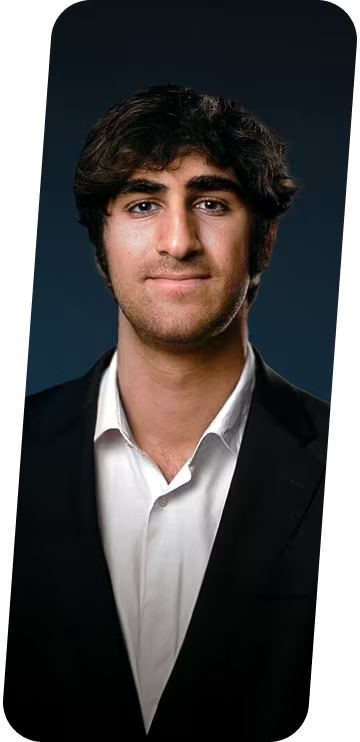
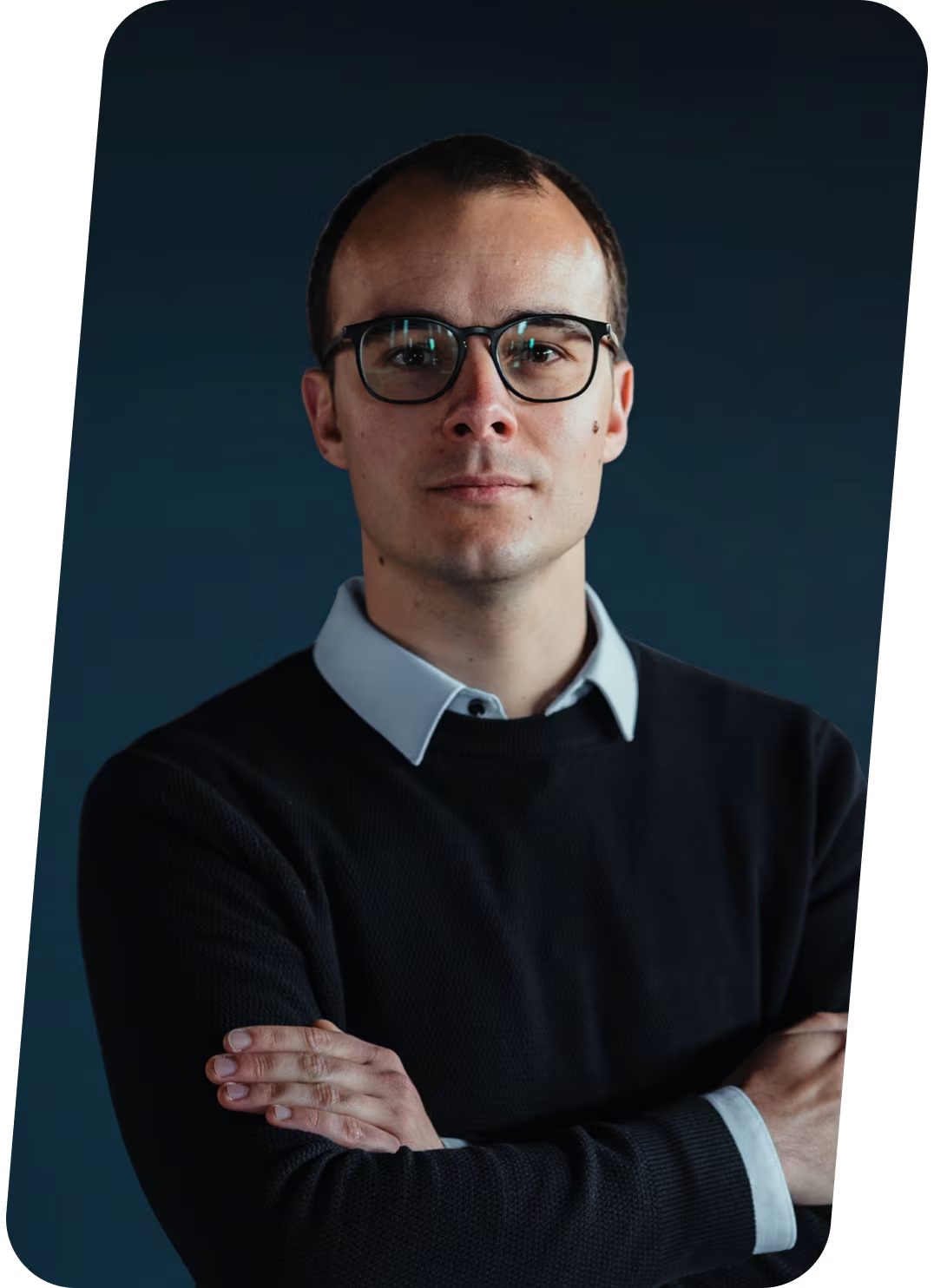
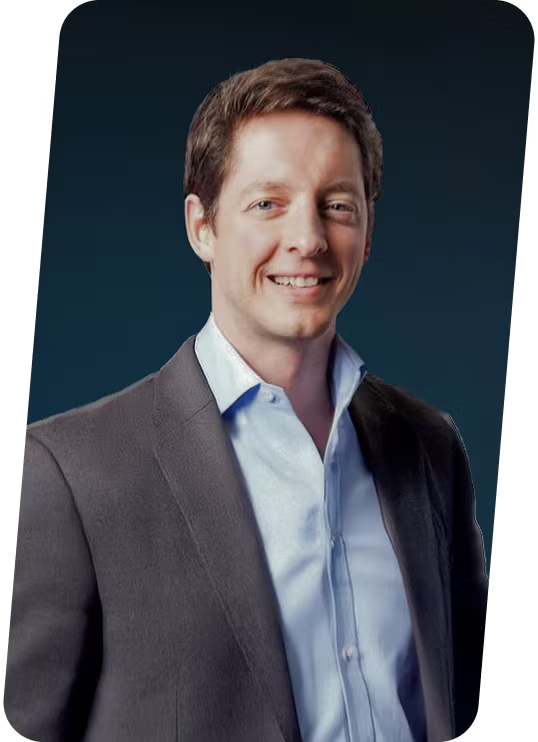
In this episode, Julian Rothenbuchner, Co-founder and CEO of Tumbleweed, talks with Daniel Dippold about the real cost of rejection before you break through. Julian is a rocket scientist building the infrastructure that could make manufacturing in space as accessible as mailing a package, with a SpaceX partnership to show for it. He opens up about the mental breakdown that followed SpaceX's initial rejection, six co-founder splits including a romantic relationship that didn't survive the pressure, and getting rejected by EWOR twice before finally getting accepted. Getting to yes cost more than anyone saw, and in this episode, Julian doesn't spare the details.




Daniel Dippold: Welcome to Been There, Done That. A podcast we launched to talk about raw, unfiltered founder stories. We listen to so many podcasts ourselves, and we figured that most of them talk about success stories – after they happened. And facts and figures get distorted, plus strategies that worked 10 years ago don't work today anymore. We at EWOR wanted to launch something that tells raw, unfiltered founder stories today.
And we believe we're in a unique position to do this, because every year we support 35 founders to build $10B+ companies. We do that as founders ourselves. 40% of our full-time team have launched companies valued between 100 million and 10 billion. Therefore, we want to talk founder to founder with people on how they got from zero to a million ARR or from zero to a seed round.
I'm Daniel Dippold, and I'm the host. I'm not a professional host, but I'm a former techie, a mathematician, someone who's built tech ventures for the last 10 years. And I want to talk techie to techie, founder to founder, with people who have what it takes to create a 10 billion dollar company. And I want to uncover the specific things they did in order to achieve that. And I hope that I can help you with those examples to build your own companies.
You’re listening to Been There, Done That, welcome to the show.
So in today's episode, I'm sitting here with Julian, who is literally a rocket scientist. You built a space organization before, scaled it to 85 people. We're going to talk about this later on. And you figured out a way to get to Mars' surface a hundred times cheaper. Right? And now you're building a box. So tell us more about the box. What's in the box?!
Julian Rothenbuchner: That's true! So we're building a box and I can assure you, the box is just a box. But what we're actually changing fundamentally is how we get this box to space and specifically how we test it. And the special thing is, it basically acts as a magical container. That means that anything inside is protected from all the certification requirements and testing requirements that you have in space, because that's a huge issue for our target market.
Daniel: Yeah. Tell us a little bit more about why that's an issue, how much costs that produces and so on, that people get a feeling for like the magnitude.
Julian: Exactly. So what we really target is in space manufacturing, and that sounds super space age, but it's actually something that's been looked at for the last three to four decades already. Right? So it's not that new. And we figured out like in the 90s that you can make 10x better semiconductors and 10x better cancer cures. And so when we first started looking at this market, we're like, what the heck is taking so long, right?! 30 years, just basically doing lab skill research is crazy! That's unlike any technology you see. So we really started looking at what the sort of hurdle is there, right? Like we kind of had a hunch that there would be some kind of hurdle that probably is not being addressed, right?
And so we actually started talking to a lot of different users of microgravity. And we looked at two things specifically. We looked at failed users, right? So basically we were like, “Hey, have you tried to send something to space and failed? We want to talk to you.” That was the first thing. The second thing is we just talked to people that have never heard of the opportunity before, but that could benefit from it and to see what reactions we'd get. Right? And what we found was that, you know, we talked to them, told them about the cost of space and, you know, as you may know, sending things to space – full stop – has gotten very, very cheap or comparatively cheaper talking.
Comparatively is the right way. Yeah, comparatively cheap. So we're talking right now about six to eight thousand euros a kilogram, depending on, you know, where, who you buy from. But basically they were completely non-shocked by this. Yeah. And this was also not the reason why any of the projects failed. Why it failed was because it was just so damn difficult to get it certified. And the difficulty actually translates a lot into cost. I can give you, for example, a figure from one of the providers that basically does this as a service. They get the launch for free. Launches cost them zero. Hosting costs them zero. It's all sponsored by NASA in this case. They charge five hundred thousand dollars for something this big just to get it through the process. Right?
Daniel: Crazy.
Julian: And there's also a lot of incompressibles. So you just wait two years. Right?
Daniel: Yeah.
Julian: And then there's like tens of thousands of requirements to keep in mind. Right. And then, you know, like the people that had failed were like, that sucked. Right? And even the people that succeeded, like one guy verbatim told me, like, “this was probably the best experience we could reasonably have had, but it sucked.” All right. And then you go to the industrials. Like we went to, like, you know, the big pharma companies and we talked to some of them and verbatim, the answer was this is a nonstarter. Like with that process, we're never going to scale. Right. Huh. And I kind of told them, like, oh, look, you know, it's like eight thousand euros a kilogram. You know, I even told them, like, 10x that. Right. And I expected a big response. That was not the case at all.
Like they were like, huh, whatever. Right. As long as we can get it, sort of. Yeah, exactly. Because that's what they actually worried about. They're worried about how long it's going to take them, how long they're going to pay their people for it, whether they have to completely adapt a new supply chain to it.Yes.
And now we're back at the box. Right. And again, they didn't ask for a box. They just asked to be isolated from the certification and testing requirements. And so we had this crazy idea of is this possible? And if you ask other space engineers, at least the ones we've asked, they think this is crazy. Some people literally told us it's never going to fly. Right. Literally my co-founder, he used to work at a few launcher companies and he had a hunch that this could work. Yeah. And well, here we are.
Daniel: Incredible. And now you, you know, you have a partnership with SpaceX and flying on SpaceX, right? You have like literally every single investor I introduced you to wanted to invest and called me afterwards was like, “this is incredible.” How do you find this company? Right. So this is where we are now.
I would love to debunk a little bit how you got there. Yeah. Right. Because it literally just happened the last year and two. And that's what this podcast is about. We want to like share the raw unfiltered, like, this is how we made it happen. So choose any arbitrary point in time, but you say like, this is where like, it's probably good to start and walk us a little bit through the specific.
Julian: Yeah, exactly. So, um, I'll pick right up at the at the user interviews because I think the first big sort of non-linear “Yeah, scale” part came when one of the users we interviewed actually just said “I wanna I want to buy this right now” and we're like, I mean, we were celebrating like we were jumping up and down – but at the same time like we were like, hot damn. Like we know what this is gonna cost and we have like a few tens of thousands in savings. Which we're lucky to have even that right? Yeah, I know a lot of people that start with less but we had a bit of savings and you know went to like, you know, my co-founders went to their parents and you know, like we had a bit of money. But we didn't have nearly enough, right? So that was but I think then we became really scared and I felt like that was a good sign that you know, we just hit some nonlinear scaling trajectory there, right? Yeah, and then that kind of then went to the second sort of big decision we made with it, which is let's just launch something, right.
Daniel: The deep tech equivalent of getting the product out.
Julian: Yeah, exactly.
Like me, I spent like almost a decade building deep tech, right? And just like, you know, climbing the TRL ladder, you know, as you're supposed to, uh, like a good boy, um, but I'd gotten fed up with this. And I think, I think just like software. So just tech has like, they figured this out. And so we tried to apply this. So we just said, look, let's sell. Right. And let's build the stupidest thing that can serve like 3% of our market. All right. And that's what we did. And so we basically put that mission at about three times cheaper than the closest comparable on the market. It ended up being, um, and, and, but it's really dumb. Like there, it can't do much. Like our customers, like we basically, the goal was okay. Our customers should feel pain on every single constraint. Um, then we've built small enough, right? And the goal was just, can we actually get the pre-certification done because that was a big question mark. Yeah.
Daniel: So, rule number one of the deep tech playbook, we're writing the book right because all of the deep tech books suck. All right. So let's write the book today. Rule number one is just go for MVL: minimal viable launch. Yeah, right. Okay.
Julian: Exactly. And like, you know, I think tech, deep tech has way more to learn from tech than the other way around, right? Like you could reformulate rule one in my mind as you're just a company. Like there's nothing special about you, you know?
So I feel like, I feel like, yeah, so that was the major, major first unlock. I think then selling out the first mission was the next big one because then we knew, okay, look, we had that customers and that was go time, right? Yeah. And then we had to basically execute at that point, we're like in July, August, right? We had a few sort of early, like long lead time items on order already. Yeah, we had to like, at that point, we had to raise a round. Because again, we had, essentially, zero money in space tech.
We had to build a clean room ourselves because we were supposed to use one because and then like, literally like three days before someone broke it, like someone punched a hole in the wall, which is not great, if you're building it.
Daniel: What?!
Julian: Yeah, like, not us, but they just called us. We're like, sorry.
Daniel: Oh, shit.
Julian: Yeah. So you rebuilt it. Yeah, we built one from scratch. Like our Head of Production was like, “Don't worry. I've built three clean rooms”. And it was like, “you've done what?!” And no, and so then we built that anyway. And then it was like, I think when we went to execution, right? That was a massive unlock. Basically, you know, it's August, we got to get hardware out. So we shipped our first piece of customer hardware in August. Yeah. And then we had the payloads back and integrated in early December.
Daniel: Amazing. So rule number two, go frugal. Yeah. Rule number three, go fast. Yeah.
Julian: And I think there, it's so easy to kind of look at what other people say, this is complete platitude, but it's so easy to kind of look at other people and say, well, look, this is possible, this is possible. Like, I try to always shoot for literally Mars in some cases, right? And worst case, you end up on the moon, which is still crazy good, right?
So just saying, let's go for it. And yes, did we have to push back our timeline and at some point like three months because our customers weren't ready, like they couldn't execute on that timeline. Absolutely, right? But we're still really, really fast. Yeah. The way I perceive things is usually like you kind of go, you know, you go somewhat at a linear growth and then something exponential happens and then you're suddenly like an order of magnitude higher up and then, you know, and I think both are important. Like they can't happen one without the other.
And I think then like the last set of exponential unlock, what we've had was kind of, you know, getting to know you guys [EWOR] and getting a few other people out there because I think the thing that hadn't kept up with these unlocks was sort of my understanding of what I was doing, right? Like I knew that what I was trying to do was crazy, right? But I was so used to crazy from what I had done before that I kind of was kind of like, oh yeah, whatever, you know? Yeah.
And I realized only when I got that sort of validation and of course it would be better if I just had that validation in me. But in this case, it was really like, damn, okay. Like I actually like, this is cool. Other people think this is cool. And like I gotta act consistently with that value, right? And I think that's the current unlock we're experiencing. And you had it in you, right? Like this.
Daniel: This is rule number four, never give up, it's massive platitudes in our rulebook right now, but who cares, huh? And it's true, you applied to EWOR three times, like the third time it worked out, so you knew like, “Hey, I can make it happen”, right? But I guess this was not the only story like where you just had constant rejection, right? Like, that's just part of building.
Julian: A hundred percent, like the first time we went to SpaceX, yeah and said look SpaceX, this is what we want to do. They were just like, “nah”. Like it took them three months like we were waiting anxiously just for their response yeah um and they were just like “nah” and like not like it's like your engineering approach makes sense but nah yeah so then we're okay and then we had to completely like revamp what is the actual documentation and sort of argumentation that we apply to this completely new thing from a regulatory perspective that we're trying to do, yeah. And what it ended up pushing us towards is basically instead of calling it what it is we just argue towards this literally being the safest possible case right um and that is what ended up working out and what's worked out so far, yeah.
Daniel: So give us the specifics, right? Like we want to really learn today how it's done. So they sent you an email back and said, no, it's not happening. What did you do? Did you send another email? Did you give them a call? What happened?
Julian: I had a bit of a mental breakdown and got sent home for a day. Which I'm someone like, I think generally a very good measure of quality for a good organization is average persistence time of problems, right?
Daniel: Mm-hmm
Julian: It's right. It's a great point, right? So basically like, you know, it was like this Wednesday or something. We got the email Wednesday. I went I went to work on Thursday. I got sent home on Thursday at like 4 p.m. because they were like, “Julian, you're just not being effective right now.” And I was like, OK, I guess. And basically like I took the weekend off, like three days to, you know, kind of to settle. Like, you know, I was on my bicycle for two hours straight like I was just about.
Daniel: What did you do? Did you smoke a joint? Did you bike? What was your recovery protocol?
Julian: Okay. I, you know, like this is highly individual, but to me, what I went, I live like 10 kilometers from the beach. So I went and just cycled to the beach and gave myself a beach day. And then I deep cleaned my apartment. And then, um, I think, I think at the same time, I was like really like, you know, this is again, I'm the 10 millionth person to say this, but like reduce the amount of stimuli. Yeah. Right. Like you're, and, and I think that really like just calmed my nervous system. And by the time I was back on Monday, our CTO and the engineers were just like, “Okay, this is the approach.” Yeah.
Daniel: There are studies that if you are focused on one object like your laptop, you can still neurologically measure like any other object that is inside and it is subconsciously distracting you. So the cleaner your environment, the more effective in terms of focus you can be. So you cleaned your house and you went back to the office with full focus.
Julian: Exactly. And on that point, quickly, like my CTO, like I'm a co-founder, he likes to say I run on an interrupt-based scheduler. So naturally, I am terrible at doing two things. I'm hella single threaded.
Daniel: You know that interrupt coalescing is like a productivity function for computers, right?
Julian: Yes, exactly. But so sometimes I just, some interrupting me triggers and I got to do something else. And I used to really try to just lock in and ignore it. But to me, like actually, you know, like then going and cleaning up for an entire day was actually like insanely good in the long run. And just, yeah. But anyways, I think, yeah, the point, back to the point of SpaceX, I guess. Yeah, you just carry on. And in this case, the problem kind of solved itself, but you just have to kind of, I think.
Daniel: But let's go into the specifics, so you recovered you went back into the office. Did you send them another email like yes, of course, no so?
Julian: We first sent them an email thanks for the feedback, right? And then we basically, two weeks later, we just sent them an updated sort of certification and test approach, which you basically need to submit. And yes, we did have to make some concessions, right? Like our first approach was, can we just do the full like pre-certification, full containerization? And it would have been crazy if that worked, right? Like we didn't expect a yes. So, and of course, like we deeply thought about, of course, how do you argue for that approach and to give it the best shot of survival, but of course the first time, you know, the second time it was, we were a lot closer, we still had to edit a lot of things, but it's just iterative. And I think with most things you do, the first time you're probably going to get to 70%.
Daniel: If you do it your way, right? And I quickly want to zoom out, and abstractly explain how I think what you did there is absolutely incredible, right? What I think you did is gradient descent. Yeah? Right? I think what most founders do when they solve an optimization problem as in can I get the basics, they do incremental steps, right? So they are, they say, okay, we have this, let's try this tiny thing, right? And maybe this doesn't work. Let's try this other tiny thing on top, right? And you will take forever mini baby steps until you're at the optimum.
You just said, let's go the full on thing, like the end of the spectrum. This is what we want to do, right? And they said, yeah, nah, it's a bit too crazy. So you jumped a little bit back and was like 70%. Okay. Like this is, this is where I believe it is. And did they accept the second time or?
Julian: No.
Daniel: No. Third time?
Julian: Yes.
Daniel: Right. So it took you three jumps because you did gradient descent, right? Like you jumped around in big leaps, which got you there so much.
Julian: Yeah. And it's so funny to say that because I actually like, no kidding, I think about decision-making in gradient descent. Basically, I sit down and I don't know what to do. I'm like, well, what is the function I'm on right now? What do I need to optimize for? And what is the sort of dimensions? I was literally thinking about this on the way over. It's like, basically, you got to first untangle your super high dimensional space. And then just figure out the three dimensions with the highest sensitivity and then figure out what the gradient is. There you are.
Daniel: Map your like co-variation matrix and like and understand what's going on, yeah.
Julian: Although I've completely over-mapped this as well, like
Daniel: Yeah, I think I'm talking to my viewpoint, is like the people invest too little into the meta layer. Yeah, like how do I do stuff and too much into like just the like doing execution layer, right? And I think ideally you have great reflection-execution cadence right and sometimes you just gotta go into reflection mode and math it out. Yeah, like I love it!
Julian: I mean, me as an engineer, right? Like my take on this is it's like, you can't be an open loop control. You have to close a control loop, right? And this is the case with any highly complex system. And we are just a highly complex system. Yes. But so you have to have that sort of control loop, right? But yeah, to kind of get out of the math swell.
Daniel: Yes, let's go back in, into I think out of theory and back into getting stuff done.
Julinan: What I wanted to talk about quickly is about the EWOR application as well. All right. So my problem, what I think is a big problem as a founder, and one of the number one challenges to solve, is you have 10 seconds to prove you're an outlier. And this is, you know, we can go into cultural differences between different countries, right? Where I'm from in Austria, this is incredibly hard, because people culturally don't believe in outliers.
Daniel: Yeah. Right? It's a bad thing. I come from a 400 people village and the general culture is don't do anything unnormal. Don't leave the village! Like it's not good to leave the village. Why ambition? It only makes you unhappy.
Julian: Yeah, exactly and I come from like the middle of the forest. Like no no, I cross the street, I'm in the forest. And it's very much the same thing. All right, but so I think I will reflect on my path because I got recommended, you know, towards you guys in I think September something around that. Yeah, and like I wasn't like what changes I wasn't on the one hand I wasn't I think good enough at that time to distill down the essence of what I was doing into like 10 seconds, right. Which is the key exercise. And something that yeah, that you have to solve, because like I come and this is I think how I was, you know raised. It's always like “don't talk”. Yes, but sometimes talking was very important.
Daniel: Yes, but generally the do is more important. I would agree with this. Right. There's a point of optimality. Exactly. Right. It's a digressive function and once you've done all of the doing, you can get a lot from the talking. And if you don't optimize, like the start of the curve is steep, right? And if you just optimize on this, like, because you're optimizing it at like two dimensional volume, right? So, like, you really need to say, okay, can I improve the talking? And a lot of people that are great at doing don't do it, right?
Julian: I think next time we've got to bring a whiteboard out to explain. It's just raw. Yeah, yeah, yeah.
Then the second time, I think what was the unlock for me is I just ran into Quinten and suddenly, I had a captive audience.
Daniel: Yeah, and you had more than 10 seconds!
Julian: Exactly.
Daniel: You had a whole dinner!
Julian: Yeah, and like he basically by the end of the, like, cause he was like, you know, I was playing it cool. Like, I was like, you know, like, ah, yeah, you know, Oh, what do you do? You know, ah, you're the founder of Felyx. I live in the Netherlands. I've ridden in Felyx like a million times. I was like, ah, big fan of your work, blah, blah. And then he was like, Oh, do you know this EWOR thing? And I was like, well, yes. And I got rejected twice. And then basically by the end of the evening, he was like, “I'm investing and I'm telling them they better too”.And that was actually it.
Daniel: I remember. Quinten giving me a call was like, “If you're not investing, I will.” And I was like, “Quinten, you know, I hate being pressured!” And he was like, “I don't fucking care. I don't fucking care.” And he didn't, rightfully so.
Because it really got us to dive into this. And then our friend Michael Baum, who started Splunk, who does a lot of space tech, looked at it. And he was like, “Yeah, this is a pretty cool approach.”
And I think what happened for you, you all, you already had it at that point, right? Like, I don't know half a year. I don't know. But like, at this point, certainly you had it. The only unlock for you was to get everyone's attention. Right. And this in my career has so often been the case. Yeah. I've been so often in a situation where I masked it out too much. I had thought too deeply, but I couldn't bring it across simply. And I never got the attention. Right. So in the end, that dinner switched things, right?
Julian: Exactly. And like, as an engineer, like, I always feel like, you know, like Lenny, my other co-founder, he is, he's awesome. He's just, he calls it being “grandma-pilled.” Like he was like, “Okay, but talk to me like a grandma, right?” And I struggle and struggle because I'm an engineer and I want to give context. And, you know, like also, you know, you know, now preparing and, and, and, and sort of preparing narratives and all these different things, like I always want to give full context, but that's not what it's about.
Daniel: Yeah. I think one of the leading themes throughout life is scarcity. Everyone has scarcity of resources, scarcity of time. And you just need to accept that other people don't care as much as you do. Simplicity is the theme. That applies to the product you build, the way you communicate it. But let's talk a little bit about the team, right? I started off with saying you built this like 85 people army, right? And now I hear that you went through a lot of co-founder transitions, right? So tell us a little bit more about that.
Julian: So how I ended up with like two of the most amazing co-founders is iteration. Right?
Daniel: It's exploration exploitation trade-offs, right? You gotta search the option space until you can find the optimum.
Julian: Exactly, right. And I think where I started in that space was with two high school friends of mine. And with basically the classic story, right?
Daniel: It's so classic!
Julian: It was like in my dad's garage as well, so like we're hitting all the stereotypes.
Daniel: I'm not gonna build the next Microsoft. I don't know who will. It's like the sigs are all there.
Julian: No, exactly. But, but that was, I think, I mean, that's, you know, you bias towards sort of proximity of, of, of, of the option. Right. And, and it, one of them lasted all of 10 months. And basically what happened there was okay. And it was just us three at this point. Right. I was now 17 and I hadn't been in school. Like thank, thank God to my school. They somehow let me pass.
But, but anyways. And we'd been working our butts off. And then this guy, like a week before we had to basically ship out the next generation of that prototype to field testing, like, you know, we'd lined up like a whole test campaign in Oman. And that guy a week before said like, “I'm out.” And also it turns out he hadn't done any of his work.
Daniel: Nice!
Julian: So like, I was like, dude, where's the solar panels?! And he's like, anyways. So then like what I did is I called up a bunch of my friends and I still remember to this day, like, you know, we were, we were like just random friends of mine that had never touched electronics before. We're like soldering together solar panels on the floor. And like, like my other co-founder, we worked like 140 hours that week.
Daniel: Shit.
Julian: And it was like, I track my time. So I know how much 140 hours is.
Daniel: So you barely didn't sleep.
Julian: Yeah, exactly. It's like I think we did 48 hours straight. I was so delirious.I was talking to Kaidlyne earlier like I literally ran into a wall. Like it was crazy and I do not recommend doing this, but sometimes it's like shit's gotta happen, right?
Daniel: It's more a function of the character that makes you successful rather than objectively really making you successful. So you've got to rather tame your character, because you already have it, you already have the drive, right? And that drive makes you work that much, but it's always in that negative. Sleeping less than six hours in my experience, and I've tracked my time for eight hours, eight years to 30 minutes, right? And I know it's always negative, at least for me.
Julian: No, exactly. And there are certain events that, you know, you have bias towards, right? Like this needed to happen, right? But generally it's a terrible idea, right? But so that was co-founder number one.
Daniel: Okay. Let's rush through the other ones.
Julian: Yes, exactly. Then the next one, he went off to Stanford.
Daniel: We're getting all the prototypes here, right?! Like the first one, emotional breakdown, right? Like too much stress, probably, I assume. Second one, opportunism. Ah, Stanford is cool!
Julian: He simply didn't have the focus. Like he now works at what is the startup called? Cognition! Okay, so you know. Like then we had a burnout, he didn't manage energy right, then we had just a guy bad at his job that was my fault and and then we actually had a relationship breakup as well. So I was actually like together with my co-founder Well, do I recommend it? No. The circumstances are somewhat mitigating…
Daniel: It has worked, right? Canva, Eventbrite, there are stories.
Julian: Actually, I think it can work, it just didn't there.
Daniel: Why not? If I may ask.
Julian: Yes, I think ultimately, at that point, I think one of the parts was I had been doing this for nine years and she had been doing this for four. And she was extremely well-respected and she is cracked as hell.
But there was just this difference of I was the master incumbent and she was the newcomer. So
Daniel: It affected your personal relationship.
Julian: Yes, and it affected the personal relationship. It affected her, it was really, really difficult for her actually. And then like she actually similarly hit a kind of burnout as well.
And yeah, that was that. And yeah, I think now it kind of like, when I had, where it led me now is kind of like, I had this moment, I think, like last March, when, you know, with my current two co-founders, where like, I noticed how hard they were pushing to take their space. And I think that's the biggest green flag. I'm a very pushy person. I take space, right? Yeah. And I can't deal with co-founders that kind of need me to give them space. Yeah. So I need people who push and they were just like, no, Julian, you focus on this.
Daniel: I will do that. You go home now, you clean your house, you go to the beach, recover, and then we try SpaceX again. Yeah, exactly. That kind of behavior. Exactly, exactly.
Julian: At this point, like I've been sent home by the team like two or three times because they’re like, “Bro, you're not being effective anymore.” You got to like, like when we were shipping the satellite off for, for, for vacuum testing, like the team was, they were on a 30 hour shift. And I was like, you know, cause you, you read in, in the books and you know, in the media you're like, Oh, your CEO is supposed to like fight from the front and stuff. And I do genuinely believe in this of course, right? But I've realized that there's a next level to this, which is basically your team sees through this and it's like, you're just here for posturing.
Daniel: Yeah, sometimes this and sometimes you try to fight all battles. Yeah, and you gotta pick your battles.
Julian: Yeah, this is and your ability to reject battles is inversely proportional to your stress level.
Daniel: Yeah, I agree, I agree.
Julian: That's just, I think that's what it's really like, what's so difficult to learn is reject, while being stressed, it's the most difficult to reject more stress.
Daniel: Yeah, yeah, yeah, and it's a downward spiral and at one point you just you'd because rejection takes energy. Yeah, and when you stress you don't have that energy right and that's like a reverse connection.
Julian: And it's easier to just you know, hit like could control space on your to-do list charter to to do is they're awesome. By the way, massive yeah, and and just add that ticket and and and it's just blocked. You I've now realized my optimal amount of tickets at the beginning of the day is like 8. It's not 25
Daniel: Yeah, and it's a big thing, right? Like how do you define what a ticket is? Right? Like how long do you spend there? But I guess that goes beyond what we can discuss today. All right. So let's maybe bring it all together again. And like we've talked about how you're productive as a founder, how you push, how you build the right team, right? How do you deal with rejection from customers, but why does it all matter? Right?
Julian: Like how does that affect me today?
Daniel: Yeah.
Julian: Yeah, it's a very funny question because I sometimes sit there and I'm like, I'm just trying to do X, why am I dealing with this, right? So I think it's so important to just look forward and for me really, like my vision is really look, you know. The previous, every generation had their unlock, the dotcom generation had the internet. Now, I think very, you know, over the last couple of years, AI has been obviously huge, but I think for our generation, I think we need to aim higher and we need to aim for space, right? That's our unlock.
And what I'm really passionate about with what I've done before and what I need to want to do now is it needs to be generally useful, right? And so the future that I'm building towards is I want to be able to give you the opportunity to ship something to space tomorrow. And all parts of that sentence are important, you, Dani, who's great at building your work, but maybe hasn't built a payload before, right? And tomorrow. Yeah. Right. Both of these are important. And ultimately what I want to enable with this is that space becomes a manufacturing platform, right? Because the materials we can make, if we can just turn off gravity are insane. I said in the beginning, right? But this is something that I genuinely feel like can be a part of an X industrial revolution. Yeah. And it might happen in space.
Daniel: And not just materials, right? New molecular structures. You can build completely new medication, right? Like a huge pharma unlock just through what you're doing.
Julian: Yeah, exactly. Like I met this person that just instantly is making what's called YanoSpace materials. And they're just a drug delivery platform that can make drugs like an order of magnitude more effective for like a whole bunch of applications. It's crazy what you can do. We've barely scratched the surface. And I want to make sure that this just becomes kind of boring and commonplace. Yeah.
I think, you know, comparisons are always overused, but I like to say space as easy as mailing a package.
Daniel: Let's leave it there, thank you so much Julian for this awesome session. I really enjoyed it and I hope everyone who listened did too.
Thank you for listening to Been There, Done That.
If this conversation resonated with you, there are three things you can do to support.
First, you can subscribe and whichever platform you're listening to this, there should be a subscribe button. It would mean the world if you subscribe.
Secondly, you can share this with someone you believe would benefit from the content of this conversation.
And thirdly, you can go to ewor.com/signals and stay up to date on all things EWOR by subscribing to our newsletter. Well thank you very much for listening today and see you at the next episode!
In this episode, Nico Dehandschoewercker, Co-founder and CEO of minitap, tells Daniel Dippold why founders chasing product-market fit shouldn't reinvent the wheel. He learned it the hard way, after trying to find PMF his own way cost him months building products no one wanted. Once he and his co-founder Luke switched to design thinking, they found the solution within days. Today, apps used by millions are tested by Mini, minitap’s AI quality assurance co-worker.
The raise followed the same logic. Nico spoke to over 100 funds for an oversubscribed $4.1M round and logged every rejection in a Notion database, sorted by "bullshit" and "not bullshit". Every rejection that held up went straight into fixing the business.
In this episode, Wiktor Stanislawek, Co-founder and CEO of Reactive AI, tells Daniel Dippold why European VCs called his pitch deck a red flag for naming OpenAI as a competitor, and why the angels he met in San Francisco called it ambition.
Wiktor's team are young founders from Poland who had never worked at an AI lab. YC passed on them twice. EWOR said yes after a one-minute demo: Reactive AI's token count stayed flat as other LLMs kept climbing. When Wiktor approached an OpenAI researcher to join the team, the researcher asked to invest, and the deal closed within 24 hours. The founder of Snowflake and a 5x unicorn founder followed. Now, Wiktor is challenging Silicon Valley's frontier labs from Poland with Reactive AI’s Large Awareness Models.
In this episode, Chris Fox, serial entrepreneur and Co-founder and CEO of Nimbus, talks with Daniel Dippold about treating profitability from day one as a repeatable strategy rather than a milestone.
Chris does not start a company until he knows the one channel that will get him to profitability. For Nimbus, that was referrals, and it carried the business to millions in ARR. He explains why the old playbook of raising big and chasing product-market fit for years is gone, why that window has collapsed from 18 months to 30 days, and why he deliberately raised almost nothing when he could have raised far more.