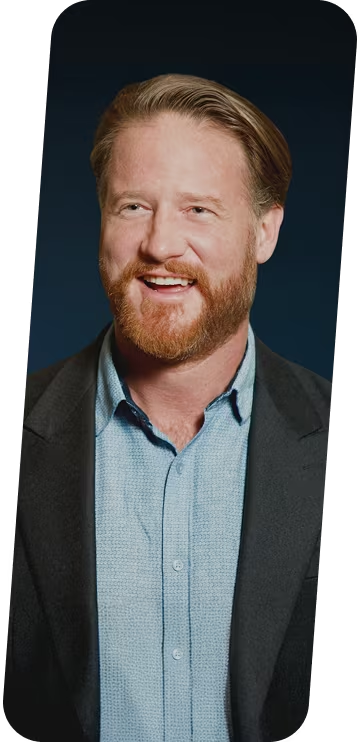
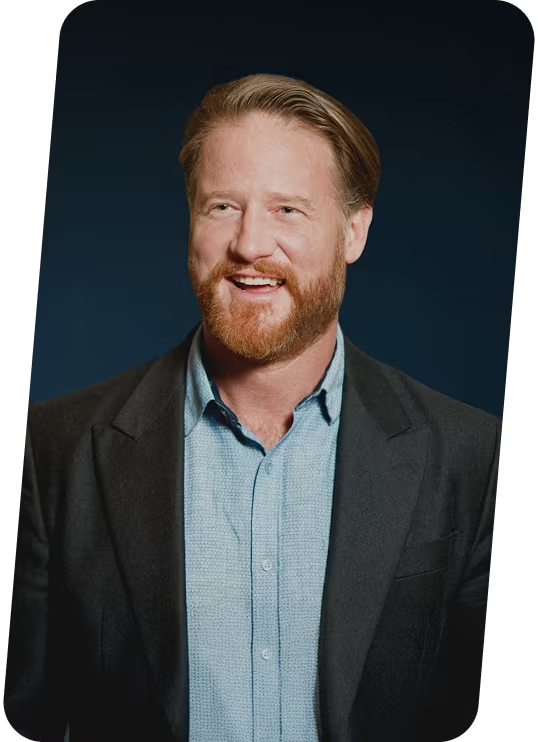
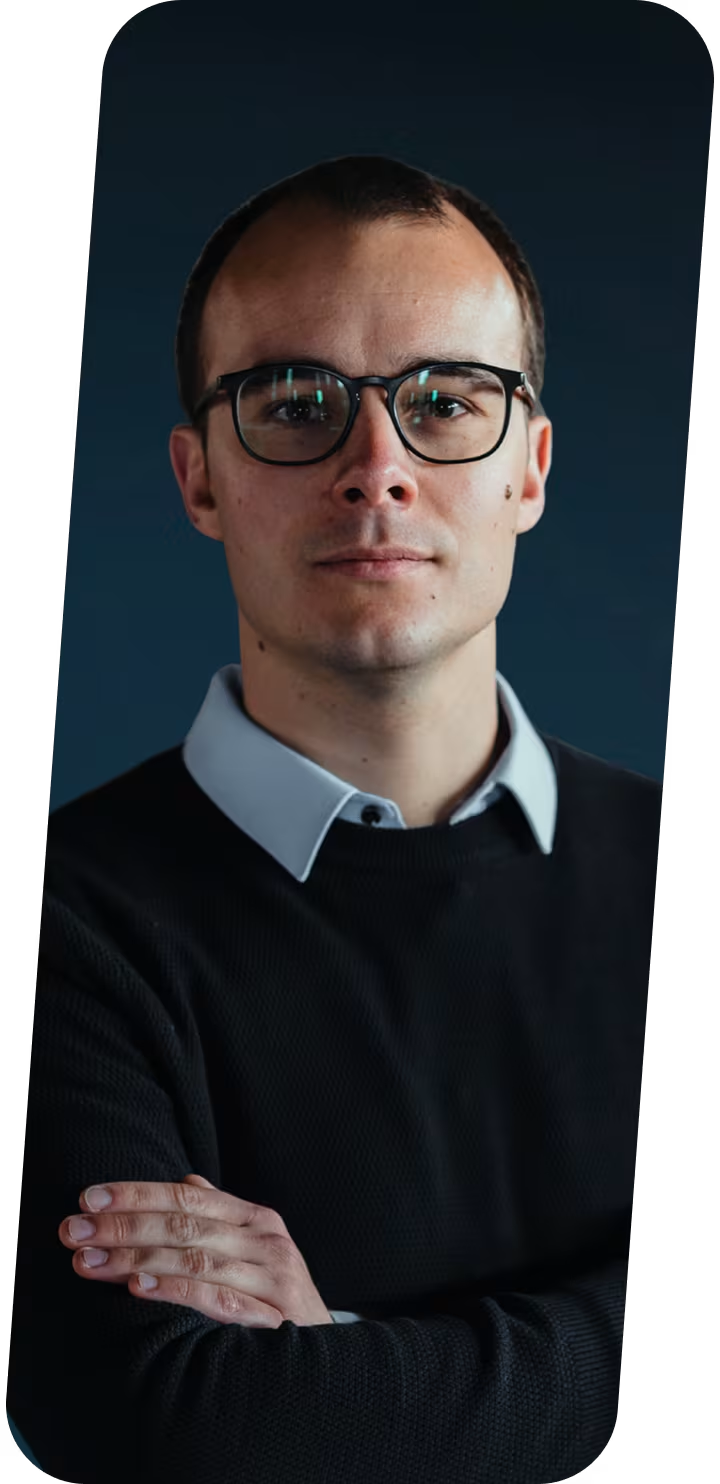
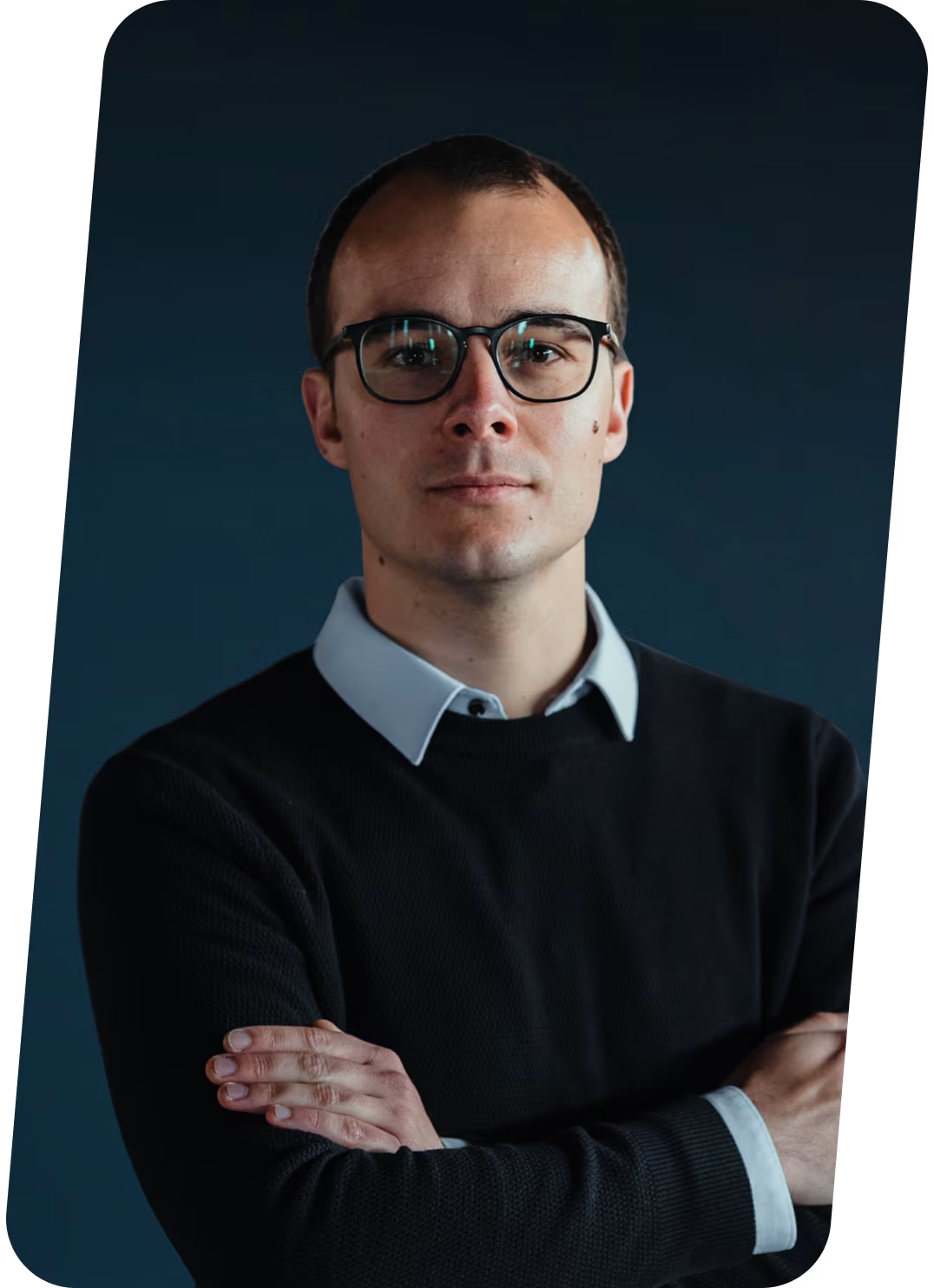
In this episode, Allegro Sprute, co-founder and CEO of Brio, talks with Petter Made about what it actually takes to lead an AI company as a non-technical CEO, including the moments when the co-founder wants to go in a different direction and every mentor in the room is suggesting something different.
Allegro started selling before the product existed, which led to early customers and enormous pressure to deliver. When the founding team's vision split in two, what followed was one of the rarest outcomes in startups: a co-founder breakup handled so professionally it didn't cost the company a single investor. He also opens up about hiring an engineer when what the company truly needed was a founding engineer, and why the difference matters more than most founders realise. When two people he deeply respected gave him completely opposite advice in the same week, Allegro had to find a third option: his own.



Petter Made: Welcome to this latest episode of the EWOR podcast, Been There, Done That. My name is Petter Made. I have 25 years of experience in fintech, and I built a company called SumUp, now valued at $10 billion and, hopefully, IPO-ing this year. Fingers crossed.
Now, I spend my time coaching startup founders as a full-time partner at EWOR. And speaking of which, today I have Allegro Sprute with me here. I've been coaching you guys for over a year now, so this really feels like going back and reminiscing about the early days.
When we first met – and I remember those first coaching calls – you were still very early with the product, but already actively testing the market through sales. Two of the three founders were basically out there selling full-time.
Can you talk a little bit about what was going through your minds at that stage? What signals were you getting from the market during those early sales experiments?
Allegro Sprute: Yes, first of all, thanks for having me. It's a pleasure to be here, a pleasure to talk to you.
Yeah, I think in the early days, one thing that I cared about a lot was that we weren't building a solution in search of a problem, right? So I didn't want to start building and then get the product out there, only to find out that nobody wanted it. So we decided to do it the lean startup way. I think this is at least the lead startup way, but we decided to go out and start selling a product that we didn't actually have at the time.
And we decided to do this with all kinds of companies, right? At that point, in the very beginning, we didn't have any kind of ICP or anything. We just said, "Okay, we're going to talk to everybody and see who loves it the most, who wants it the most, and who's willing to pay the most money."
And we did this for quite some time. We knew there were a bunch of companies that wanted the product, and then, in the end, we ended up in a situation where, of course, we actually had to build it, right?
And yeah, that's a different kind of challenge. I think it's always an amazing feeling when you know you're building something that somebody is actually waiting for and wants to use. At the same time, it puts quite a lot of pressure on the entire team because they need to ship, and ship very fast. And there's basically always this feeling that whatever you're doing right now should have been done weeks ago.
But yeah, those were the early beginnings. I think that was exactly the time when we started talking.
Petter: Yeah. So, for those who don't know, Allegro is building a company focused on conversational AI training for salespeople – helping them become more professional and pitch more confidently.
I remember in the beginning, we were talking about leveling up through different programs where users would go through increasingly difficult sales training scenarios. They really had to build on their skills to get the customer to engage, and also, I guess, to better listen to the problem.
I also remember that, very early on, we talked about how you and Tim, your co-founder at the time, had very different approaches to sales. Maybe you can speak a little bit about that, because I think it would be interesting for the audience to hear about two different — but both successful — approaches to enterprise sales.
Allegro: Yes, absolutely. I think, in our case, there was really no right or wrong way to do sales. Like you said, we had very different approaches.
For Tim, it was really hardcore cold-calling and trying to reach as many people as possible. He also tried to reach many different contacts within a large account and just find a way in, right? Trying to get meetings.
For me, since we decided at some point to mainly sell to enterprises, I realised that what worked really well was building very strong relationships and having a clear top-to-bottom approach. So I really tried to get to people in management positions and board positions, and I always found a way to reach them and talk to them. I went to conferences, and I tried to jump from intro to intro just to get connected to a specific person.
It was definitely an approach that took more time. I had fewer meetings than Tim, but when I got there, the conversion rate was quite high. And I wouldn't say one of us had more success than the other. In the end, it kind of leveled out.
What mattered was that everyone found the approach they felt most comfortable with and where they saw the most success. And this is how we did it, and it worked for us.
Petter: Yeah, this is the way.
I remember when you described what you were doing, we sort of coined the term “contact hopping.” Yeah. Where you'd get someone to want to help you. You had this approach where you'd ask for advice and help:
“Hey, I'm building this company. We think it's valuable for your sales training department. Are we doing the right thing? Can you give me some feedback?”
This lowers the barrier because they're not being sold to. Instead, they're being asked to participate and give advice. And it creates this almost psycho-behavioral feeling of, “I've got to help Allegro, he asked me for help.”
I think that's the genius behind this contact-hopping method, because you eventually work your way through the organization to the key stakeholder. You get a champion — probably the person you initially talked to — and then, yeah, you get that second meeting where you can actually present the proposal, right?
Allegro: It's true. I think the only thing I realised at some point was that we needed to be careful, especially with larger corporates. Either you get in because you have some kind of contact somewhere in the organisation, or you approach them at a conference and they're already close to the department you wanted to talk to anyway.
But if you don't have any contact, then you do typical cold outreach, right? And we realised over time that there are specific teams — innovation teams, transformation teams, whatever they may be called — that are really keen to try out new things. On the one hand, this was very valuable for us because there was always someone open to having that first call. And of course, it felt good. You know, there's a data point: okay, they're interested, whatever.
But I think, especially at a time when topics like AI are super hot, and corporates want to learn more and find ways to implement the technology into their processes, founders have to be careful. Should you treat this as a positive data point, yes or no? Of course, it's a good signal that they want to talk to you, but in the end, what matters is whether you actually close a deal.
And if you do close a deal, are they just doing a small pilot with you? If it's €20k or €30k, that's good money, right? But for a large corporate, how much is it really? I think the real data point is whether you can actually get them to roll it out and sign a larger deal.
That was the thing with these innovation and transformation departments. They're always a good way to get in, but the question is whether it's really the kind of signal you should judge as positive, or whether you should be a bit careful.
Petter: Do you get past the design partner stage? That's the key there, right?
Exactly. Once you guys got into the actual training departments in these big corporates you were targeting — and you were swinging for some really big logos — getting them on board validated that you were solving a real problem that companies genuinely felt. But also that they were willing to roll this out across the organisation.
And I think, in the beginning, we talked about whether you were replacing trainers or creating the convenience for everyone to train whenever they wanted, without having to fit into a trainer's schedule. Because salespeople should be out meeting customers, right? Having everyone in the building at the same time for a course is extremely costly and disrupts their rhythm.
So there were a lot of positives there. But what was the feedback? What was the biggest problem where you thought, “That's it — that's what we're solving, and that's why they're willing to bring us on board”? What was that aha moment?
Allegro: The messaging definitely changed over time. We learned more and more about what people really cared about. And of course, it depended on who we were talking to.
If you're talking to the training department or the head of training, they care about something very different compared to a sales manager. In some companies, it's the sales manager who's responsible for training sellers, right? And they look for different things.
What we realised is that every solution out there that offers training for sellers focuses on the training itself. They focus on completing courses, ticking boxes, watching videos, doing quizzes — all of that.
But the reality is that nobody wants that. And it doesn't matter whether it's sales or any other part of life. You want to become better at your job. That's the goal. You want to do a better job, close more deals, improve performance. The training is just the inevitable path to get there.
You either learn by doing — which can take years until you've experienced enough situations to develop intuition — or you train intensively early on so you can accelerate that learning curve.
And that's what we're optimising for today. It's not about spending more time training. It's about shortening the amount of time needed and making every minute so impactful that users can achieve the same result as traditional training methods or in-person trainers, but much faster.
Petter: It's a bit like public speaking or going to the gym. It's repetitions. You want to expose yourself to different scenarios and practise how to reach a positive outcome in those situations.
Some people are naturally better salespeople than others, sure. But like you said, when you're not doing the real thing, you're training for the real thing. And your solution gives people the ability to train more often in much more lifelike situations.
Allegro: One hundred per cent. And when I look back at how people judged the success of our product, many sales leaders said, “Okay, we're just going to measure how much time sellers spend in your product.”
Petter: That's not a good metric.
Allegro: Exactly. It's not. And I understand why people think that. Especially with traditional training methods, that's how success was measured. You had videos, courses, and dashboards showing usage time.
But that's not what we're optimising for. In the end, the only thing that matters is whether the conversion rate improved or not. Of course, people need to invest time in the training or it won't work. But if we optimised purely for time spent in the product, we'd just add more videos. That's not the point.
The point is improving user ROI — making every minute they invest more valuable.
Petter: Yeah. I think we talked a lot about dashboards and showing buyers or stakeholders the results of the training. But even then, what does that really tell you? At the end of the day, it's the conversion rate. How are people actually selling? How does that improve over time?
That's also a challenge for you guys because ideally you'd want that data integrated into the product and dashboard — combining training data with actual outcomes. Showing: “You put in the hours here, and look — your results improved there.”
If you can solve that challenge, then your pricing model changes completely because you'd be charging based on created value rather than hours spent.
Allegro: Exactly. It really depends on the type of company we work with. Smaller companies and mid-market companies often record all of their sales calls, especially outbound and cold outreach.
But since we're in Germany, many teams don't record calls because it's not allowed. That makes it much harder because we don't get transcripts or outcome data inside our product.
So if someone uses our product to improve at handling objections or certain sales situations, we don't always have proof that they successfully applied it in real conversations. We're missing that proof point if we don't have access to the transcript.
And that's often the case with larger companies. In customer service it's different, but in sales, companies typically only record calls later in the funnel. Early cold calls are usually not recorded, so that's definitely a challenge.
Petter: Early on in the company's journey, you guys were selling across industries and company sizes. Eventually, you focused on big logos — what we called “land and expand”. Get into a large company, expand into additional departments, then potentially expand internationally.
I think that's a really solid strategy.
Given all the data points you now have around go-to-market and sales, how would you summarise your experiences? What worked and what didn't?
Allegro: The land-and-expand approach works very well in large enterprises. We've definitely seen that once we prove positive impact in one department, the champions there are more than happy to introduce us to other departments and spread the word.
In many cases, that happened much faster than we expected. Suddenly we had multiple departments knocking on our door saying they wanted to use the product too. So that strategy works extremely well.
What I personally had to learn was that the people we initially spoke to were focused on training success, user feedback, and engagement metrics. They cared about whether people found the product helpful and whether they used it regularly.
But when we started discussing larger deals, the conversation suddenly became: “What's the ROI?”
And of course I knew that question would come eventually. But during the pilot stage, success criteria were all about implementation and user feedback because that was what the initial stakeholders cared about. The problem was that the people defining pilot success weren't the people holding the budget.
That was a huge learning for us. The person deciding the success criteria for the pilot should also be the person who ultimately controls the budget for the larger rollout.
So yes, land and expand works — but you need to prove ROI from the very beginning because that's what budget holders care about.
There's a saying that it's better to have one or two customers who absolutely love your product than one hundred who merely like it. And I think that's true. If you deeply understand why certain customers love your product, you can identify similar companies much more effectively.
And one thing you learn as a founder — especially inside a community like EWOR — is that you get advice from incredibly experienced people, but often that advice completely contradicts itself. One person tells you one thing, another successful founder tells you the exact opposite, and you're left thinking, “Okay... what am I actually supposed to do?”
Petter: There's usually more than one path to success, and everyone is biased by their own experiences.
When we built SumUp, we spoke to hundreds of customers and gathered huge amounts of data to understand the problems small businesses faced.
By speaking to many customers, you develop a much broader and more holistic understanding of the market. And when you're prospecting widely, you start seeing where the strongest signals are — where the real pain points exist.
But in enterprise, the opposite strategy can work. Take Legora, for example. They embedded themselves inside a Swedish law firm for months to deeply understand the workflow.
Of course, there's a danger there too: you risk building entirely around one customer and becoming a consultancy rather than a scalable product company. So context matters.
The right strategy depends entirely on your ICP and market dynamics.
Allegro: Exactly. Everyone gives advice based on their own experiences and the situation they were in. But eventually you learn that there isn't one “right” answer.
You stop looking for certainty and instead start collecting data points. You listen to everyone, but in the end, you make your own decisions.
Petter: Yeah. At the end of the day, you have to follow your own founder instinct.
If Henry Ford had asked customers what they wanted, they would've said faster horses.
One topic we discussed a lot — and where I definitely pushed you guys — was hiring, especially on the technical side. Hiring the right people is incredibly important, particularly now as AI capabilities accelerate and competition for top talent intensifies.
You guys started as a remote-first founding team, even though everyone was based in Germany. That decision shaped your culture from the beginning. So walk us through that thought process.
Allegro: Absolutely. The founding team actually met in Berlin, but shortly afterwards it became clear that everyone was based in different parts of Germany.
So we had to decide whether we'd relocate or operate remotely.
What worked really well for us was creating a rhythm where every eight weeks or so, we'd meet in person for a few days purely to focus on strategy. We'd lock ourselves in a room and think deeply about where we wanted to take the company.
Those sessions became incredibly valuable. In between, we'd all go back to our co-working spaces and focus on execution. But any larger strategic discussion got parked for the next strategy session.
I genuinely believe that if you never meet in person, especially as a founding team, it's much harder. You need that human connection — not just strategy discussions, but lunches, laughs, deeper conversations.
If you're remote from day one and build your culture around it, it can absolutely work. But switching from office-first to remote later is much harder because it fundamentally changes the culture.
Companies like GitHub and Zapier made it work because they were built that way from the start.
Petter: Exactly. And hybrid is probably the hardest model of all because you naturally end up with an “us versus them” dynamic between remote and in-office employees.
I remember encouraging you guys to get away from day-to-day operational conversations and spend time talking about the big-picture strategy. Seeing you actually turn that into a habit was fantastic.
So tell me about hiring your first developer. What was that process like?
Allegro: I'm deeply convinced that you only build a great company if you hire the best people possible from day one.
The challenge is that the best people usually aren't actively looking for jobs. They're already employed and well-paid.
And in our case, since I studied business rather than engineering, my network was extremely limited on the technical side. We had to find completely different ways to source talent.
At one point, the product felt like it was constantly on fire. Customers were waiting for promised features, and every fix seemed to create another issue somewhere else.
Petter: Classic startup problems.
Allegro: Exactly. And that's when you start thinking: maybe my hiring bar is too high. Maybe I just need someone right now.
Petter: The temptation of the B-player.
Allegro: Absolutely. And honestly, the sessions we had with you during that time were extremely valuable because you pushed us not to lower the bar.
At some point, we stopped searching for a founding engineer and started searching for just an engineer. And that's a very different thing.
A founding engineer treats the company's success as their own responsibility. That's the difference.
We eventually hired someone who was a great engineer. She did exactly what we hired her to do. But we realised afterwards that we'd hired an engineer — not a founding engineer. And that became a problem for us.
Petter: Those early technical hires are incredibly formative. They shape the codebase, development speed, quality standards, responsiveness — everything.
A true founding engineer doesn't just write code. They take ownership at the level of a founder. That's absolutely critical.
Allegro: Completely agree. But beyond skill and seniority, personality matters just as much.
We always say: this should be someone you'd happily have Sunday brunch with. If I don't feel like I'd enjoy spending time with someone outside of work, I probably wouldn't hire them anymore.
You want people you can laugh with, learn from, and have deep conversations with. Especially within the first five hires, because those people become the cultural foundation of the company.
Petter: Exactly. Those first five to ten people become the company culture. Everyone else who joins later learns from them.
And if you don't intentionally shape culture from the beginning, you'll still get a culture — it just might not be the one you want.
You also went through something that unfortunately happens to many startups: a co-founder break-up. And usually those situations end badly. But yours didn't.
Can you talk a bit about that experience?
Allegro: I didn't realise it was 60%. That's interesting.
But yes — it was probably one of the toughest experiences I've had so far. Mostly mentally. You're parting ways with someone you've spent an enormous amount of time building with.
What happened was that the founding team gradually started pulling the company in different directions. Thankfully, everyone in the team was a very strong communicator, which I actually think is an underrated skill in founding teams.
Eventually we had to sit down and honestly ask ourselves why we kept going in circles and failing to align strategically.
And ultimately, we realised that we essentially wanted to build two different companies.
Petter: Two completely different companies.
Allegro: Exactly.
At that point, we had to decide whether we pivoted entirely or whether one person would leave the company.
And ultimately we decided to continue in the current direction because we already had strong traction.
Petter: Data points being traction.
Allegro: Exactly.
Petter: You guys were making real money.
Allegro: Exactly. We already had proof that the market wanted what we were building, so we decided to double down on that direction.
What really helped was that the situation never became personal. Both sides worked very hard to keep conversations professional and empathetic.
We knew that if emotions took over, it could damage the company itself. And as a small startup, we simply couldn't afford endless legal battles or distractions. Every hour spent on conflict was an hour not spent selling.
Because we avoided personal conflict and communicated openly, we found a way through it without breaking the company.
Petter: Yeah. It's a regretful parting of ways. And unfortunately, these things happen.
But in today's AI landscape, where technology evolves incredibly quickly, the need for strategic alignment is probably more important than ever because new opportunities constantly emerge.
Allegro: Completely agree. At such an early stage, the founding team moving in the same direction isn't optional — it's absolutely essential.
We had to make sure we weren't going in circles anymore.
Petter: And you feel like you resolved the situation in a way that satisfied everyone involved, which is very unusual.
Allegro: It definitely is unusual, and I'm very proud that we managed it that way.
In the end, it felt like flipping a switch. Suddenly everything moved in the right direction again. There was less friction, people moved faster, and the company regained momentum.
It was the right decision, even if it wasn't a pleasant one.
Petter: A break-up is still a break-up.
Allegro: Exactly. It's never nice.
Petter: But now the remaining co-founders are aligned, you have a founding engineer in place, and you're pushing forward.
Allegro, thank you so much for taking the time to share your experiences and lessons from building your company. I've really enjoyed this conversation.
And thank you everyone for listening. Hope you got value from this episode, and we look forward to seeing you next time.
In this episode, Wiktor Stanislawek, Co-founder and CEO of Reactive AI, tells Daniel Dippold why European VCs called his pitch deck a red flag for naming OpenAI as a competitor, and why the angels he met in San Francisco called it ambition.
Wiktor's team are young founders from Poland who had never worked at an AI lab. YC passed on them twice. EWOR said yes after a one-minute demo: Reactive AI's token count stayed flat as other LLMs kept climbing. When Wiktor approached an OpenAI researcher to join the team, the researcher asked to invest, and the deal closed within 24 hours. The founder of Snowflake and a 5x unicorn founder followed. Now, Wiktor is challenging Silicon Valley's frontier labs from Poland with Reactive AI’s Large Awareness Models.
In this episode, Chris Fox, serial entrepreneur and Co-founder and CEO of Nimbus, talks with Daniel Dippold about treating profitability from day one as a repeatable strategy rather than a milestone.
Chris does not start a company until he knows the one channel that will get him to profitability. For Nimbus, that was referrals, and it carried the business to millions in ARR. He explains why the old playbook of raising big and chasing product-market fit for years is gone, why that window has collapsed from 18 months to 30 days, and why he deliberately raised almost nothing when he could have raised far more.
In this episode, Fryderyk Sitnik, Co-founder and CEO of Margin, talks with Daniel Dippold about the radical frugality that kept his company alive long enough to find the idea that worked.
Fryderyk and his co-founders spent a year iterating and living on €300/month each in the Polish suburbs. Living on low burn meant that turning down money got easier, not harder. The team later said no to a €2M preempt offer over a single term, and to an acquisition offer, because neither fit the scale of what he wants Margin to become.